MPPT and PWM for solar off grid system: Which one offers higher efficiency gains?
For users of off grid solar systems, a suboptimal charge controller can waste 15% to 25% of the system’s annual energy production. For a family relying on a 5kW off grid solar system to power their remote cabin, this translates to a 450% to 750kWh annual loss—enough to power a refrigerator for 6-10 months. One farm user struggled to keep their irrigation pump running because their PWM charge controller couldn’t capture enough energy on cloudy days until they upgraded to MPPT. This article will also address a key question when using solar off grid system: Which offers greater efficiency gains, an MPPT or a PWM charge controller?
What are MPPT and PWM charge controllers for the solar off grid system?
Both devices perform the same core function: regulating the power from the solar array to the battery bank, preventing overcharging and undercharging.
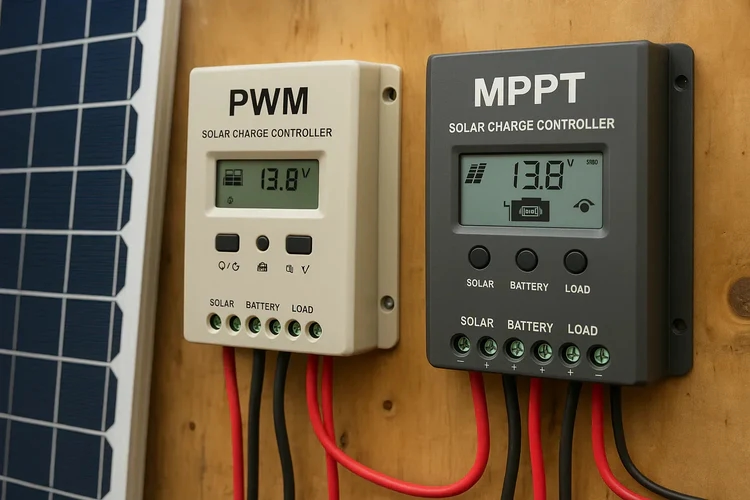
PWM charge controller: A simpler, more affordable option. PWM works similarly to a light switch, sending a steady “pulse” of current from the array to the battery when the battery charge is low. As the battery nears full charge, it reduces the pulse width to avoid overcharging. PWM is best suited for small off-grid solar systems where the array voltage matches the battery bank voltage.
MPPT charge controller: A more advanced option. MPPT doesn’t just output power; it “searches” for the solar array’s “maximum power point.” It then converts the solar array’s excess voltage into the additional current needed by the battery. For example, if your solar array generates 48V in full sunlight, and the battery voltage is 12V, the MPPT converts this 48V into four times the current, capturing more energy.
Solar off grid system providers typically use PWM with small off grid solar systems and MPPT with larger, more demanding installations. The key difference is that MPPT can adapt to changing environmental conditions, while PWM works best in stable, full sunlight.
MPPT vs. PWM Efficiency Comparison
In terms of efficiency, MPPT charge controllers outperform PWM in almost all practical scenarios, especially in solar off grid systems where grid power can’t offset energy waste. Here’s a comparison of the two:
Full-sun conditions: MPPT controllers operate at 90% to 95% efficiency, meaning they convert 90% to 95% of the array’s energy into battery power. PWM controllers are 75% to 80% efficient under ideal sunlight conditions, but because they can’t convert excess voltage, they waste 20% to 25% of that energy as heat. For a 2kW array, under full-sun conditions, MPPT captures approximately 7.6kWh, while PWM captures approximately 6.4kWh, a daily difference of 1.2kWh.
Variable conditions: This is where MPPT truly shines. Cloudy skies, partial shade, or extreme temperatures can all change the array’s maximum power point. PWM controllers can’t adjust; if shade causes the array voltage to drop by 20%, PWM efficiency drops to 60% or less. MPPT, on the other hand, can find a new maximum power point, maintaining 85-90% efficiency even in partial shade.
Large Arrays or Voltage Mismatch: For off grid solar systems with power greater than 2kW, or for arrays operating at higher voltages to reduce wiring costs, MPPT is the best choice. Its voltage conversion capability allows you to use larger, higher-voltage arrays without sacrificing efficiency.
When is PWM Suitable for the solar off grid system?
PWM still has its place in specific off grid system settings. It’s suitable for smaller systems where the energy consumption is minimal. If your system only generates approximately 2kWh per day, the extra $100-200 for MPPT may not be worth it. Furthermore, when your budget is tight, a PWM controller can cost 30-50% less than an MPPT. For users who prioritize upfront savings over long-term efficiency, PWM is an ideal choice.
Furthermore, the efficiency gap with PWM is minimized if your off grid solar system is located in a sunny, unobstructed area with minimal temperature fluctuations. Under these ideal conditions, PWM energy loss may be only 10-15%, acceptable for small systems.
MPPT Advantages in Off-Grid Solar Use Cases
MPPT efficiency is essential for solar off grid systems that power or operate critical loads. Solar off grid systems that power entire homes (refrigerator, stove, heating system) need to make the most of every watt. A 5kW array equipped with MPPT in partial shade can capture approximately 4.75kWh per day, enough to keep a heat pump running on cloudy afternoons.
In addition, in remote areas, an off grid solar system for farm power uses solar energy to operate irrigation pumps, livestock water heaters, or grain dryers, all of which require a stable energy source. MPPT can adapt to variations in sunlight, ensuring that pumps run longer and reducing the need for backup generators. Furthermore, in areas where low temperatures in winter cause the array voltage to rise, MPPT can convert the excess voltage into higher current, offsetting the effects of shorter days. In contrast, PWM wastes excess voltage, leading to undercharged batteries and dead loads.
Cost and Efficiency: The ROI of MPPT vs. PWM
The biggest drawback of MPPT is its higher upfront cost, but the long-term energy savings generally make it a better investment. Let’s take a typical off grid solar system as an example:
Upfront Cost Difference: For example, a 3kW off grid solar system costs approximately $3,500 using PWM mode, while an MPPT system costs approximately $3,700.
Annual Energy Savings: In a sunny location with occasional shade, MPPT mode consumes approximately 300 kWh more per year than PWM mode. For off grid users, this translates to an annual savings of $90.
Payback Time: The $200 higher cost of MPPT mode is recouped in approximately 2.2 years. The energy savings continue thereafter, and after 10 years, the MPPT system will have saved approximately $900, more than covering its initial cost. For larger systems, the return on investment is faster. A 5kW off grid solar system equipped with MPPT can save approximately 500 kWh per year, shortening the payback period to 1.5 years.

Choosing the Right Charge Controller
Which offers higher efficiency, MPPT or PWM? MPPT is clearly more efficient, especially under variable conditions or for large off-grid solar systems. However, for smaller, cost-effective systems in sunny conditions, PWM is still suitable. As an off-grid solar system manufacturer, we analyze your sunlight data, load requirements, and budget to find the most suitable off-grid solution for you.