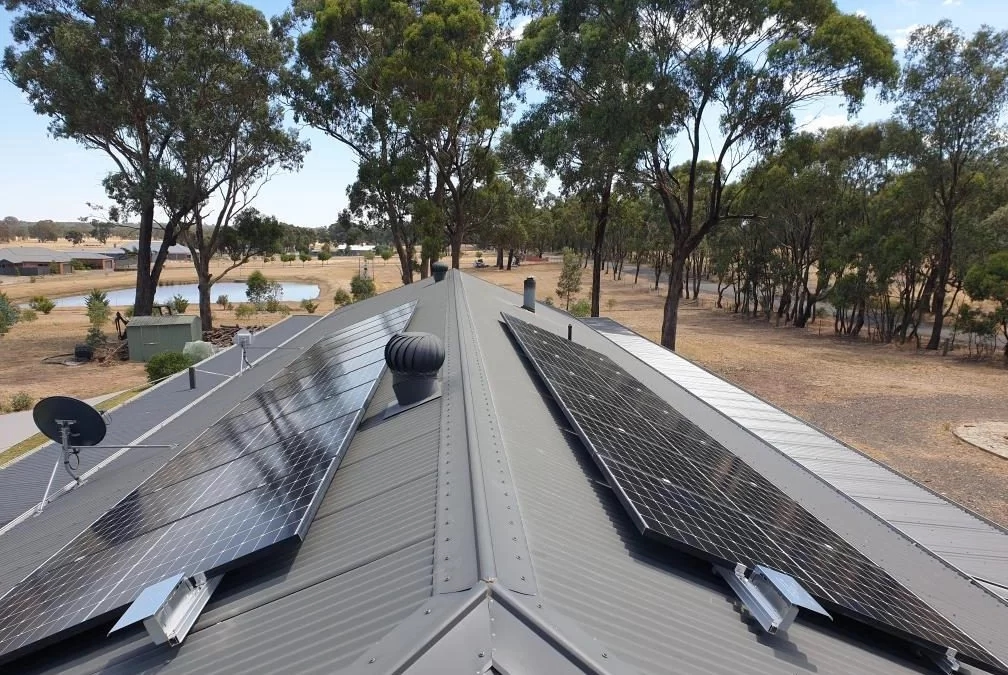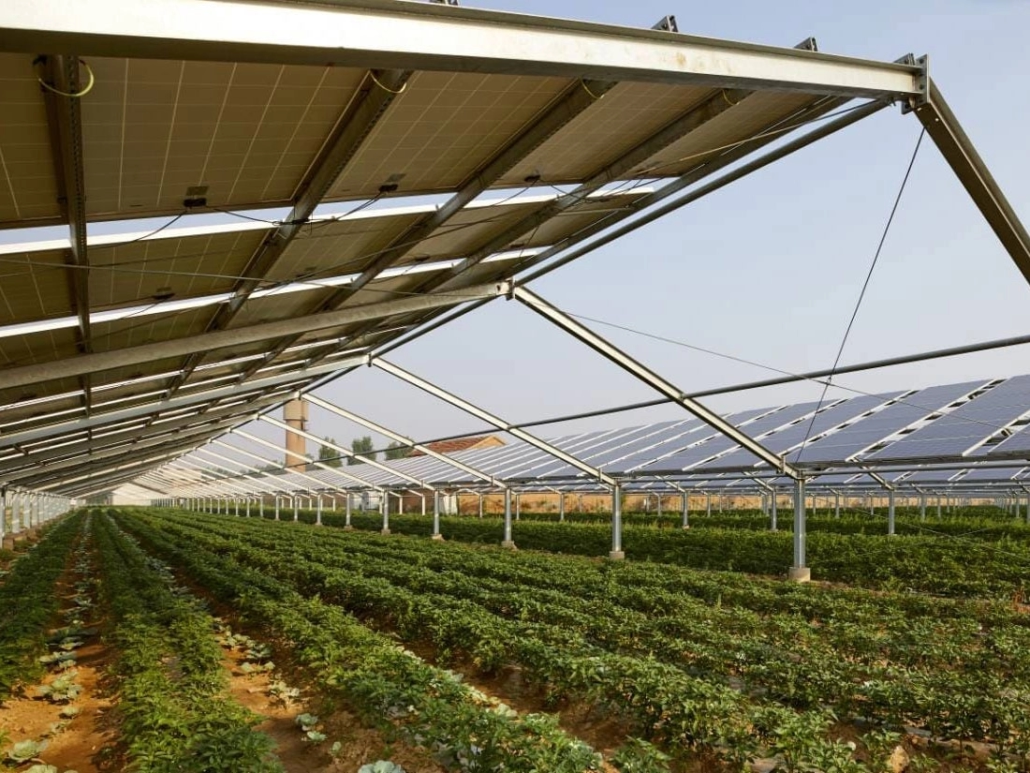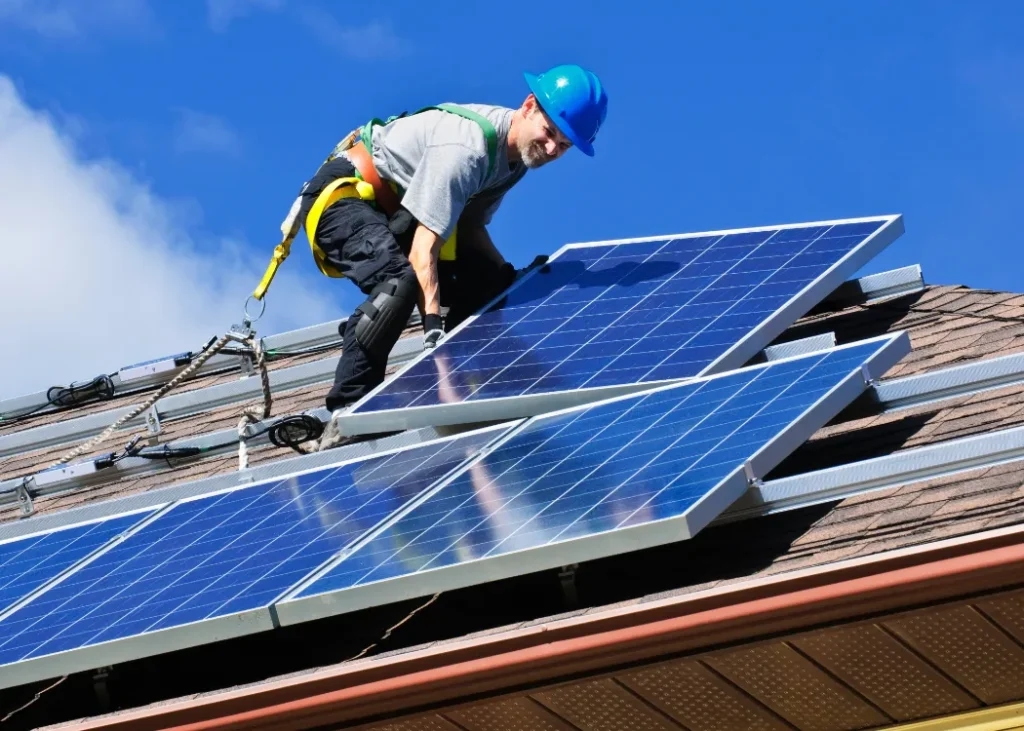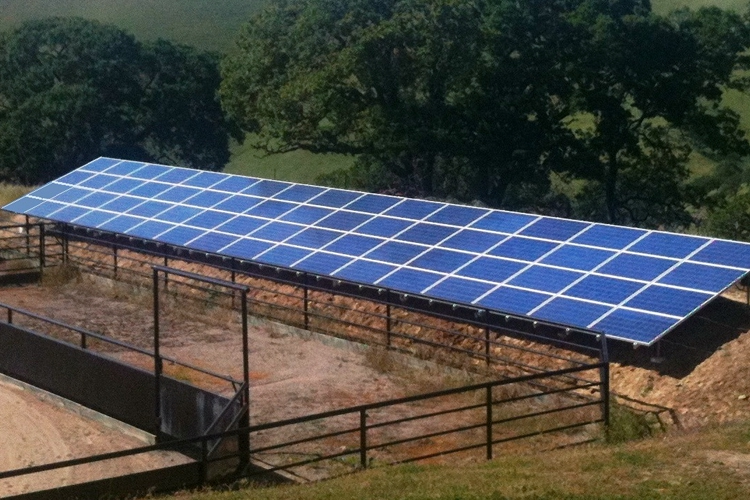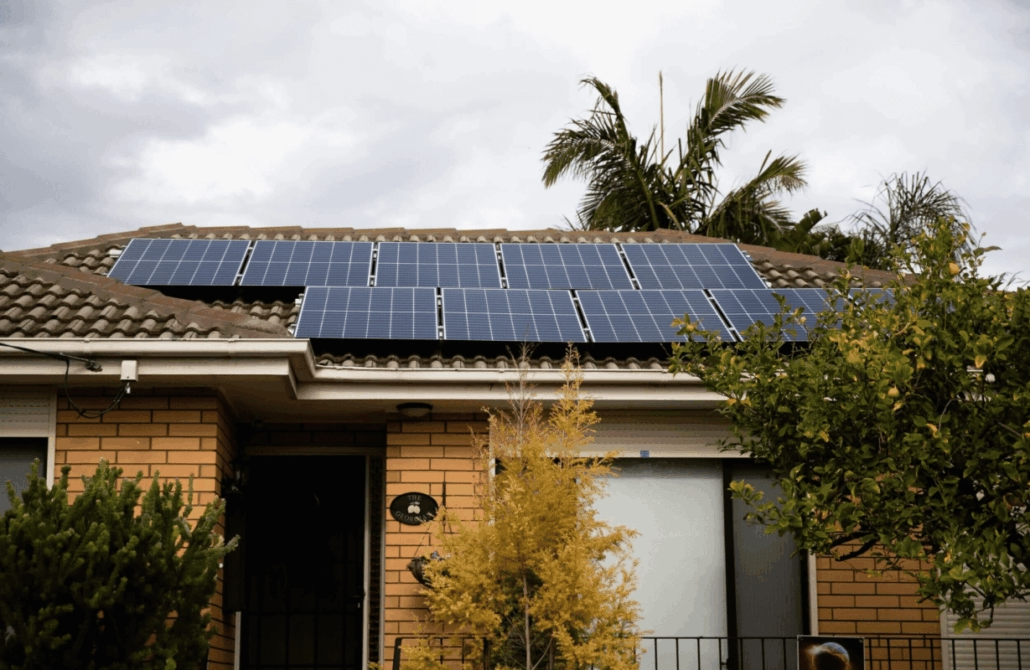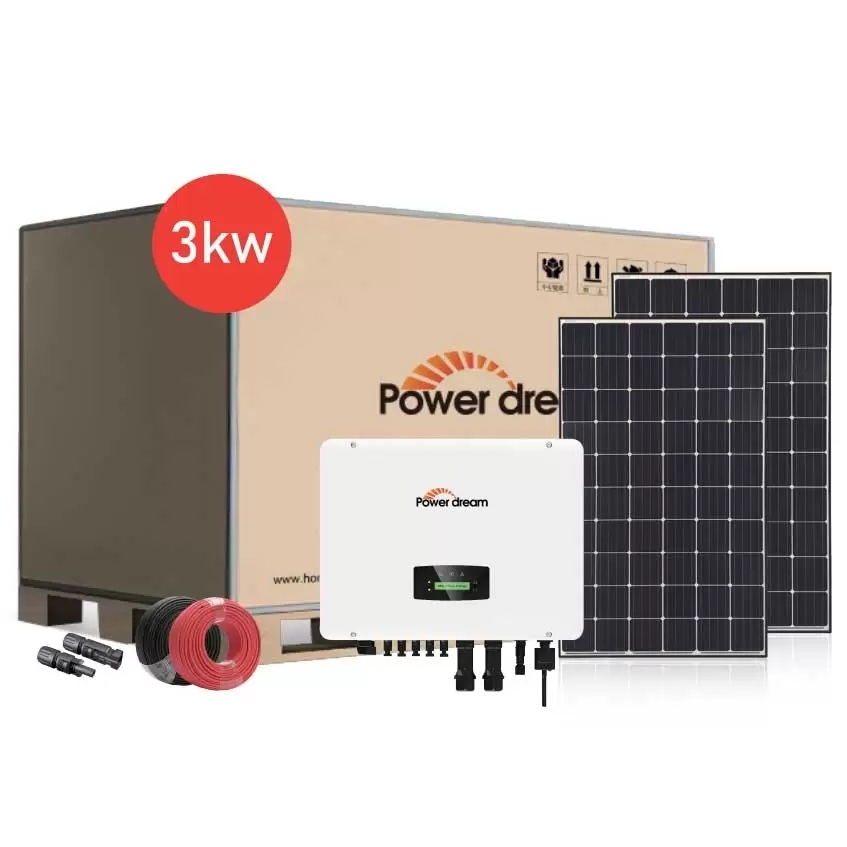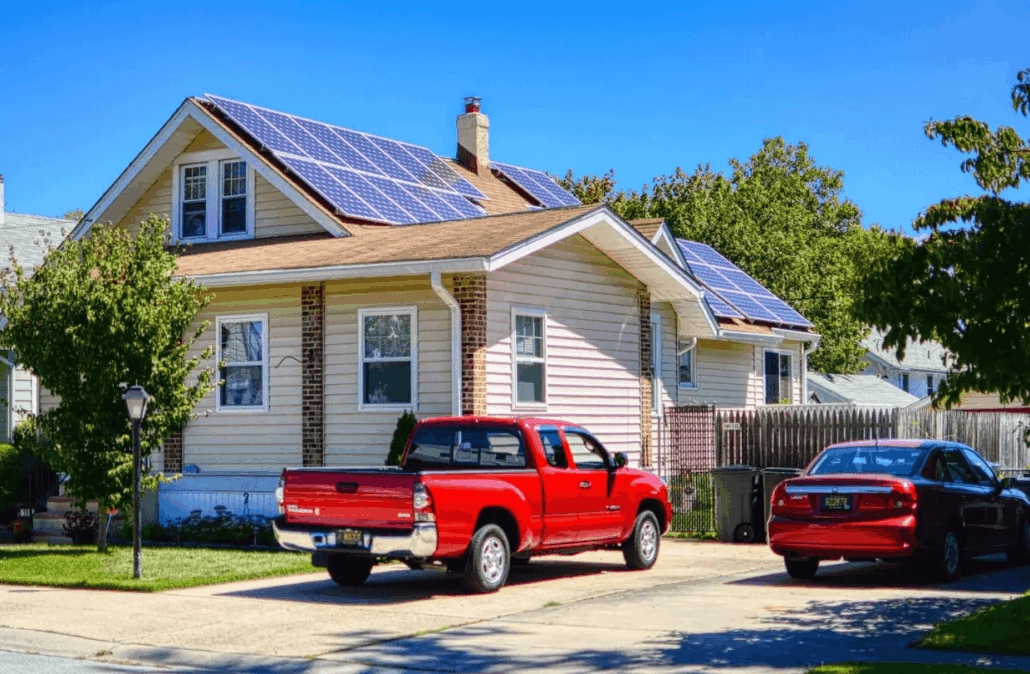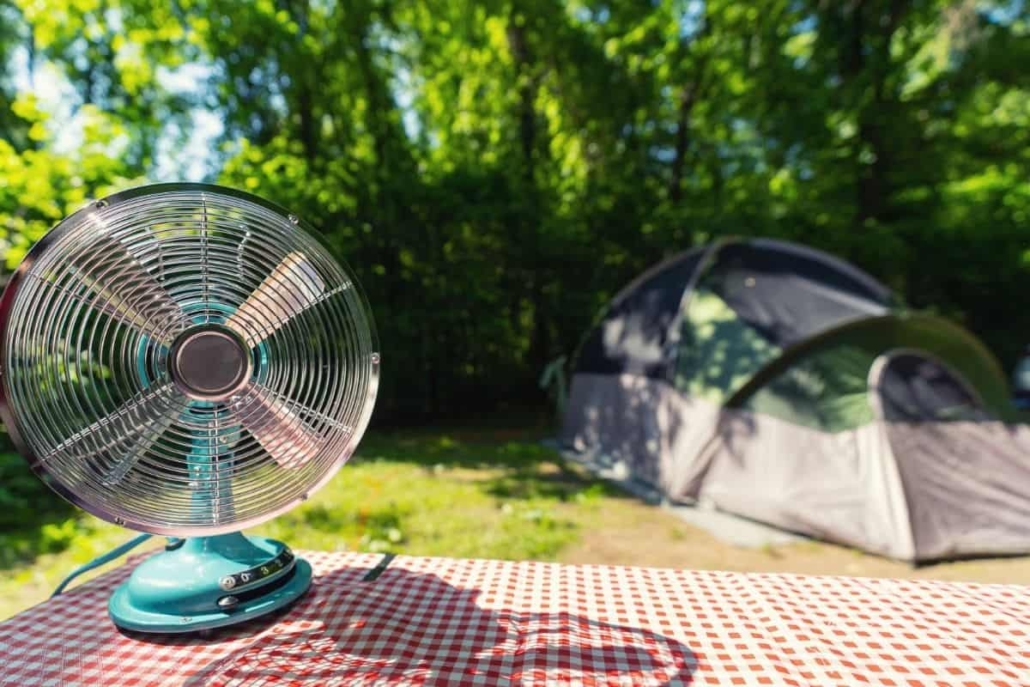
Market trends and technological advancements in the home solar energy system

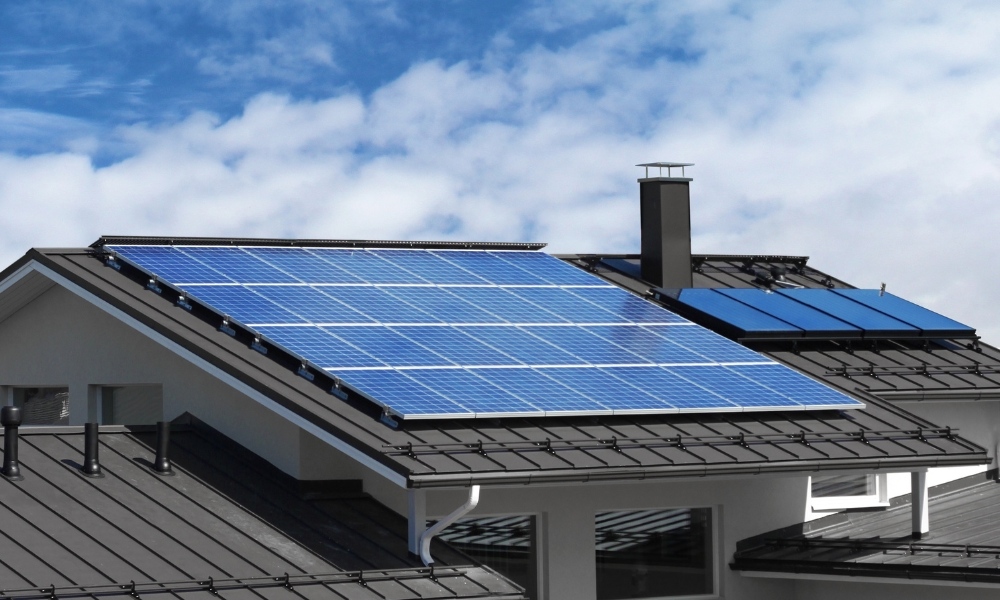
In many countries and regions today, rooftops are more than just shelter from the elements—they also collect energy, reduce utility bills, and stabilize the power grid. Over the past decade, the home solar energy system has transformed from a niche green option to a mainstream home investment. Data shows that falling panel costs, improved energy storage economics, and more intelligent electrification are driving this adoption. As a home solar system manufacturer, I see three forces shaping this market: economic, technological, and policy factors.

Market Adoption and Economic Drivers of Home Solar Energy System

Driven by falling costs, rising retail electricity prices, and increased public awareness of energy independence, the adoption of home solar energy systems continues to grow globally and across the United States. Key market drivers include: declining component prices, with monocrystalline PERC and N-type technologies lowering the cost per watt; improved balance-of-system efficiency; and financing innovations such as solar loans, power purchase agreements (PPAs), and leases, which reduce the barrier to entry for upfront costs. Furthermore, utility rate structures, particularly time-of-use (TOU) pricing, increase the value of solar-plus-storage systems by allowing homeowners to shift generation to peak pricing periods. Meanwhile, corporate and municipal commitments to decarbonization, along with local incentives, continue to stimulate residential solar system deployment.

From a manufacturer’s perspective, economies of scale and standardized designs reduce installation costs, while differentiated services—warranties, performance guarantees, and monitoring—become competitive advantages. For homeowners, the result is clear: in many US markets, an appropriately sized and installed home solar system can typically pay for itself within 5-10 years, while also increasing property value and reducing reliance on the grid.
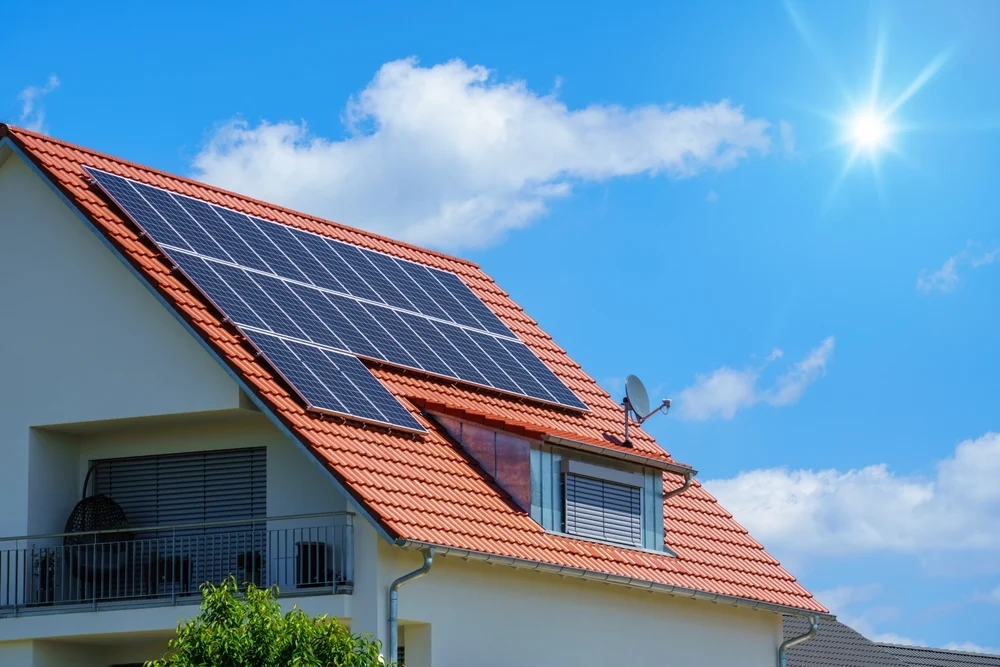
Market Adoption and Economic Drivers of Residential Solar Systems

Photovoltaic Module Innovations and Panel Efficiency Trends in the Home Solar Energy System

One of the most significant technological advancements in home solar systems is the rapid improvement in photovoltaic module efficiency and reliability. Monocrystalline technologies, including PERC, bifacial, and heterojunction (HJT) cells, have increased module efficiency, while many high-end panels maintain long-term degradation rates of less than 0.5% per year. New N-type cell technology and TOPCon structures further reduce recombination losses and improve module efficiency. Bifacial modules and frameless designs can collect reflected light, resulting in slightly higher energy generation per unit of rated power on specific roof types.

For homeowners, higher-efficiency panels mean fewer components are needed for the same capacity, resulting in less roof space occupied—which is especially important for roofs with limited area or shading. Furthermore, some manufacturers of home energy solar systems are improving reliability by enhancing encapsulation materials and using thicker glass to reduce microcracks and potential-induced degradation. These component-level improvements allow designers to deliver greater system capacity within the same roof area, thus increasing annual electricity generation.
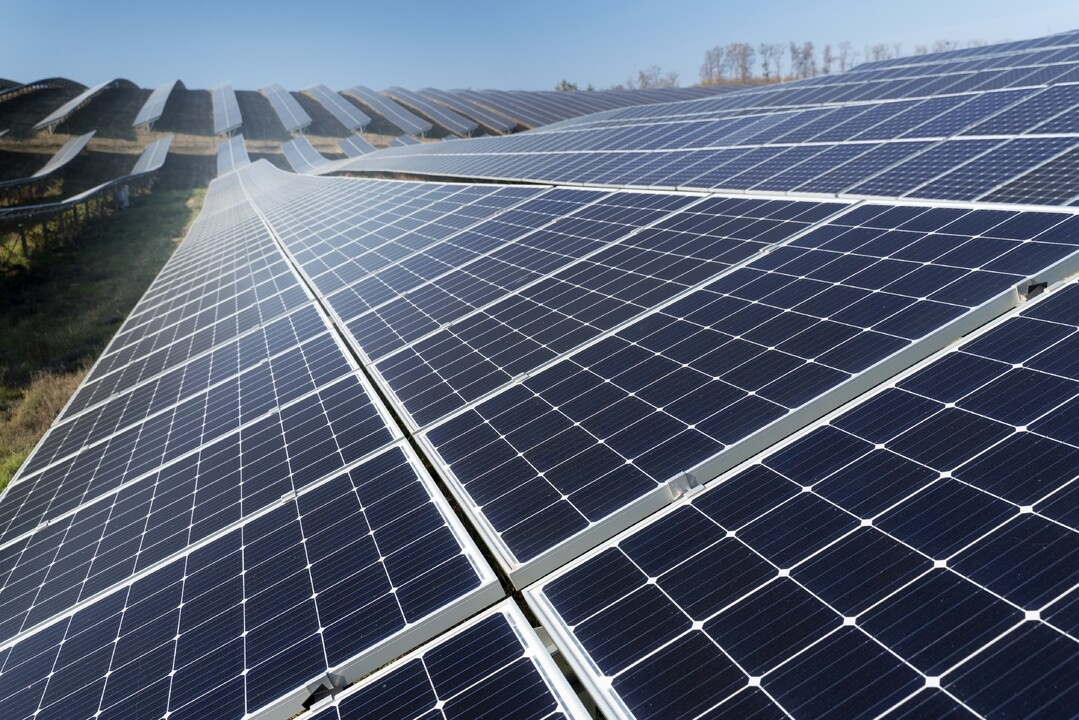
Photovoltaic Module Innovations and Panel Efficiency Trends in the Home Solar Energy System

Energy Storage and Battery Integration Trends

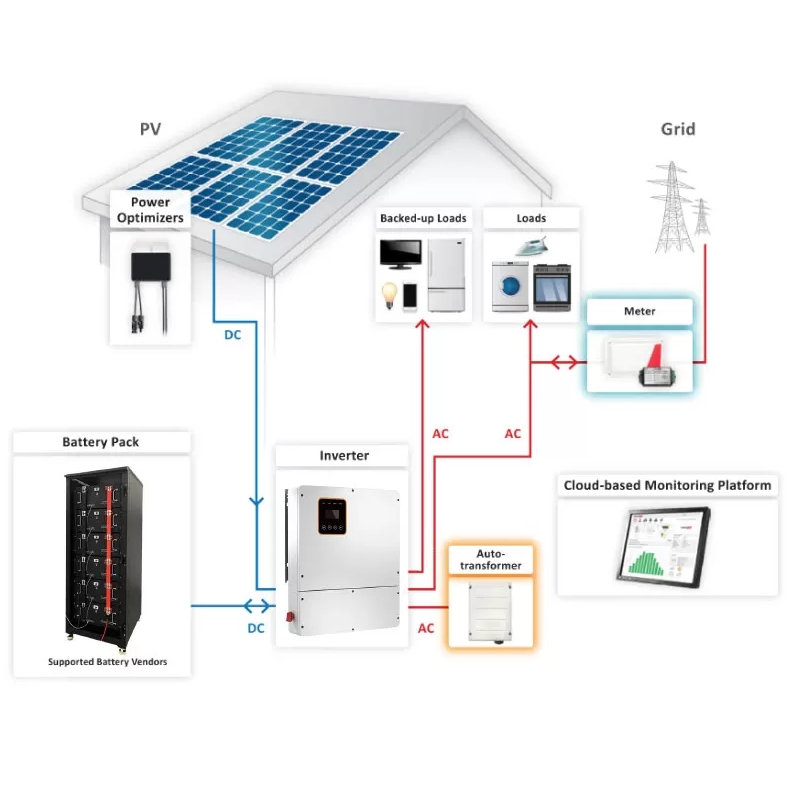
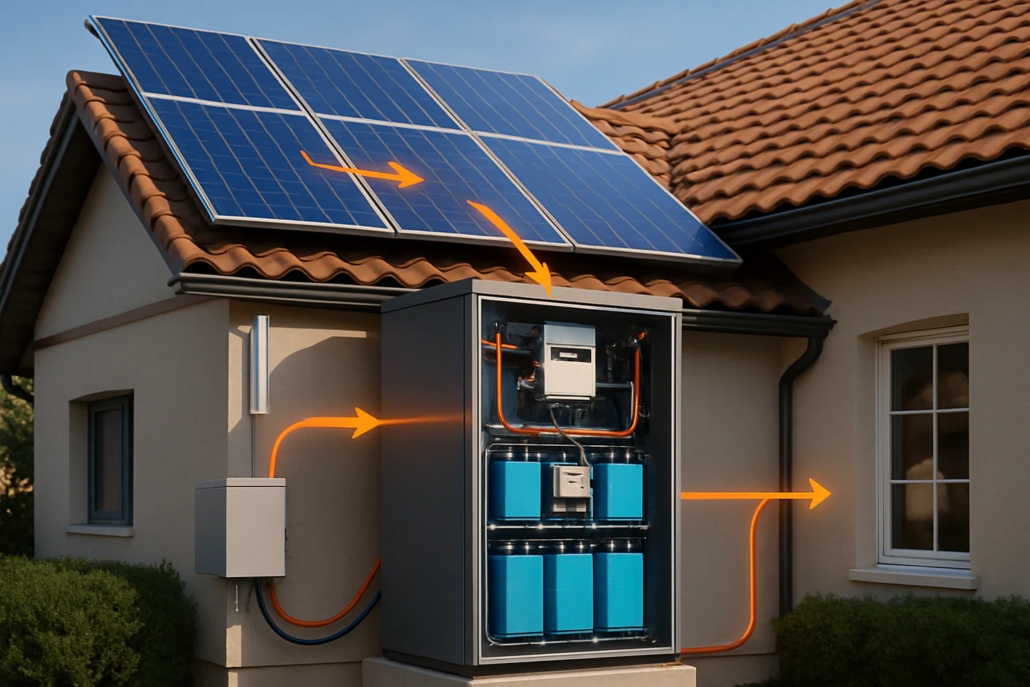
The inclusion of home energy storage is transforming the value proposition of home solar systems. Lithium-ion batteries remain the dominant technology for home energy storage due to their high energy density, decreasing costs, and reliable performance.

Recent trends include integrated inverter-battery systems for simplified installation; AC-coupled and DC-coupled storage topologies suitable for retrofit and new-construction projects, respectively; and increased use of secondary battery technologies to achieve circular-economy benefits. Improvements in battery chemistry and economies of scale have reduced the cost per kilowatt-hour, making energy storage economically viable for many homeowners.

Energy storage enables self-consumption, backup power during outages, and time-of-use shifting to avoid expensive peak-hour electricity rates. Software also plays a crucial role, with intelligent energy management systems (EMS) optimizing charging and discharging times based on weather forecasts, electricity price signals, and user preferences. For homes in areas prone to fires or power outages, combining solar with battery backup power enhances system resilience. It can be a decisive factor in choosing a home solar system.

Inverters, Power Electronics, and Grid Interaction

Inverters and power electronics are critical to the performance of a home energy solar system and its interaction with the grid. Technological advancements are primarily evident in three areas:

1. Smarter grid-tied inverters capable of advanced functions such as voltage-reactive power support and fault ride-through; the application of microinverters and power optimizers; and integrated hybrid inverter architectures.

2. Grid-tied inverters support new utility projects and facilitate the widespread adoption of rooftop solar systems by providing reactive power support and frequency response. Microinverters and DC optimizers maximize energy harvesting efficiency on partially shaded or complex-roofed homes by independently managing each component. At the same time, initial purchase costs are higher, but they typically increase energy yield and simplify system expansion.

3. Hybrid inverters reduce the number of components in combined PV and battery storage systems and enable features such as stacked storage, flexible islanding operation, and firmware upgrades. For homeowners, choosing the exemplary inverter architecture depends on roof shape, shading conditions, storage plans, and desired grid services.

Smart Home Integration, Monitoring, and Digital Services

Home solar systems are increasingly integrated into the broader smart home ecosystem. Monitoring platforms now provide real-time generation, consumption, and battery level data, accessible via mobile apps and cloud dashboards. Beyond basic monitoring, innovative energy management platforms enable automated load shifting, EV charging coordination, and demand response participation, monetizing flexible loads. Data analytics and predictive maintenance utilize component-level data and weather forecasts to prevent failures and schedule cleaning.

Furthermore, software enables Virtual Power Plant (VPP) participation, where aggregated residential systems can provide grid services and receive incentives. For homeowners, these digital services mean convenience, reduced O&M costs, and potential additional revenue streams. Privacy, cybersecurity, and interoperability standards remain important considerations when deploying cloud-connected energy devices.
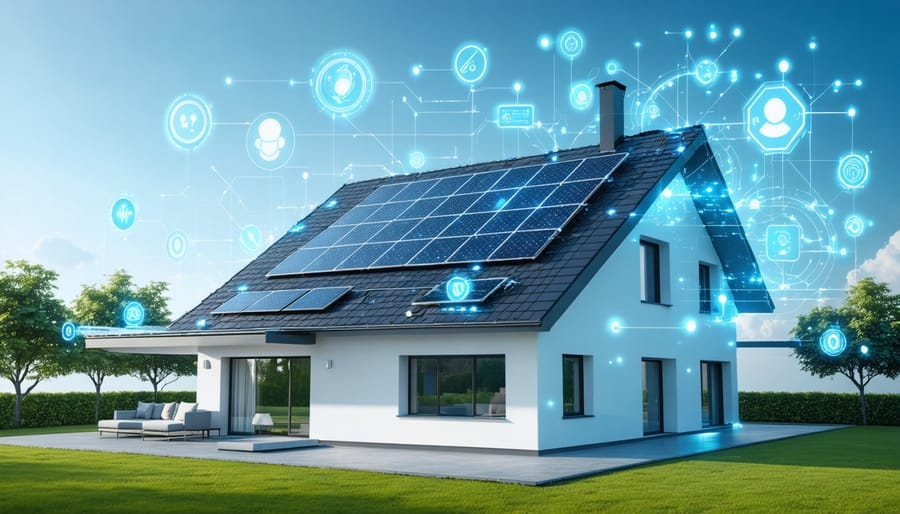
Home Solar System Smart Home Integration, Monitoring, and Digital Services

Installation Trends, Design Optimization, and Permitting Streamlining

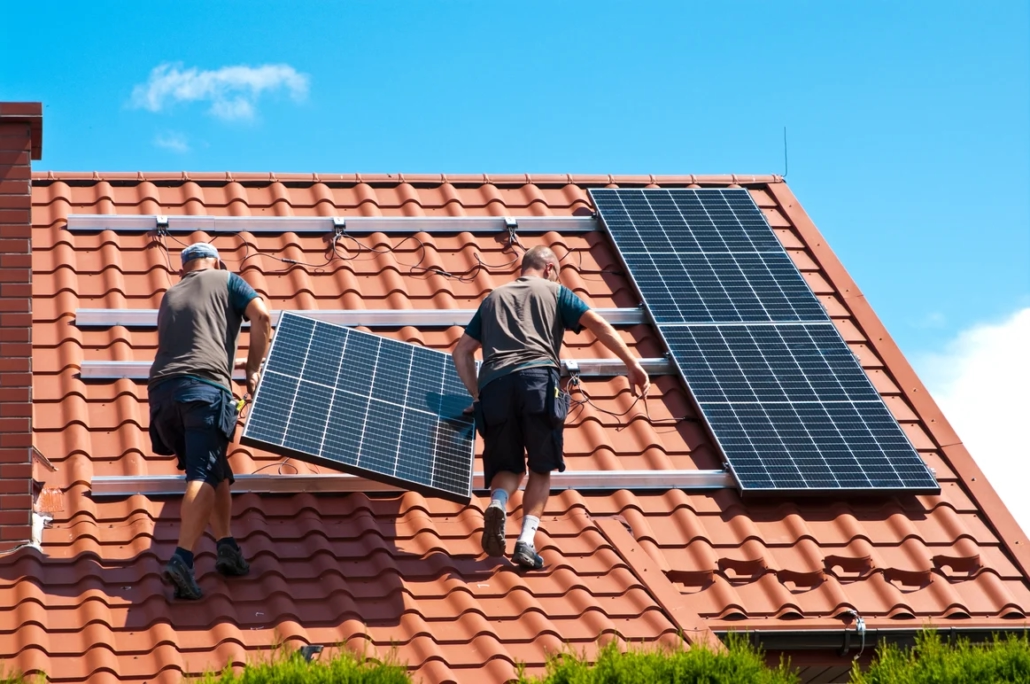
Home solar system installation methods are evolving to increase energy yield and reduce soft costs. Standardized racking and pre-assembled system balance-of-system kits reduce rooftop labor time. As a result, there is a growing trend towards roof-integrated solar systems and low-profile rail systems that improve aesthetics and reduce wind loading. Additionally, site modeling tools, drone mapping, and 3D shading analysis simplify the design process and enable accurate energy yield estimates before construction.

In some regions, permitting and interconnection delays remain significant obstacles; however, digital permitting processes and streamlined standards are shortening installation times in some advanced cities. For retrofit projects, AC-coupled storage kits and microinverter solutions reduce complexity and avoid running DC wiring through the house. For designers, the focus remains on maximizing power generation per unit of roof area, optimizing string design to cope with shading, and minimizing interference with future expansion.

Future Trends in the Home Solar Energy Storage Industry

Home solar energy systems are becoming increasingly mature, evolving into a flexible and reliable home energy solution. Market trends show a growing adoption of home solar systems, driven by economic benefits and incentives, while technological advancements are enabling more efficient solar panels, integrated energy storage systems, smarter inverters, and higher-quality digital services.
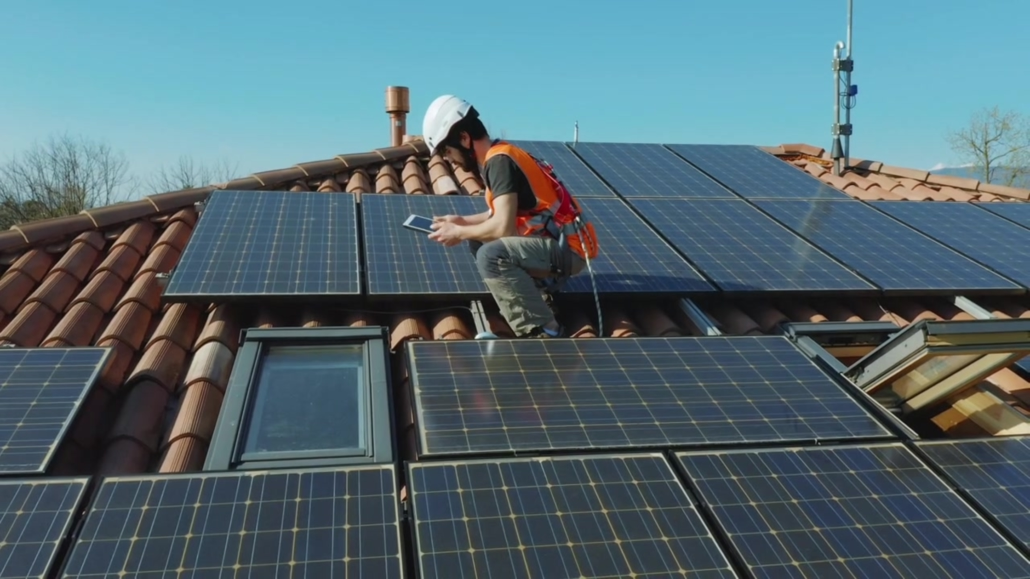
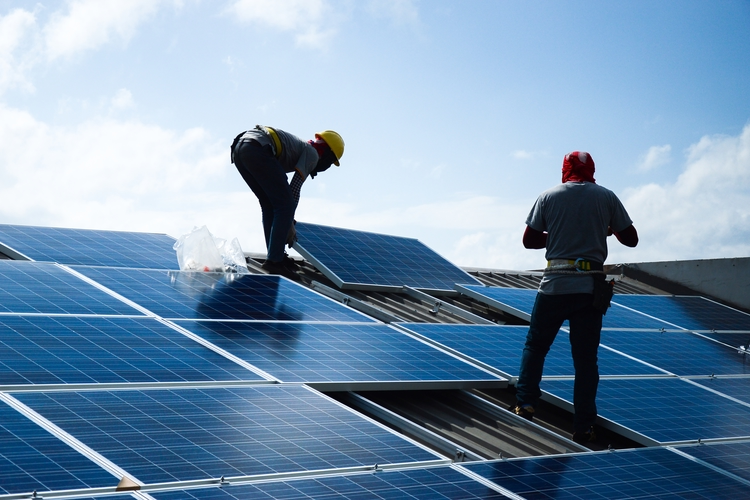
Installation Guide to Monocrystalline Solar Panels for Roofs: Orientation (South/East/West) Matching

A correctly oriented and installed monocrystalline solar panel array can convert solar energy into stable, clean energy. In many climates, a well-positioned rooftop solar panel array can meet 15% to 25% of a home’s annual electricity needs per kilowatt of installed capacity; the actual figures will vary depending on latitude, shading, and orientation, but the key is that small design decisions during installation will ultimately accumulate into significant differences in energy production over the system’s lifespan. This guide will show you how to select, install, and configure monocrystalline silicon solar panels on your roof, including assessing your roof, choosing a south-facing or east-west layout, and matching strings and inverters to maximize output and reliability.

Monocrystalline Solar Panels: Starting with Roof Assessment and Site Survey

Before selecting monocrystalline silicon solar panels or signing permits, be sure to conduct a systematic assessment of your roof. The best installation orientation decisions begin with a reliable understanding of the site conditions.

Key information to record:

Roof Orientation: Measure the azimuth angle of each central roof plane. South-facing roofs in the Northern Hemisphere have an azimuth angle of 180°. A compass app can be used, or a surveyor can be hired for more precise measurements.

Roof Pitch: Standard residential roofs have a pitch ranging from 10° to 45°. The pitch interacts with the orientation to determine seasonal yield.

Available Area: Map the unobstructed area of ​​each roof plane, considering vents, skylights, chimneys, and setback requirements.

Shading Analysis: Conduct a year-long shading study. Short-term inspections can capture noticeable shading, but simple shading tools or smartphone apps can reveal seasonal obstructions.

Structural Load Capacity: Confirm that the roof structure can support the additional dead and live loads. Most modern roofs can support a standard PV array, but older roofs may require reinforcement.

Monocrystalline Solar Panels 1(1)

Installation Options for South-Facing Monocrystalline Solar Panels

For most roofs in the Northern Hemisphere, south-facing is the default recommended installation direction. Installing solar panels facing south allows them to absorb the maximum amount of daily sunlight throughout the year, thus typically maximizing annual power generation.

Advantages of South-Facing Orientation:

With the correct tilt angle, south-facing arrays often produce the most energy annually because they receive balanced sunlight in both the morning and afternoon. Furthermore, system sizing is easier, and real-time shading decisions are simpler.

Practical Orientation and Tilt Rules:

If you live in a mid-latitude region (e.g., 30° to 40° North latitude) and want the highest annual energy output, the tilt angle should be close to or slightly less than your latitude (latitude minus 10° to latitude). If winter production is more important, increase the tilt angle by about 10°; if summer production is more important, slightly decrease it. Installation is both more straightforward and more aesthetically pleasing when the roof slope matches the desired tilt.

Installation Options for South-Facing Monocrystalline Silicon Solar Panels 1

When can separate east-west installations provide greater value?

East-west layouts are not a secondary option, but a strategic one. When roof geometry or obstructions limit south-facing monocrystalline silicon solar panel installations, orienting panels east and west can provide greater value.

Why choose East-West?

Because it provides a wider production curve, the east side is better for morning power generation, and the west side is better for afternoon power generation. An east-west side-by-side layout produces a flatter daily power generation curve and better matches morning and evening peak electricity demand. Also, many residential roofs have large east-west-facing planes. Utilizing these two planes can increase the total area of ​​solar panels and power generation. Furthermore, if trees or chimneys shade the south side, but the east and west sides remain unobstructed, utilizing the east and west sides is practical and often more effective.

Design Tips for East-West Arrays:

Use matched strings: Group east-facing modules together and west-facing modules together to avoid string mismatch issues in case of partial shading. Ideally, each orientation should have its own MPPT input on the inverter. Consider the inverter structure: Microinverters or DC optimizers perform well in east-west installations because they can manage panel-level power mismatches and extract more energy from mixed orientations. If using string inverters with single maximum power point tracking,

Tilt angle is essential: A moderate tilt angle should be maintained for east-west orientations, as the sun is lower on the horizon in the morning/afternoon, and a steep tilt angle will reduce the angle of incidence.

Energy efficiency: An east-west balanced layout typically results in slightly lower annual energy consumption than an optimal south-facing layout, but in cases where peak electricity demand occurs during off-peak hours or roof area is limited, an east-west layout can improve overall system efficiency.

When can separate east-west installations provide greater value

Roof Array Tilt, Spacing, and Row Matching

Orientation is only half of what affects solar panel installation performance; tilt angle and array spacing also significantly impact annual energy generation and system reliability. For rooftop monocrystalline silicon solar panel installations, these geometric parameters are often constrained by roof slope and available area; if adjustable, they should be deliberately set.

Tilt Guidance:

Based on latitude rules, a standard baseline tilt angle for balanced performance throughout the year equals the latitude, which can be adjusted by ±10° depending on seasonal needs. When the rack tilt angle does not match the roof slope, wind load, and structural load requirements must be confirmed. Low-friction tilt frames (10°–15°) can also be used to balance performance with wind load and maintenance access.

Row Spacing:

Avoid self-shading: When panels are tilted, the upper monocrystalline solar panels may shade the lower panels in the early morning during winter; increasing spacing appropriately can reduce energy loss. For single-layer rooftop PV systems, spacing is less of an issue. Still, if you are installing multiple layers of panels or elevated frames, you need to calculate the spacing to prevent winter shading.

Service Space: Maintain minimum clearance required for cleaning and fire escape. Many regions have requirements for walkway width or edge clearance.

Matching Panels and Strings:

Maintain a consistent electrical group configuration: combine panels of the same brand/model and orientation into the exact string. Mixing panels with different tilt angles/azimuths in the precise string will lead to mismatch losses. Paired panels should maintain a consistent tilt angle. If the modules in the exact string have uneven tilt angles, the string’s performance will depend on the module with the smallest tilt angle. Maintain consistent panel geometry within each string.

Electrical Matching and Inverter Selection

Matching orientation and the electrical aspects of panels may sound technical. Still, the key points are simple: minimize mismatches, use the correct inverter approach, and plan for the long term.

Two common inverter strategies:

Single Maximum Power Point Tracking (MPPT) string inverter: Best suited for arrays with consistent orientation. It is cost-effective but more sensitive to orientation deviations.

String inverter with multiple MPPTs: Allows you to connect east-facing solar panel strings to one MPPT and west-facing strings to another. This is a good option for roofs with asymmetrical orientations.

Practical Matching Rules:

Ensure the string voltage is within the inverter limits; installers will design the strings based on the inverter’s input voltage range. This limits the number of modules per string, but it’s standard practice. Also, allocate MPPTs by direction: if the inverter has two MPPT inputs, one for south/east and the other for west or different tilt groups. Prioritize designs that facilitate monitoring: choose inverters with module-level monitoring to quickly identify underperforming modules.

Adjust Installation Orientation Based on Goals and Document All Information

The choice of orientation for rooftop monocrystalline solar panel systems is not a simple either/or decision. In many regions, south-facing arrays maximize annual energy production. Still, when roof geometry, shading, or electricity usage patterns are better suited to morning or evening generation, east-west or split layouts often yield higher returns. The right choice depends on three factors: a reliable site survey, a clear understanding of electricity load and tariff structures, and a power solution that minimizes mismatches.

Aluminum Alloy Solar Mounting System: Lightweight & High-Strength for Easy Installation

When evaluating the efficiency of solar power systems, most people focus on the conversion rate of solar panels or the stability of inverters, neglecting a critical component that directly affects system lifespan and operational efficiency: the solar mounting system. According to data from the International Renewable Energy Agency (IRENA), poorly performing solar mounting systems can reduce overall power generation efficiency by 5%-15% and shorten the lifespan by more than half. This is precisely where PowerDream, as a professional solar product manufacturer, excels. Our solar mounting system is made of aluminum alloy and stainless steel (A2-70, SUS304/410). These systems not only address common pain points of traditional brackets, such as heavy weight, difficult installation, and susceptibility to corrosion, but also achieve a perfect balance between lightweight design and high strength, ensuring a stable service life of 20-25 years, even in harsh environments.

Aluminum Alloy: The Lightweight Material in Solar Mounting System

Material selection is fundamental to high-quality solar mounting systems, and aluminum alloy stands out among many materials due to its unique properties. Unlike traditional steel brackets, which are prone to rust and heavy, PowerDream solar mounting systems use high-purity aluminum alloy that undergoes rigorous heat treatment and surface anodizing. This material has a density of only 2.7 g/cm³, which is 35% of carbon steel, making the entire solar mounting system significantly lighter.

For example, a mounting system for a 10kW rooftop solar project weighs only 300-400kg, while a traditional steel system of the exact specifications weighs 800-1000kg. This lightweight advantage is particularly evident in rooftop installations: it can reduce the load-bearing pressure on the building’s roof by more than 50%, eliminating the need for additional roof reinforcement and saving significant construction costs and time. At the same time, the anodized layer on the aluminum alloy brackets is more than 10 μm thick, effectively resisting oxidation, acid rain, and salt spray corrosion, making it suitable for harsh environments such as coastal areas, industrial zones, and high-altitude regions.

Aluminum Alloy The Lightweight Material in Solar Mounting Systems

Hybrid Design with Stainless Steel for High Strength

Lightweight design does not mean sacrificing strength. To further enhance the system’s structural stability, we use a hybrid design combining an aluminum alloy with high-quality stainless steel components. Power Dream makes key stress points—such as connecting bolts, nuts, and fasteners—from stainless steel materials that meet international standards, including A2-70 stainless steel for general applications and SUS304/SUS410 stainless steel for high-corrosion, high-load environments. A2-70 stainless steel has a tensile strength of up to 700 MPa, twice that of ordinary steel bolts, ensuring a strong, reliable connection between the solar mounting system and the roof or ground and preventing loosening.

In addition, we have optimized the structural design of the aluminum alloy beams and columns by using a hollow-section design, increasing bending and torsional strength by 30% while reducing weight. Through rigorous mechanical performance testing, the PowerDream solar mounting system can withstand a maximum wind load of 60 m/s and a maximum snow load of 1.2 kN/m², meeting the installation requirements of different climate zones worldwide.

How does the solar mounting system save 50% of construction time?

For solar project contractors and installers, the installation efficiency of the solar mounting system directly affects project progress and labor costs. PowerDream has fully considered this need in the product design process and created a modular, pre-assembled solar mounting system. First, all system components, including aluminum alloy beams, columns, clamps, and stainless steel fasteners, are pre-processed and numbered at the factory. Installers only need to assemble them according to the installation manual, eliminating the need for on-site cutting, welding, or drilling, significantly reducing the difficulty of on-site construction.

Secondly, we have designed a quick-connect structure for the key components of the solar mounting system: the beams and columns use an insert-type connection design with locking bolts, which can be fixed with a simple wrench, and the installation time for a single connection point is less than 1 minute. Compared with traditional steel mounting systems that require on-site welding and rust prevention treatment, PowerDream’s system can save more than 50% of installation time.

How does the solar mounting system save 50% of construction time

20-25 year service life, more reliable durability

Traditional steel solar mounting systems typically have a service life of 10-15 years, and problems such as rust, deformation, and loose connections often occur after 5-8 years, requiring frequent maintenance and replacement, thereby increasing the project’s operating and maintenance costs. In contrast, PowerDream manufactures solar mounting systems from high-quality aluminum alloy and stainless steel, follows rigorous manufacturing processes, and designs them for a service life of 20–25 years, perfectly matching the lifespan of solar panels. Authoritative third-party testing confirms this: after 3000 hours of salt-spray corrosion testing, the aluminum alloy brackets showed no significant corrosion and their mechanical properties remained unchanged; after 10,000 fatigue vibration tests, the system connection points remained secure, with no signs of loosening or deformation.

For users choosing solar projects, selecting PowerDream’s solar mounting systems means no need to replace brackets over the entire lifespan of the solar system, significantly reducing operational and maintenance costs.

Roof, Ground, and Floating Solar Mounting System

Different photovoltaic installation scenarios have different requirements for photovoltaic mounting systems. PowerDream has launched a series of targeted products to meet the diverse needs of its customers. For rooftop photovoltaic projects, we have designed a lightweight bracket that does not require roof penetration: we fix the base to the roof using counterweights or vacuum suction cups, avoiding damage to the roof’s waterproofing layer, and we adjust the bracket’s angle based on local latitude to maximize solar energy utilization.

For ground-mounted photovoltaic projects, we have developed pile-driven and concrete foundation support systems: professional equipment is used to drive piles into the ground, and the depth of the piles is adjusted according to geological conditions to ensure system stability. Additionally, for floating photovoltaic projects on lakes, reservoirs, and other bodies of water, we use a combination of corrosion-resistant aluminum alloy frames and high-density HDPE pontoons. This structure not only provides excellent buoyancy but also effectively resists corrosion from water and microorganisms. Whether on residential rooftops, large industrial plants, desert ground, or water surfaces, PowerDream can provide customized photovoltaic mounting system solutions to ensure stable operation in various scenarios.

Roof, Ground, and Floating Solar Mounting Systems

The Foundation of High-Efficiency and Durable Solar Systems

In the entire solar power system, the solar mounting system is far more than just an accessory; it is the solid foundation that ensures long-term, efficient, and stable operation. While many users are preoccupied with improving solar panel conversion efficiency and neglecting the potential risks posed by inferior brackets, PowerDream has already developed a comprehensive bracket installation solution built on aluminum alloy and stainless steel. It not only solves the pain points of traditional mounting systems—such as heavy weight, complex installation, and short service life—but also incorporates advantages such as a lightweight design (reducing roof load by 50%), high strength (withstanding strong winds of up to 60 meters per second), and a modular design, ensuring reliable conversion of your solar energy into value.

How to solve the grid compatibility problem of a grid connected solar system?

A homeowner who installed a 15kW grid-connected solar system by a local contractor experienced a grid outage that not only failed to reduce electricity bills but also crippled his refrigerator, grill, and POS system. The power company stated that the solar inverter was incompatible with the grid, causing unstable voltage and triggering their safety switches. Many grid connected solar system users encounter grid incompatibility issues. On average, each incompatibility-related outage costs businesses significant money, and 22% of homeowners face fines from utility companies for non-compliant systems. As a grid-connected solar system manufacturer, I will explain how to address the grid compatibility issues that plague these systems, ensuring your solar system and the grid work in harmony.

Problems Caused by Grid Incompatibility of Grid Connected Solar System

Many solar buyers believe that “compatibility” is merely a technical afterthought that the installer will handle. However, grid connected solar systems do not exist in isolation; they are intricately connected to the local power company’s grid, and even minor mismatches can lead to catastrophic failures.

The first is unplanned power outages. The power grid relies on stable voltage (120V/240V for residential, 480V for commercial) and frequency (60Hz in the US). A mismatched inverter will supply unstable power to the grid, triggering the power company’s protective relays to disconnect. This is because the inverter cannot handle the frequent voltage spikes in the state. Secondly, it will result in energy savings losses. Incompatible systems often operate less efficiently or shut down during peak sunlight hours. Thirdly, there are power company fines and legal risks. All US power companies have strict grid connection standards for grid-connected solar systems (defined by the IEEE 1547 standard). Non-compliant systems will face fines and may even be disconnected entirely. Fourthly, it can damage equipment. Voltage mismatch can burn out solar panels, inverters, and even your business’s electrical equipment.

What we need to understand is that not all grid-connected solar systems work on all grids. Instead, you need a system designed specifically for your grid, not a “works for any grid” system.

Problems Caused by Grid Incompatibility of Grid Connected Solar System (1)

Three Core Compatibility Issues of Grid Connected Solar System

Compatibility issues don’t happen by chance—they stem from four predictable gaps between the solar system and the grid.

1. Voltage and Frequency Mismatch

Grid voltage and frequency fluctuate slightly, but your inverter must match these changes in real time. If the grid voltage is 118V and the inverter outputs 125V, the grid’s relays will trip. Signs of this problem:

The system shuts down during peak sunlight. Your home/office lights flicker when the solar system is on. Your power company notifies you of a “voltage anomaly.” Cause: Ordinary inverters use a “fixed” voltage setting, not an “adaptive” one. PowerDream’s grid-connected inverters use grid tracking technology, adjusting voltage and frequency 100 times per second to match your power company’s specifications.

2. Anti-Islanding

Anti-islanding is a safety feature that shuts down your on grid solar system during a grid outage. This prevents the formation of an “island” of power that could potentially electrocute repair personnel. All power companies require anti-islanding devices, but many inexpensive systems use defective devices. For example, the system continues to operate during grid outages, and the power company rejects your grid connection application, citing “insufficient safety features.” The inverter displays an “anti-islanding failure” code. This is because low-quality equipment uses outdated “passive” detection methods, missing many outages.

3. Communication Protocol Defects

Your grid-connected solar system needs to communicate with the power company for net metering and remote monitoring. If the protocols of both parties are incompatible, you will not be able to save costs or understand your electricity usage. Signs of incompatibility include:

The power company cannot track your remaining electricity consumption—therefore, you will not receive net metering subsidies. You cannot view the system’s output or grid status in the power company’s application. The power company requires you to perform a “protocol upgrade” after installation. This is because the power company uses a different protocol. Systems designed for Modbus are incompatible with power companies using SEP 2.0.

Three Core Compatibility Issues of Grid Connected Solar System

Design Strategies to Ensure Smooth Grid Interaction

Effective grid compatibility begins in the design phase of the on grid solar system. First, a comprehensive grid impact study should be conducted to assess feeder strength, transformer capacity, voltage distribution, and background harmonic levels, as these factors determine the technical limits the system must adhere to. System capacity should not only match available rooftop or land area but also the local grid strength, avoiding excessive photovoltaic system integration on weak feeders. Therefore, smart inverters with advanced grid-connection support can be selected, enabling the system to actively regulate voltage and frequency rather than passively operate as a generator. Proper phase balancing minimizes imbalances and neutral point loads.

If power quality risks exist, line reactors, passive filters, or active harmonic suppression devices can be integrated into the design. Output control and power curtailment strategies should be embedded from the outset through a dynamically adjusted output energy management system. In situations with limited grid capacity, adding energy storage or reactive power compensation devices can provide rapid response support. At the same time, well-coordinated protection schemes ensure that relays, circuit breakers, and inverters work together to prevent false tripping.

Design strategies to ensure smooth interaction between grid-connected solar systems and the power grid (1)

Inverter and Control Solutions for Compatibility Issues

In grid connected solar systems, the inverter is the primary interface between solar power generation and the grid; therefore, its control capabilities are crucial for resolving compatibility issues. Advanced inverters equipped with volt-ampere (VA), volt-watt (W), and frequency-watt (W) functions can automatically adjust active and reactive power output in response to real-time grid conditions, helping stabilize voltage and frequency. Properly configured low-voltage and high-voltage ride-through capabilities keep the system grid-connected during short-term disturbances, reducing unnecessary outages and improving overall grid resilience.

Simultaneously, anti-islanding algorithms must be carefully calibrated to meet the requirements of local power companies, ensuring rapid disconnection during actual power outages and preventing false tripping. Communication protocols must support standard protocols; inverters can seamlessly integrate with monitoring systems, power company telemetry systems, and site-level energy management platforms.

Grid Connection Rules, Compliance, and Testing Best Practices

Resolving grid compatibility issues also requires strict adherence to grid connection rules and testing procedures. Power companies should be involved early in the project lifecycle to review preliminary designs and clearly define constraints such as output limits or protection requirements. The selected grid-connected solar system must comply with applicable national, regional, and power company-specific standards that guide equipment selection and protection settings. Additionally, during commissioning, functional testing should verify power quality metrics, including inverter operation, protection logic, ride-through performance, and harmonic distortion. In many cases, power companies require witness testing to verify safety-critical functions before approving operation.

Compatibility is key to a reliable grid connected solar system

A grid-connected solar system should make your life easier, not more complicated. It should lower your electricity bills, reduce carbon emissions, and operate quietly in the background—not cause outages, fines, or equipment damage. Compatibility is fundamental to every successful grid-connected solar system. This requires understanding your power company’s unique specifications, using appropriate inverters and controllers, and conducting rigorous testing before and after installation. Furthermore, it requires partnering with a manufacturer that prioritizes engineering development over sales and has the expertise to back up its commitments.

High-Power Solar LED Street Light: Municipal Road Safety with 12000lm Brightness

In many cities around the world, residents consider insufficient street lighting their primary safety concern. Meanwhile, some respondents cited rising electricity costs for traditional streetlights; 59% said they lacked the budget for expensive grid-connected lighting upgrades. On average, each municipality spends thousands of dollars annually (electricity + maintenance) on each traditional streetlight, money that could be used for other safety measures. Therefore, we’ll show you how PowerDream’s 400W high-power solar LED street light meets municipalities’ needs for both safety and energy efficiency. This streetlight boasts 12,000 lumens of brightness, intelligent motion detection, and is grid-independent. You can integrate it into your road system to achieve brighter, safer street lighting.

Traditional Solar LED Street Lights Fail to Provide Good Street Lighting

Most municipalities continue to use traditional street lights (sodium lamps, metal halide lamps) out of habit, not because they are effective. These outdated systems are deficient in three key areas: safety, cost, and sustainability. Even low-quality solar LED street lights (100W-200W) cannot meet the requirements.

First, there are safety hazards due to insufficient brightness. Sodium lamps have a maximum brightness of only 8,000 lumens, and their yellow light distorts colors, making it difficult for drivers to distinguish pedestrians’ dark coats and shadows. A suburban Detroit area found that intersections lit by sodium lamps had 42% more nighttime traffic accidents than those illuminated by high-power solar LED lights. Second, there are high long-term costs. Traditional streetlights require grid power, costing $80 to $120 per lamp per month—plus an additional $300 to $500 per year for maintenance. Third, they lack flexibility and pose environmental hazards. Sodium lamps cannot adapt to changing environments—they remain dim all night, even during peak pedestrian hours. They also waste energy.

12,000 Lumens Brightness + Motion Detection for Enhanced Safety

PowerDream’s 400W high-power solar LED street light is more than just a “brighter bulb”; it’s a smart safety system designed specifically for municipal roads. We’ve combined stadium-grade brightness of 12,000 lumens with a proprietary motion detection system to achieve a perfect balance between safety and sustainability.

1. 12,000 Lumens Brightness: Clear, Uniform Light, Eliminating Blind Spots

This streetlight uses high-efficiency LEDs to produce 12,000 lumens of 5000K cool white light—the same brightness standard used for highway ramps by the U.S. Department of Transportation. Unlike sodium lamps, which produce uneven “spots” and shadows, our optical lens design evenly distributes light across a 1,500-square-foot area, covering both lanes of traffic and sidewalks on both sides of the road.

2. Smart Motion Detection: Bright When Needed, Always Efficient

This light’s built-in passive infrared (PIR) motion sensor detects motion within a 30-foot (approximately 9-meter) radius and a 120-degree field of view, covering pedestrian crossings, bike lanes, and road edges. This intelligent feature saves up to 50% on energy compared to solar streetlights that maintain 100% brightness all night.

3. Safety Beyond Brightness: Durability for Municipal Applications

Municipal streetlights face harsh weather conditions—rain, snow, strong winds, and even vandalism. PowerDream’s high-power solar LED street lights are durable, with a lifespan of several years and extremely low maintenance costs:

– IP65 Waterproof Rating: Effectively protects against rain, snow, and dust.

– Wind Resistance: Withstands hurricane-force winds.

– Vandal-resistant design: A 3mm thick aluminum casing and tamper-proof screws prevent theft or damage.

12,000 Lumens Brightness Motion Detection for Enhanced Safety

Core components of the solar LED street light ensure reliability

The performance of a high-power solar LED streetlight depends on the quality of its components. PowerDream’s proprietary components in its solar LED street lights ensure 99.2% uptime, even during weeks of continuous cloudy weather.

1. 110W Monocrystalline Silicon Solar Panel: Maximizes Sunlight Absorption

This battery uses monocrystalline silicon cells, effectively absorbing sunlight even on cloudy days. A 6-hour charge stores enough energy to operate for 72 hours at 30% brightness or 24 hours at 100% brightness.

2. 140Ah Lithium-ion Battery: Long Lifespan, Maintenance-Free

We use deep-cycle lithium-ion batteries, which outperform lead-acid batteries in all aspects:

– Lifespan: 10 years, compared to only 3-4 years for lead-acid batteries.

– Depth of Discharge (DoD): 80% (using 80% of the capacity without damage), compared to only… 50%.

– Weather resistance: Usually operates in temperatures ranging from -40°F to 140°F – will not freeze or overheat.

The battery is installed in a weatherproof compartment at the base of the pole, making replacement very convenient (no climbing required).

3. AL6063+Teijin PC: Robust and durable, corrosion-resistant

The luminaire is mounted on a rust- and corrosion-resistant aluminum alloy pole. The steel pole comes with a base for easy installation and a cable management system to conceal wiring.

Core components of the solar LED street light ensure reliability

How to choose the right lighting solution for your municipal area?

Not every road needs the exact lighting solution – the required brightness and pole height vary between residential streets and industrial corridors. PowerDream’s team of municipal lighting experts will help you customize high-power solar LEDs to meet your specific needs. Streetlights should avoid unnecessary functions and ensure sufficient brightness in key areas.

First, the road type needs to be analyzed: residential, main road, commercial, or industrial. Traffic flow should be considered: peak pedestrian/cyclist/driver times. Sunlight and weather conditions should be assessed: average daily sunshine hours, average rainfall/snowfall. Simultaneously, existing infrastructure should be identified, including the availability of utility poles. If poles are in good condition, they can be reused and connected to the power grid. Next, the pole height and spacing should be selected, as these determine the uniformity of street lighting. We recommend: Residential streets: 12-foot poles, 50-foot spacing; Commercial/main roads: 15-20-foot poles, 75-foot spacing; Industrial/warehouse areas: 20-foot poles, 100-foot spacing. Feet. Finally, there’s customizable motion detection and brightness, allowing you to adjust the light settings to suit your area’s needs.

Brighter and Safer Street Lighting for You

PowerDream’s 400W high-power solar LED street light solves this problem. With 12,000 lumens of brightness, intelligent motion detection, and no grid charges, it provides the safety your community needs while saving you money. The 12,000 lumens, intelligent motion detection, and grid independence allow you to integrate it into your road system for brighter and safer street lighting.

Break free from grid dependence: Achieving energy independence through a solar hybrid system

A solar hybrid system integrates photovoltaic power generation, battery storage, intelligent control, and grid-connected or generator power supply, providing reliable electricity, reducing electricity bills, and offering power backup during grid failures. In many regions and countries, residents are affected by power outages caused by severe weather and other environmental factors. To ensure reliable electricity and energy access for users in these areas, we will explain how a hybrid solar system reduces dependence on the grid, its advantages over traditional solar systems, and how to choose the right system for your needs.

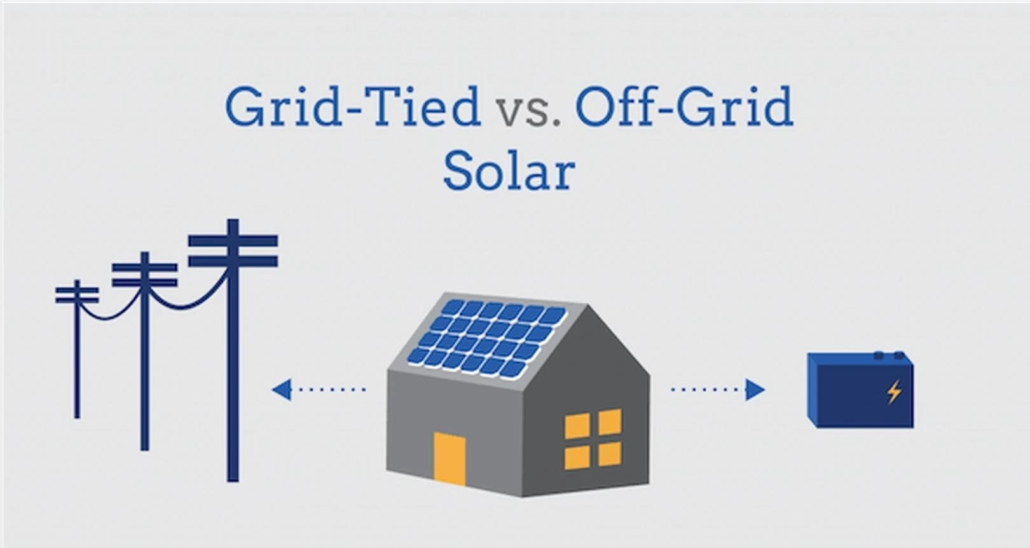
Why a Solar Hybrid System is Superior to Individual Grid-Connected or Off-Grid Systems?

First, the most common solar systems are grid-connected and off-grid, but neither solves the core problem of grid dependence. A hybrid solar system combines the advantages of both, creating a reliable, self-sufficient energy source with a degree of security.

1. Grid-Connected Solar: Ineffective During Power Outages

Grid-connected systems use solar panels to power your home and feed excess energy back into the grid to offset your electricity bill (net metering). But the problem is: they stop working during power outages. Why? To protect power workers repairing transmission lines from reverse power generation. This means that even when it’s sunny, you’ll still be in darkness when the grid is down.

2. Off-Grid Solar: Independent, but Unreliable

Off-grid systems use solar panels and batteries to power your home without a grid connection. However, they carry risks: if your electricity consumption exceeds the battery’s storage capacity (e.g., a week of consecutive cloudy days), you’ll experience a power outage. They also require larger batteries to handle insufficient sunlight.

3. Solar Hybrid Systems: The Best Option for Independence

Solar hybrid systems combine solar panels with battery banks while maintaining grid connectivity. They work as follows: On sunny days, solar energy powers your home, and excess energy charges the batteries. On cloudy days or at night, the batteries supplement solar energy, reducing reliance on the grid. During power outages, the system automatically switches to battery power to keep the house running. The grid serves as a backup power source, only activated when the batteries are depleted.

Why a Solar Hybrid System is Superior to Individual Grid-Connected or Off-Grid Systems

Key Components for True Energy Independence in Hybrid Solar Systems

The power of hybrid solar systems lies in their components—each meticulously designed to work together to ensure reliability and energy self-sufficiency. PowerDream’s solar hybrid systems consist of three core components, all optimized for energy independence.

1. High-Efficiency Solar Panels: Maximizing Sunlight Capture

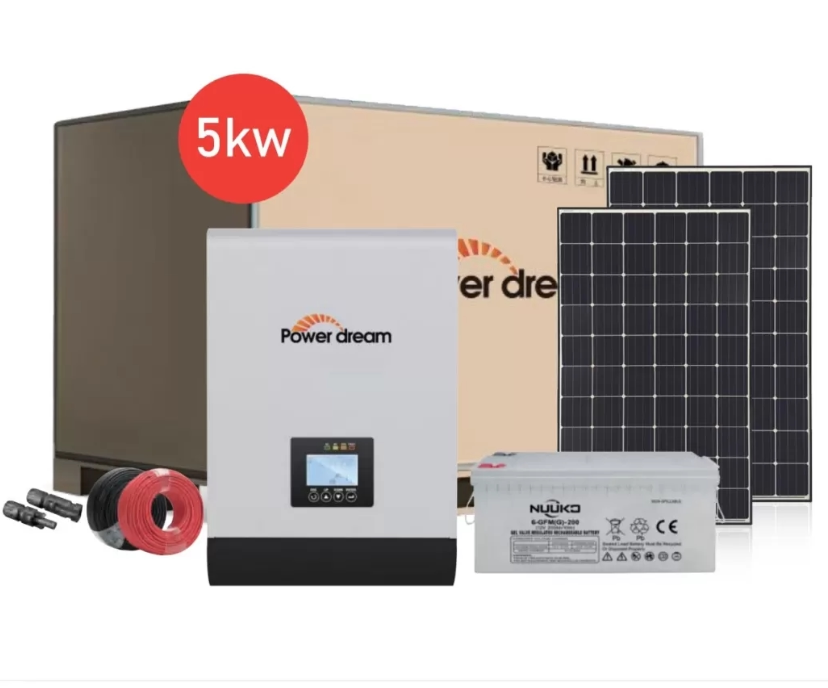
We use high-efficiency monocrystalline silicon solar panels that capture more sunlight, even on cloudy days. A 5kW system (10-12 panels) is suitable for most residential rooftops, generating 600-750 kWh per month in sunny areas and 400-550 kWh per month in less sunny regions.

2. Hybrid Inverter: The Core Control of the System

The hybrid inverter is key to the system’s “intelligence.” It converts the direct current (DC) generated by the solar panels into alternating current (AC) for home use, manages battery charging and discharging, and seamlessly switches between solar power, batteries, and the grid. PowerDream inverters feature two key functions for independent power generation:

– Dual MPPT: Optimizes power generation even when some solar panels are partially shaded.

– Zero Output Mode: Allows you to store all excess solar energy in the battery for use during power outages.

3. Lithium-ion Battery Pack: Stores electricity on demand to meet your needs

Batteries are key to energy independence—we use only high-quality lithium-ion batteries to ensure their long lifespan and superior reliability. Our 10kWh battery stores enough energy to power a 2000 sq ft home for 1-2 days of everyday use, or 3-4 days if you prioritize essentials.

Key Components for True Energy Independence in Hybrid Solar Systems

Smart Energy Controller: Monitor energy management via your smartphone

You can connect to your hybrid solar system via an app to track energy usage, battery level, and solar power generation in real time; you can also set priority modes, such as a “standby mode” during storms or an “energy-saving mode” during peak hours. Beyond its core appeal, the authentic charm of a hybrid solar system lies in its user-friendliness and ease of operation—you don’t need to toggle switches or manually adjust settings, as it automatically adapts to sunlight, your electricity consumption patterns, and grid conditions, thus maintaining your energy independence.

Furthermore, excess energy is stored in the battery, which starts at 70% after nighttime use and rises to 85% by 10 AM. Solar power peaks between 10 AM and 3 PM, while the home’s HVAC, dishwasher, and children’s tablet consume approximately 1.5 kW; this means there’s a surplus of 1.5-2.5 kW to charge the battery, which reaches 100% capacity by 1 PM. The system then switches to “zero-output mode,” storing all excess solar energy instead of feeding it into the grid for later use.

How to Choose a Hybrid Solar System for Your Energy Independence Goals?

Not all hybrid solar systems are created equal—size, components, and design are all crucial. The right system for you depends on your energy consumption, location, and priorities. Find the perfect system for you by following these four steps—the PowerDream team will handle the rest:

Step 1: Calculate Your Energy Needs

First, review your electricity bills from the past 12 months. Find your average monthly electricity consumption and peak consumption. A household using 600 kWh per month needs a 5 kW system; a small business using 1200 kWh per month needs a 10 kW system.

Step 2: Assess Your Sunlight and Space

The orientation, shading, and area of ​​your roof determine how many solar panels you can install. South-facing roofs receive the most sunlight, but east-west facing roofs can also work with PowerDream’s dual MPPT inverters. A 5kW system requires 150–200 square feet of unshaded roof space; a 10kW system requires 300–350 square feet. If you have limited roof space, we offer ground-mounted solar panels.

Step 3: Choosing Battery Capacity

Battery capacity depends on how long you want to maintain independent power during a power outage:

10kWh (most popular): Powers a home for 1-2 days or 3-4 days.
15kWh: Powers a home or small business for 2-3 days or 5-6 days.
20kWh and above: Suitable for rural homes or businesses requiring longer backup power.

Key Components for True Energy Independence in Hybrid Solar Systems

Installation, Operation, and Maintenance Best Practices

Proper installation and operation of a solar hybrid system ensures efficient and safe operation. Obtaining the necessary permits and inspections before installation, and complying with local building, electrical, and fire regulations, will protect your legal and financial interests. Furthermore, plan for an easy-to-install location, placing the batteries and inverter in a well-ventilated, temperature-controlled area to maximize lifespan and ensure safety. Utilize real-time monitoring technology to monitor power flow, battery health, and alarm status. Remote diagnostics reduce downtime and streamline support processes. Then, schedule preventative maintenance, check electrical connections, test generator starting functionality, verify battery voltage, and update system software annually or as directed by the manufacturer. Most importantly, install appropriate fire extinguishers where needed, label critical circuits, and ensure emergency personnel can quickly disconnect circuits.

Achieve Energy Independence for Your Home

Solar hybrid systems not only save you money but also enable you to achieve energy independence. At PowerDream, we design solar hybrid systems around three key engineering priorities: reliability, efficiency, and user-centric operation. First, we use integrable components, long-life photovoltaic modules, hybrid inverters with intelligent EMS, and battery systems seamlessly with predictable cycle life. Second, our systems include flexible operating modes: grid-connected, self-consumption maximization, and safe islanding with load priority. Third, we provide comprehensive commissioning, monitoring, and warranty services for installations.

On Grid Solar System with MIN inverter: suitable for small space applications

In many countries and cities, homeowners cite limited space as the primary reason they haven’t installed on grid solar systems. To address this issue, we’ve designed 3kW and 10kW on grid solar systems based on the MIN series inverters (3kW systems use the 3000TL-X, and 10kW systems use the MIN10000TL-X/XE). These compact, energy-efficient systems are designed to transform even the smallest spaces into energy hubs. Therefore, we will detail how our grid-connected solar systems equipped with MIN inverters solve the challenges of small spaces and which users each system is best suited for.

The Obstacle of Small Spaces and Why An On Grid Solar System Can’t Solve It?

Why has the small space remained a bottleneck for solar energy applications? First, on grid solar systems consist of two indispensable components: solar panels and inverters. Traditional systems fail in confined spaces primarily for two reasons.

First is the bulky inverter. A standard 10kW on grid inverter is about the size of a mini-fridge and requires additional ventilation space. This equates to a waste of over 3 square feet of valuable space, often forcing solar panels to be installed in less efficient areas. For a 3kW system, a traditional inverter is still as large as a microwave oven, taking up space that could have accommodated more solar panels.

Secondly, the panel layout is fixed. Traditional inverters use a single MPPT technology, meaning all panels must face the same direction and angle. In confined spaces, this wastes available space—you can’t utilize narrow corners or multiple orientations to install more panels. Therefore, the issue isn’t just about space, but about balance. Users in small spaces need a compact yet powerful grid-connected system.

The Obstacle of Small Spaces and Why An On Grid Solar System Can't Solve It 2-3 (1)

MIN Inverters in On Grid Solar System—Compact and Powerful

PowerDream’s MIN inverters (3000TL-X for 3kW systems, MIN10000TL-X/XE for 10kW systems) are at the heart of our small-space on grid solutions.

1. Unbelievably Large Size

The 3000TL-X inverter (for a 3kW on grid solar system) measures approximately 15.75 x 22.41 x 6.98 inches, allowing wall mounting, under-eave installation, or even installation in a power room without a dedicated outdoor space. The 10000TL-X/XE inverter(for a 10kW on grid solar system) is only slightly larger, measuring approximately 15.8 x 25.2 x 7.4 inches. This represents a 70% space saving compared to conventional inverters.

2. Dual MPPT: Flexible Layout for Irregular Spaces

The MIN series inverters all feature Dual MPPT technology—meaning they can control two sets of solar panels with different orientations. This is a revolutionary feature for small spaces. For example, suppose your roof has a section facing south and a narrow wall facing west. In that case, you can install solar panels in both areas separately. Furthermore, PowerDream’s tests show that dual MPPT technology can increase power generation by 15-20% in irregularly shaped, small spaces.

3. High Efficiency and Energy Saving: Small Space, High Power

Compact size doesn’t mean compromised performance. The 3000TL-X boasts a conversion efficiency of up to 97.5%. In comparison, the MIN10000TL-X/XE achieves an even higher 98%, meaning your solar panels can convert more sunlight into usable electricity. In small homes, homeowners must fully utilize every square foot of solar panel space.

3kW and 10kW: Tailored for Small Spaces

PowerDream’s MIN inverter solar systems are available in two configurations—3kW and 10kW—each designed for specific small space needs. Whether you’re a homeowner with a small roof or a small business owner with a terrace, there’s a grid-connected solar system to choose from.

on-grid-solar-system-1

3kW and 10kW: Suitable for Residential and Small Apartments

Ideal Applications: Detached houses, apartments with balconies/terraces, or home offices. Required Space: 40–60 square feet (5 monocrystalline 550W solar panels).

Key Features: 3000TL-X inverter, dual MPPT controller, up to 97.5% efficiency, 5-year warranty.

10kW On Grid Solar System: Suitable for small businesses and multi-unit buildings.

Ideal Applications: 2-4 unit apartment buildings or small offices (500-2,000 square feet).

Required Space: 100-120 square feet (18 monocrystalline 550W solar panels).

Key Features: MIN10000TL-X/XE inverter, dual MPPT controller, 98% efficiency, built-in surge protection, 5-year warranty.

Flexible Installation Options

Both systems are suitable for non-traditional installations—crucial for small spaces. We offer wall-mounting options that allow panels to be installed on exterior walls or awnings, enabling them to double as awnings for outdoor spaces. Ground-mounted installations utilize a low-profile design suitable for small patios or side spaces.

3kW and 10kW Suitable for Residential and Small Apartments (2) (1)

High Efficiency, Reliability, and Seamless Grid Integration

A compact size is a significant highlight, but our on grid solar systems equipped with MIN inverters continue to generate value even after installation. These systems are carefully designed to be efficient, reliable, and seamlessly integrated with the grid—addressing the main concerns of small-space users regarding grid-connected solar systems.

As a on grid system, it connects directly to your local power grid. When your solar panels generate more electricity than you consume, the excess power flows back to the grid, and your electricity company deducts it from your account. For small-space users, this can turn limited space into extra income. Furthermore, MIN inverters allow you to monitor power generation, track energy savings, and receive alerts when the system requires maintenance via your mobile phone. MIN inverters also have an IP65 weatherproof rating, meaning they can withstand rain, snow, dust, and extreme temperatures. Furthermore, our on grid solar systems comply with all US utility standards (UL 1741, IEEE 1547). 98% of US utility companies approve them. We handle the permitting and grid connection process for you, saving you time and effort.

Having the Right System

Many solar product manufacturers tend to overlook small spaces, either offering small, low-performance systems or simply telling customers “it’s not possible.” PowerDream’s 3kW and 10kW on grid solar systems, using MIN inverters, completely solve these problems, specifically designed for small spaces, rather than ignoring them. The 3000TL-X and MIN10000TL-X/XE inverters are not only compact but also more innovative, more efficient, and more flexible than traditional models. Combined with our high-efficiency solar panels and flexible mounting brackets, you can transform a small rooftop, balcony, or patio into a cost-effective solar asset.

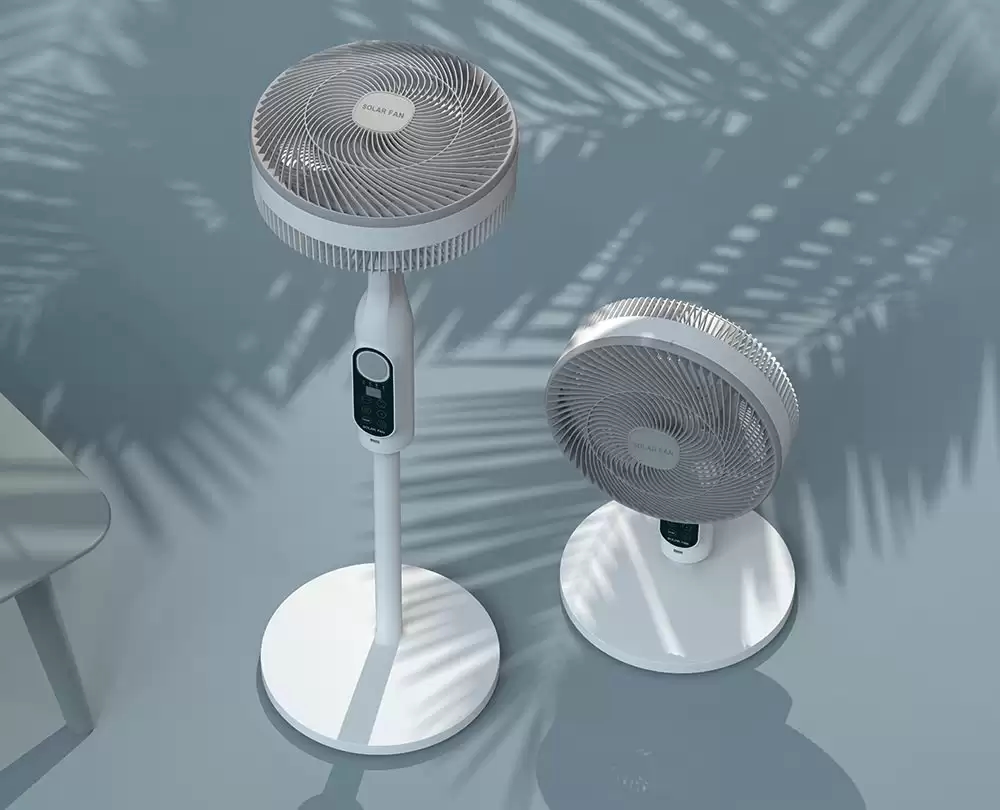
The perfect solar-power fan for camping: intelligent human detection technology

78% of campers report battery anxiety with traditional camping fans—either the fan suddenly runs out of power, or it wastes electricity when no one is in the tent. Worse still, these campers say they forgo bringing a fan altogether, sacrificing comfort for convenience. That’s why our PowerDream is the perfect camping solar-power fan: it’s the first fan to use Intelligent Human Detection technology, allowing it to “sense” your needs. Our solar fan is 65% more energy-efficient than traditional fans, lasts 3 times longer on a single charge, and requires no manual adjustments. This enhances your camping comfort and transforms your outdoor camping experience.

Traditional camping fans suffer from continuous operation issues

Whether battery-powered or basic solar-powered, they have three fatal flaws that not only undermine camping comfort but also waste resources. First, unnecessary battery drain. Traditional fans run at full power all day, even when no one is in the tent. Our tests show that a standard 10,000 mAh battery will run out of control in 5-7 hours if left on continuously. Secondly, manual adjustment compromises convenience. Waking up at 2 AM to lower the fan’s power diminishes the camping experience. Thirdly, solar energy utilization is low. Ordinary solar fans charge during the day but don’t prioritize energy saving at night. Furthermore, traditional fans are not only uncomfortable but also unsafe when temperatures rise.

Traditional camping fans

Solar-Power Fan with Smart Human Detection Technology

The PowerDream camping solar-power fans solve these problems with a core innovation: innovative human detection technology.

Simply put, it works like this: The fan has built-in sensors that detect body temperature and movement within a 10-foot radius. When you enter the tent, the sensors trigger the fan to immediately switch to your preset airflow level and turn on the built-in LED light in low light conditions. When you leave the tent, whether to get water or go to the restroom, the sensors detect the absence of heat and human movement, and the fan performs two actions: adjusting the light brightness to 10% and switching to a silent, energy-saving mode. In our tests, we found that this solar fan runs for an average of 18-22 hours on a full charge, while traditional fans last only 5-7 hours. Best of all? It requires absolutely no manual operation. This is the power of intelligent human-detection technology: your fan will work for you, not against you.

Solar-Power Fan with Smart Human Detection Technology

Key Features of a Solar-Power Fan Essential for Camping

Intelligent human detection technology is at the heart of this solar-powered fan, but it was designed with the outdoor environment in mind from the outset. We’ve equipped it with several features specifically designed for camping. First, it delivers airflow on demand, offering three speed settings: low for sleeping, medium for daytime tent cooling, and high for hot afternoons. Second, it integrates LED lighting with three modes: full brightness, low brightness, and strobe. Unlike separate camping lights, this solar fan’s LED lamp is integrated into the fan, eliminating the need for an individual device. It also features dual charging via solar power and USB, making it easy to handle various weather conditions. The 5W monocrystalline silicon solar panel can fully charge the fan in 6-8 hours of direct sunlight, and you can charge it via USB on cloudy days.

Best Practices for Real-World Camping

Good camping gear solves specific problems—and our solar fan excels in the scenarios campers encounter most often. Family camping is always busy, with children playing outside or going to the bathroom. Innovative sensing technology means the fan never wastes electricity when the tent is empty. For group camping, everyone’s comfort needs are different. Our fan has three speed settings for campers to adjust to their preferences, while a PIR sensor ensures it only consumes power when someone is using it. For solo camping, the built-in LED light eliminates the need for a separate camping light, and the strobe mode adds peace of mind.

Best Practices for Real-World Camping (1)

Your camping comfort deserves “on-demand” intelligence.

The point of camping is to escape the hustle and bustle of daily life, not to struggle with a broken fan or waste energy. The PowerDream camping solar-power fan uses human body-sensing technology to automatically start when you need it and automatically conserve energy when not in use, keeping you comfortable and safe outdoors. Compared to traditional fans, our fan runs for 3 times longer, consumes 65% less energy, and requires no manual adjustment. It’s more than just a fan; it’s a two-in-one tool that combines comfort and safety, making your trip easier and more convenient whether you’re camping with family, friends, or alone.

Complete Guide to Choosing a Solar Mounting System: Rooftop vs Ground-Mounted

Most homeowners and business owners allocate 90% of their solar budget to solar panels and inverters. However, the solar mounting system, which supports these panels, determines 30% of the system’s efficiency and 40% of its long-term reliability. Therefore, choosing the correct installation method maximizes sunlight utilization, reduces maintenance costs, and protects your investment. An inappropriate choice can lead to performance degradation, repairs, or even the replacement of the entire system. As a solar product supplier, we understand that the choice between rooftop and ground-mounted installations ultimately depends on five factors: space, sunlight conditions, budget, roof condition, and long-term goals. Therefore, we combine on-site testing and customer case data to analyze the advantages, disadvantages, and ideal application scenarios of each option in detail.

The Core Difference Between Rooftop and Ground-Mounted Solar Mounting System

Both solar mounting systems can mount solar panels, but their design, installation, and performance differ. First, there’s their compatibility with your home. Rooftop solar mounting systems use solar mounting brackets, rails, and anchors to secure the panels directly to the roof. It makes full use of existing roof space, thus not taking up yard or land area. Common rooftop solar installation systems include:

Pitched roof mounting: Suitable for sloping roofs (asphalt, metal, tile); Flat roof brackets: Suitable for commercial buildings or residential flat roofs, these brackets use counterweights instead of drilling for fixation; Adjustable tilt brackets: These brackets allow you to adjust the angle of the solar panels according to the season to increase sunlight exposure.

Ground-mounted solar mounting systems mount solar panels on poles or frames fixed to the ground, typically installed in patios, fields, or vacant land. It offers greater flexibility in terms of installation location and tilt angle, but requires ample open space.

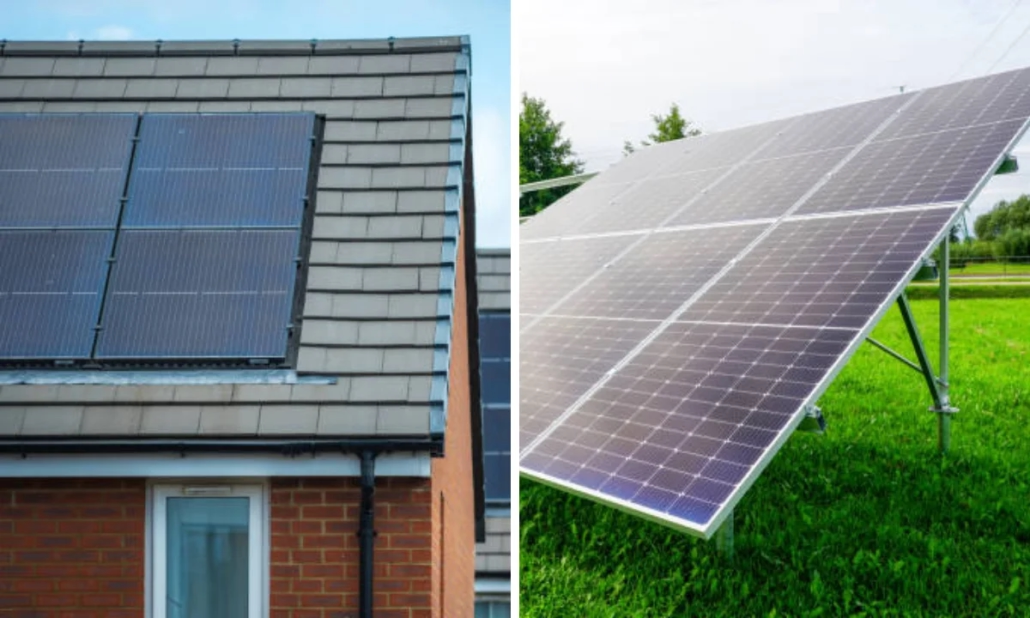
The Core Difference Between Rooftop and Ground-Mounted Solar Installation Systems

Advantages of Rooftop Solar Mounting System and When to Choose Them

Rooftop solar mounting systems are the most popular choice for residential customers—most of PowerDream’s residential installation projects use rooftop mounting—because they solve two significant problems: limited space and budget constraints.

Space Saving: Ideal for urban and suburban homes

If your patio area is small or used for gardening, play, or parking, a rooftop solar mounting system can make the most of the space on your roof. A 5kW system only requires 35-40 A of square footage of roof space, roughly equivalent to the size of a small patio.

Lower Cost: Faster Installation, Less Material

Rooftop solar systems cost 20% to 30% less than ground-mounted systems because they use less material, have shorter installation times, and lower installation costs.

No Land Permit Required:

Ground-mounted solar systems typically require a land-use zoning permit, especially in communities governed by a Homeowners Association (HOA) or a historic district. Rooftop solar systems are usually covered by standard solar licenses, which result in faster approval processes.

Advantages of Rooftop Solar Installation Systems and When to Choose Them

Advantages of Ground-Mounted Solar Systems

Ground-mounted solar systems are uncommon in urban residences but are common in commercial projects and rural homes. Their flexibility and efficiency make them worthwhile if you have enough space.

Maximum Efficiency: Optimal Tilting Angle and Sun Coverage

Unlike rooftop installations, ground-mounted solar systems allow you to set the optimal tilt angle based on your location. Power generation can be increased by 8-10% compared to a 25° tilt rooftop installation. Power generation can be further improved by adding a tracking system. 15-20%.

Easy Maintenance

Cleaning, inspecting, or repairing ground-mounted solar panels is safer and more economical—no ladders or roof work required. For homeowners with limited mobility, ground-mounted solar panels eliminate the risk of falls when cleaning panels themselves.

Scalability: Expand Your System Over Time

Ground-mounted systems are easy to expand if you plan to add more solar panels, for example, to power electric vehicles or for home extensions. PowerDream’s modular ground-mount design allows you to add 1-2 solar panels at a time without significant modifications.

No Roof Risk

Old, fragile tiled, or structurally complex roofs are not suitable for rooftop solar systems. Ground-mounted solar systems avoid roof damage, leaks, and load-related issues.

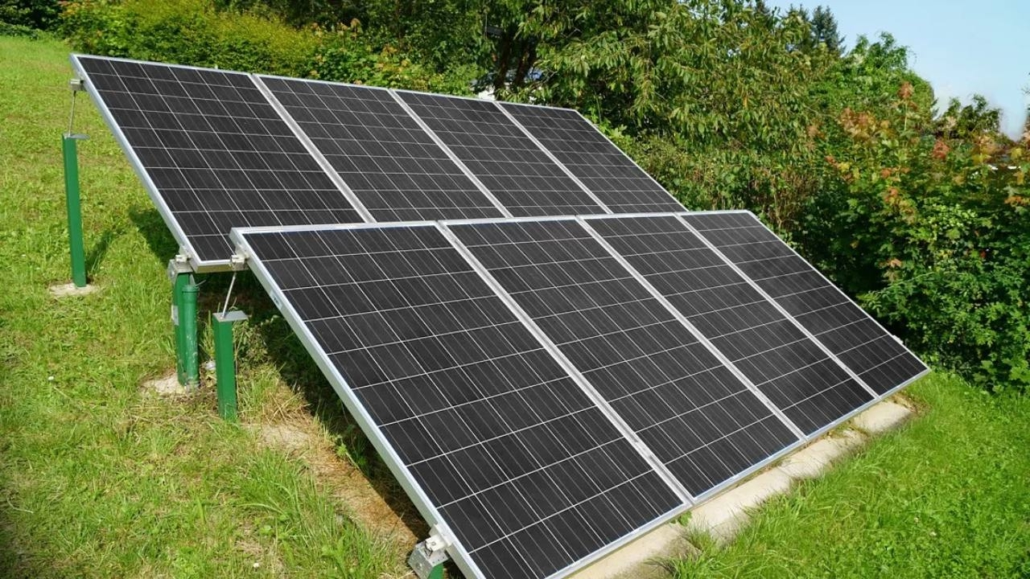
Advantages of Ground-Mounted Solar Systems

Key Factors to Help You Choose the Right Solar Mount

The choice between rooftop and ground-mounted is not about “which is better,” but about “which is better for your home.” PowerDream engineers use a 4-factor evaluation method to recommend the right solar mounting system for each customer. You can use this process to narrow down your choices.

1. Space Availability: Careful Measurement and Decision-Making

First, measure two dimensions: roof space and patio space. For rooftop installation: calculate the available roof area (excluding skylights, chimneys, and shaded areas). For ground-mounted installations, mark shaded areas and ensure at least 30 square feet of space per kilowatt.

2. Budget: Balancing Upfront Costs and Long-Term Savings

Rooftop solar systems have lower upfront costs, but ground-mounted systems may be more cost-effective in the long run due to their higher efficiency. If you plan to live in your current residence for more than 10 years, the higher savings from a ground-mounted system may outweigh the longer payback period. If you plan to sell your home in 5 years, the lower cost of a rooftop solar system is more beneficial to your property’s resale value.

3. Local Regulations and Homeowners Associations (HOAs)

Check the planning regulations and homeowners’ association (HOA) rules in your city. Some homeowner’s associations prohibit ground-mounted solar systems or restrict the color of roof panels.

4. Climate and Weather

In snow-prone areas (such as the northeastern and midwestern United States), rooftop installations are easier to clear of snow (due to gravity) than ground-mounted installations, but ground-mounted installations are easier to clear. In hurricane-prone areas, PowerDream’s wind-resistant solar mounting brackets (capable of withstanding 150 mph winds) are suitable for both rooftop and ground-mounted installations, but ground-mounted installations require deeper bases.

Key Components – Solar Mounting Brackets and More

The quality of a solar mounting system depends on its components. Cheap solar mounting brackets, rails, or anchors are prone to damage, leading to solar panel displacement, leaks, or even detachment. PowerDream systems use commercial-grade components designed for a lifespan of over 20 years, and we prioritize the following three key components:

1. Solar Mounting Brackets: The Foundation of Stability

Brackets secure the solar panels to rails (roof mounting) or frames (ground mounting) and must withstand wind, snow, and the weight of the solar panels. We use two materials:

– Aluminum Brackets: For roof mounting systems, aluminum is lightweight (reducing roof load by 40%) and rust-resistant. Our brackets undergo a powder-coated process to resist rain and UV radiation.

– Stainless Steel Brackets: For ground mounting systems, steel is stronger and ideal for movable tracking brackets. These steel brackets undergo hot-dip galvanizing, which effectively prevents rust even in coastal or humid areas.

2. Rails: Even Load Distribution

The rails run horizontally across the panel, evenly distributing weight. Our extruded aluminum rails (roof mount) and steel rails (ground mount) feature a hollow construction—lightweight yet robust. The rails are pre-drilled for easy installation and are compatible with all panel sizes.

3. Anchors and Fasteners: Preventing Leaks and Displacement

Roof anchors are bolted to the roof rafters (not just the cladding), and the holes are sealed with EPDM rubber gaskets—100% leak-proof. Ground mount anchors use concrete bases or helical piles.

All our solar mounting system components come with a 25-year warranty, and every batch of brackets and rails is tested in our in-house laboratory to ensure they meet our standards.

Choose the right installation system for you.

The key to choosing between roof- and ground-mounted systems is matching the system to the unique characteristics of your property, including space, roof condition, budget, and climate. For urban/suburban homes with good roof conditions, roof mounting can save money and space. For rural homes and commercial properties with open land, ground mounting offers the highest efficiency and scalability.

How to resolve power inconsistencies in an off grid solar kit for small residential homes?

In the United States, small homes are the fastest-growing housing type, with 63% of homeowners opting for an off grid solar kit for sustainability and cost savings. However, small homes present unique limitations, including limited roof space, unpredictable energy demand, and tight budgets, making power instability a common problem. Consequently, many homeowners frequently experience fluctuating power levels. This power instability is not part of off grid living, but a solvable issue rooted in four key factors: incompatible off grid solar kits, improper installation, inadequate maintenance, and outdated control systems. Therefore, this guide will utilize our field test data to explain in detail how to diagnose, repair, and prevent these problems.

Why Off Grid Solar Kit’s Power Instability Has the Greatest Impact on Small Homes

Small homes are more susceptible to power instability than traditional homes. This is primarily due to three unique characteristics of using off grid solar systems in small homes, each of which can amplify minor flaws into serious malfunctions.

First, limited energy storage and generation capacity. Small homes typically have only 10-20 square feet of available roof space for solar panels, while standard homes have over 100 square feet. This means that most small off-grid home solar systems have a daily power generation limit of 1-6 kWh and a battery storage capacity of 5-10 kWh. Even a small drop in panel output or a sudden surge in load can deplete the battery or trip the inverter.

Secondly, energy use is variable and concentrated. Small homes concentrate all living needs in a small space: cooking, heating, charging appliances, and other household appliances all rely on the same small off grid solar system. These appliances combined can exceed the inverter’s power limits, causing the system to shut down. Thirdly, 58% of small homeowners build their own off-grid solar systems, often using a mix of cheap and incompatible components. Such combinations can result in the battery not being able to store enough energy generated by the solar panels, or the inverter being unable to handle the battery’s output power.

Why Off Grid Solar Kit's Power Instability Has the Greatest Impact on Small Homes

Power Instability Troubleshooting – Three Steps to Find the Root Cause

Before replacing parts or upgrading your off grid solar system, you need to diagnose the problem. Power instability is rarely caused by a problem with the solar panels themselves; it’s almost always a failure of a specific component or setup. We offer a three-step diagnostic process for every customer, which you can also complete yourself in 30 minutes.

Step 1: Test Solar Panel Output – Is Your Energy Reliable?

Solar panels are the foundation of an off grid solar system – if they don’t perform well, everything else will fail. Between 10 AM and 2 PM, connect a multimeter to the solar panel’s positive and negative terminals and measure its output. For a 300W panel, under direct sunlight, you should see 18-22V (open circuit voltage) and 13-15A (current). If the output power is more than 20% lower than the rated power, the problem may be due to shading, dust or debris, aging, etc.

Step 2: Check Battery Health – Does Your Battery Pack Still Have Power?

Batteries store energy for use on cloudy days and at night – if the batteries are low, your off grid solar system will fail when it’s most needed. After fully charging, use a multimeter to test the battery voltage. Lithium-ion batteries: Voltage should be 13.2–13.6V (12V system). A reading below 12.8V indicates degraded battery performance. Lead-acid batteries: Voltage should be 12.6–12.8V (12V system). Below 12.4V indicates reduced capacity.

Step 3: Verify Inverter and Controller Performance – Is the Power Conversion Correct?

The solar inverter converts DC battery power to AC, while the charge controller regulates the power flow from the solar panels to the batteries. Both are common points of failure. To test the inverter output, plug a multimeter into a 120V outlet powered by the off grid solar kit – the voltage should be 115–125V. If the voltage is below 110V or above 130V, the inverter is faulty. For the charge controller, check if the battery is in a “float charge” state after being fully charged. If the battery remains in a “constant current charging” state after 8 hours of sunlight, the controller cannot adjust the power, leading to overcharging or undercharging.

Ensure Component Matching in Off Grid Solar Kit

The biggest reason for unstable power in small home off grid solar kits is component mismatch. For example, a 400W solar panel paired with a 50Ah battery won’t work together. PowerDream’s off-grid solar systems are meticulously designed to match generation, storage, and conversion ideally.

Here is our formula for matching components to small homes based on daily electricity consumption (DEU):

1. Calculate your daily electricity consumption: Use a smart energy monitor to track your consumption. Most small homes consume 2-5 kWh per day.

2. Solar Panel Size: Multiply your daily electricity consumption by 1.5. For example, for a daily electricity consumption of 3 kWh: 3 x 1.5 = 4.5 kWh, which is the daily power generation required. Each 300W solar panel generates approximately 1.2kWh of electricity per day; therefore, 4 panels are needed.

3. Battery Storage Capacity: Multiply your daily energy demand (DEU) by 2 (to cover 2 cloudy days). For example, for a daily energy demand of 3kWh: 3 x 2 = 6kWh, which is the required daily storage capacity.

4. Inverter Size: Add the power of your maximum simultaneous load. Suppose you are using a 1500W heater and a 600W coffee maker simultaneously: 1500 + 600 = 2100 watts. Please choose a 2500W inverter (leaving a 20% margin to avoid overload).

Ensure Component Matching in Off Grid Solar Kit

Smart Control – An Effective Solution for Power Fluctuations

Even the best-matched off grid solar systems can experience fluctuations due to weather or load peaks. Intelligent control addresses this problem by “managing” power flow—prioritizing critical load demands, adjusting charging rates, and preventing overload.

Utilizing an MPPT (Multi-Stage Photovoltaic) charge controller maximizes solar input by adjusting panel output in real time to utilize every watt of sunlight fully. PowerDream’s MPPT controllers can improve panel efficiency by an average of 18%. Simultaneously, intelligent inverters with load management can be used. PowerDream inverters employ “load prioritization” technology, allowing you to specify which loads are essential and which are optional. If demand exceeds capacity, the inverter will shut down unnecessary loads rather than tripping the circuit breaker. Furthermore, real-time monitoring and adjustment can be achieved through an energy management system that connects to your off-grid solar kit via Wi-Fi, providing real-time data on panel output, battery level, and load usage.

Ensuring Proper Installation and Regular Maintenance

Even a perfectly matched, intelligently controlled off grid solar kit can fail if improperly installed or neglected. Small homeowners often cut corners in this area—DIY installations may save money initially, but subsequent repair costs can reach thousands of dollars.

When installing, pay attention to the panel angle and orientation: In the United States, the panel should face south at a tilt angle of 30-45 degrees—this maximizes year-round sunlight absorption. Additionally, pay attention to the wiring specifications; the connection between the panel and the controller should use 10AWG copper wire. Thin wire can cause voltage drops and a 10-15% power loss. Also, ensure the batteries receive adequate ventilation. In small homes, regular monthly maintenance, including cleaning the panels, checking the battery terminals, and testing the inverter output, can help ensure the off grid solar system operates stably.

Ensure proper installation and regular maintenance of the off grid system

Making Off Grid Solar Systems Stable in Small Homes

Instantaneous power in small home off grid solar systems is not inevitable. This can be due to incompatible components, outdated control systems, improper installation, or lack of maintenance—all of which are solvable. Identifying the root cause and selecting appropriate components are key to resolving power instability issues. Additionally, at PowerDream, we design off grid solar kits specifically for small homes—our 5kWh and 10kWh kits can be installed on rooftops with limited space to meet the energy needs of small homes and include all the intelligent control systems and installation hardware to ensure a stable power supply for your home.