
Solar Power Street Light vs Traditional Grid Street Lights: Cost/Installation/Energy Savings Comparison
For decades, most cities have relied on traditional grid street lights. However, with rising energy costs, expanding urban infrastructure needs, and increasing pressure to reduce carbon emissions, many cities and project developers are rethinking how street light systems are powered. Solar power street light integrate photovoltaic panels, LED lights, smart controllers, and energy storage batteries into a self-sufficient lighting system. They generate and store electricity during the day and automatically provide lighting at night, without relying on the public grid. For municipalities, contractors, and infrastructure planners, the key question is no longer simply whether Solar power street light is effective, but how they compare to traditional grid-connected streetlights in terms of cost, installation complexity, and long-term energy savings.
Differences between Solar Power Street Light and Traditional Grid System
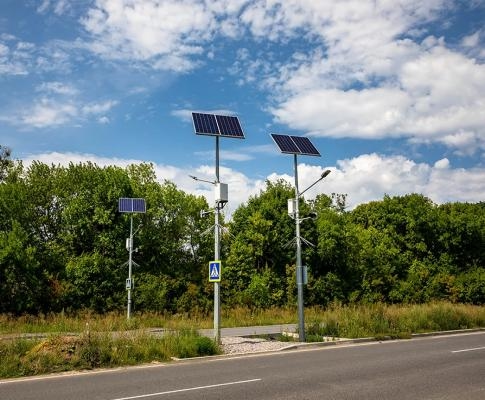
Solar power street lights integrate photovoltaic panels, batteries, LED lights, controllers, and sometimes communication equipment into a single or modular pole system. In contrast, traditional grid streetlights rely on centralized distribution networks, powering the lights through underground or overhead conductors and using utility-grade light controllers or centrally managed lighting control panels.
The key architectural difference lies in independence versus grid dependence. Solar power street lighs operate as local micro-energy systems—generating, storing, and consuming energy on-site—significantly altering the project lifecycle. For planners, the advantages include eliminating mainline excavation and trench repairs, reducing coordination with utility companies, and faster approval processes in many areas. Conversely, traditional grid systems rely on existing or expanded power infrastructure, have lower unit costs for the lights themselves, and generally simpler power-quality requirements due to stable AC power
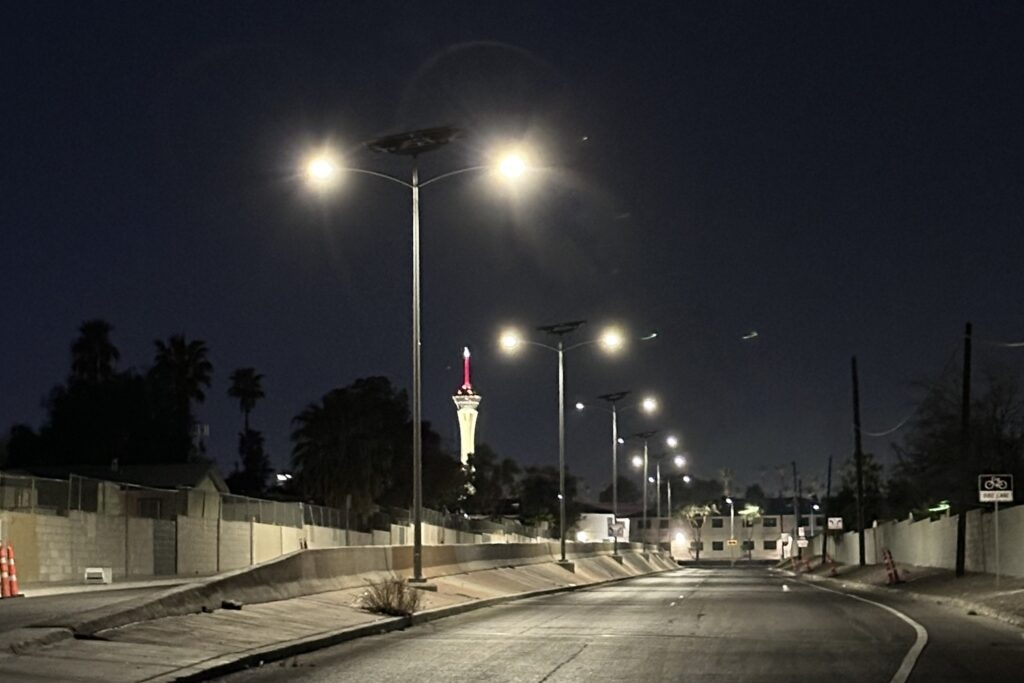
from utilities.
Upfront Costs and Capital Allocation
Upfront capital expenditure is often the most significant difference when comparing Solar power street lights and traditional grid streetlights. A high-quality Solar street light, including photovoltaic modules, lithium batteries, LED lights, and a smart controller, typically costs more per pole than a traditional grid-connected LED system, especially when grid power is readily available and service is nearby.
However, capital expenditure is more complex. Traditional installations often incur substantial civil engineering and utility coordination costs. These non-equipment costs can exceed the cost of the light fixture hardware, particularly in areas with high excavation costs, such as city centers, historic districts, or hardscape. Solar power street lights, utilizing trenchless foundations and plug-and-play installation, avoid these civil engineering costs. The cost advantage of Solar power street lights is evident for projects where trenching or extending service lines is costly or impossible.
Operating Costs and Energy Savings of Solar Power Street Lights
Solar power street lights effectively shift energy costs from recurring operating expenses to one-time capital expenditures. Traditional grid LED street lights consume municipal electricity every night; over their 25-year lifespan, electricity bills accumulate. In contrast, Solar power street lights can generate and store their own energy, eliminating the need for lamp-based electricity bills and typically achieving decades of energy independence. This translates into substantial savings for municipalities paying retail or demand-based electricity rates.
The payback period for Solar power street lights differs significantly from that of grid-connected street lights. In situations with high grid costs or complex civil engineering conditions, the payback period is 2-8 years; in situations with low grid costs and low civil engineering costs, the payback period is longer. Furthermore, fleet-level modeling typically indicates that solar systems offer predictable operating expenses, which is attractive for municipal budgeting. Finally, changes on the demand side must be considered. For example, the relative economic advantage of solar energy will increase when utility fees rise, or future grid decarbonization reduces the marginal value of the grid.
Installation Comparison of Solar Power Street Light and Traditional Grid Systems
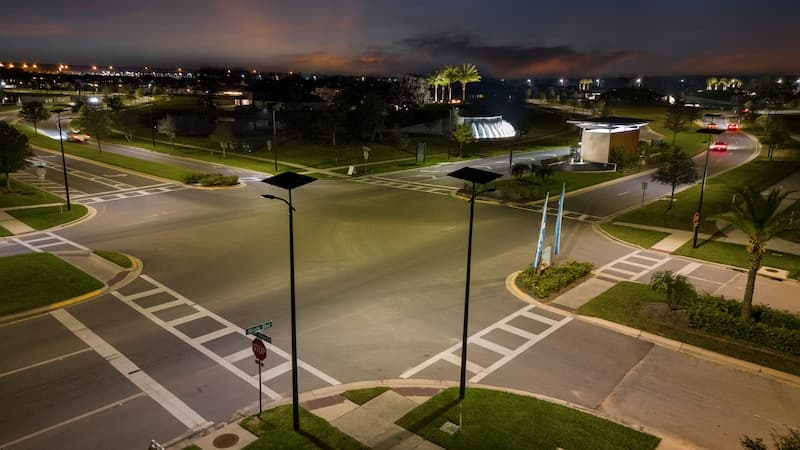
One of the most significant practical advantages of Solar power street lights is their quick and easy installation. Integrated or modular solar poles simplify on-site work, from pole placement to mechanical assembly to a brief commissioning process. In many cases, installation can be completed in a day without extensive earthwork. Installation teams only need basic skills, not high-voltage grid interconnection. For suppliers, this simplifies logistics: smaller personnel, fewer permits, and faster pole turnaround times.
Complexity and Coordination Costs of Grid-Connected Installation
In contrast, installing traditional grid-connected street lights typically requires trenching, coordinating with utilities, and managing traffic. While the lights themselves are simple in structure, the civil engineering is complex: excavation, pipe laying, wire pulling, manhole installation, backfilling, pavement repair, and testing. Each step can cause delays: utility location, cross-departmental approvals, and inspections.
Also note that grid-connected installations typically require a licensed electrician and, in some cases, coordination with the power company for service extensions or load studies. For municipalities with limited staff, this often translates to high contracting costs and lengthy construction periods. In contrast, solar projects can be deployed quickly with just one qualified installer and a small civil engineering team. Overall, Solar power street lights offer significant advantages for projects that prioritize speed and minimize public disruption.
Choosing the Right Light for the Right Place
Solar power street lights and traditional grid street lights each have their place. Solar power street lights are particularly advantageous in areas where grid expansion costs are high, rapid deployment is crucial, and minimizing public disruption, achieving energy independence, and ensuring sustainability are paramount. Grid-connected streetlights are more suitable in areas with easy access to utilities, low energy costs, and ideal centralized management.
