How to Pick Solar street lights: Power Dream MJ-LH Model for Industrial Park Roads
For industrial parks, factory grounds, and community roads, reliable outdoor lighting is a crucial tool for ensuring safety, improving productivity, and protecting assets. Therefore, choosing the right solar street lights is not just about buying fixtures, but about selecting the appropriate energy source, control system, and form factor based on actual needs. PowerDream’s MJ-LH series solar street lights are designed specifically for industrial park roads and similar applications: they utilize high-efficiency polycrystalline silicon solar panels, lithium iron phosphate batteries, an intelligent control system including radar sensing, and offer multiple power options to meet varying lighting coverage needs and budgets.
Why do industrial park roads need dedicated solar street lights?
Industrial park roads and distribution yards have unique lighting requirements. These environments typically require broad, uniform illumination to ensure safety; reliable operation under various weather conditions; and low-maintenance solutions to reduce operating costs for large numbers of streetlights and long-distance lighting. Ordinary solar lights designed for residential sidewalks cannot reliably meet these needs.
Key industrial requirements:
- Higher lumen output and better optical control to illuminate wide lanes, loading docks, and intersections.
- Robust batteries with deep discharge capabilities to maintain autonomous operation for several days, even with insufficient sunlight.
- Intelligent control for energy savings and safety in areas with intermittent human presence.
- Durability and low maintenance to ensure reliable operation even when unattended for extended periods.
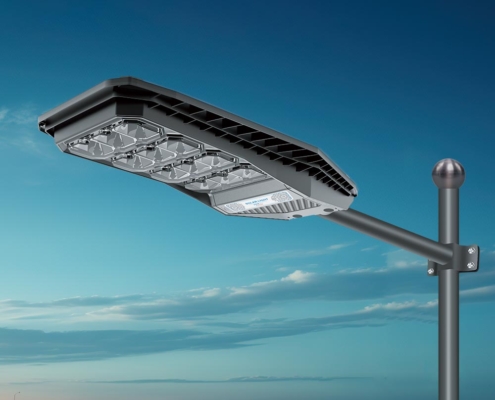
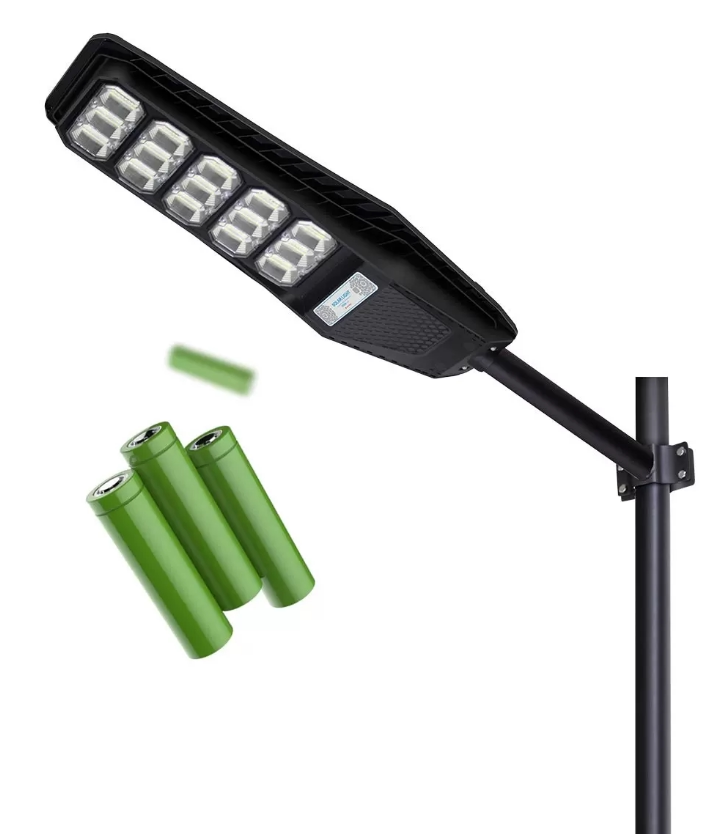
The MJ-LH series solar street light is designed specifically for these applications. Each MJ-LH fixture uses a high-efficiency 4V/18W polycrystalline silicon solar panel as the primary energy collector, designed to quickly collect solar energy in both sunny and cloudy conditions and charge the built-in LiFePO₄ battery. The lithium iron phosphate battery offers safe, stable deep-cycle performance and a long lifespan – crucial for installations the require replacing dozens or even hundreds of streetlight batteries.
Furthermore, MJ-LH series models feature intelligent control functions, including remote control, radar sensors, and three configurable lighting modes, enabling operators to balance brightness, runtime, and energy consumption precisely. Therefore, this solar streetlight series meets the performance and reliability requirements of industrial park roads.
How do solar panels and lithium iron phosphate batteries extend nighttime operation?
Energy harvesting and storage determine the actual performance of a solar street light. Two parameters are most critical: the energy the solar panel collects daily and the usable energy the battery can store and reliably release for many years.
Solar Panel Specifications:
High-efficiency polycrystalline silicon solar panel (4V/18W). Power Dream selected this size panel to achieve fast charging at the typical installation tilt angles and orientations common in industrial parks. The 18W rated power ensures continuous daytime charging even under partial shading, allowing the system to replenish battery power quickly in sunny or cloudy weather. In addition, for durability, the MJ-LH solar street light panel uses a tempered glass laminate, is coated with an anti-reflective coating, and features a robust junction box to resist moisture and mechanical stress, which is crucial for roadside deployment.
Battery Specifications (Lithium Iron Phosphate Battery):
Lithium iron phosphate (LiFePO₄) offers advantages such as long cycle life (typically over 2000 cycles at 80% depth of discharge), good thermal stability, and safe chemical properties, making it suitable for outdoor lighting. These characteristics make LiFePO₄ a wise choice for MJ-LH solar streetlights, which require years of reliability and safe deep-discharge performance.
The importance of this combination lies in achieving longer nighttime operation. The rapid energy harvesting from the solar panel, combined with the deep-cycle capacity of the lithium iron phosphate battery, extends nighttime operation. In fact, depending on the model and lighting mode, the MJ-LH device can maintain lighting for multiple nights with insufficient sunlight. The low degradation of the lithium iron phosphate battery ensures stable performance for many years, reducing maintenance and replacement cycles and lowering the total cost of ownership.
Intelligent Control and Safety Features of Solar Street Lights
Today, the functionality of solar street lights goes beyond just lighting; they must also intelligently manage energy and respond to usage and operational constraints. The MJ-LH solar street light provides a flexible control system that helps balance lighting needs and energy budgets. Smart Control Features:
Remote Control: Operators can control the lights remotely, reducing the need for on-site configuration and enabling centralized management for industrial park deployments.
Intelligent Lighting Control: The MJ-LH platform supports time-based dimming, dusk-to-dawn mode, and adaptive strategies to extend battery life while meeting safety standards. For example, the default setting maintains 30% to 50% of the rated output at night and increases to 100% at a preset time or when motion is detected.
Radar Sensor: Advanced radar sensing technology detects moving objects over a broader range than simple PIR sensors. Radar sensors provide stable detection performance in various weather and temperatures, allowing MJ-LH luminaires to dynamically increase brightness when vehicles or pedestrians pass by and dim the brightness when the area is unoccupied.
How to Choose Between Sizes and Models?
PowerDream’s MJ-LH series offers three model levels to meet a range of lighting needs, from narrow lanes to wide industrial corridors.
MJ-LH9300 (300W): Best suited for areas with narrow coverage, side roads, sidewalks, or locations with limited budgets.
MJ-LH9400 (400W): Provides balanced brightness and coverage for standard industrial park roads. This model is suitable for main internal roads, medium-width lanes, and areas with moderate nighttime vehicle activity. Depending on the required uniformity, pole spacing is expected to be in the range of 20-35 meters.
MJ-LH9500 (500W): A high-output lighting solution for large coverage areas, main roads, or locations requiring high brightness and long battery life. The MJ-LH9500 is particularly suitable for wide lanes, roundabouts, and areas requiring consistently high visibility. It supports larger pole spacing and longer battery life for extended illumination.
When choosing, please clearly specify your lighting requirements. Illuminance levels and uniformity targets can be determined based on road class and safety standards. Industrial park designs typically set road illuminance targets at 10-20 lux, with higher targets for critical loading and unloading areas. Also, consider pole spacing and mounting height: taller poles increase coverage but may reduce illuminance; consider glare and pole budget when choosing mounting options. Simultaneously determine energy and autonomy goals. If the site requires multiple nights of autonomous operation, choose the MJ-LH9500 with a larger battery pack or reduce the rated power to conserve energy.

Providing suitable road lighting solutions
PowerDream’s MJ-LH solar street lights combine high-efficiency polycrystalline silicon solar energy harvesting, long-life lithium iron phosphate battery energy storage, and an intelligent control system to meet the demanding lighting needs of industrial park roads, sidewalks, and roadside areas. When selecting MJ-LH luminaires, you can choose the appropriate model based on coverage targets, plan the installation scheme using professional photometric data, and ensure efficient and safe operation with remote management capabilities.