
How does Power Dream provide solar street lighting solutions tailored to different situations?
When providing solutions for each customer requiring solar street lights, we meet specific needs by translating site-specific data into engineering solutions. Our solar street lighting solutions combine the following aspects: precise determination of solar panel tilt and azimuth angles, meteorological resource analysis, precise load curve analysis for solar street light fixtures, and battery capacity design that fully considers continuous cloudy days and extreme low-temperature derating. We offer customized solutions, from photovoltaic arrays to LED luminaires, from MPPT charge controllers to lithium iron phosphate battery packs and cloud monitoring, ensuring your lighting needs are met.
Latitude, longitude, and local meteorological resources determine the design of solar street lighting solutions
For each solar street lighting solution, Power Dream first collects the site’s latitude and longitude and extracts local meteorological data: monthly average solar radiation (insolation), average temperature range, typical wind speed, annual rainfall/snowfall patterns, and the historical number of consecutive low-insolation days. These parameters determine the expected solar resources and various environmental factors affecting photovoltaic output, battery capacity, and mechanical design.
Why use latitude and longitude? Because the sun’s trajectory, altitude angle, and azimuth angle directly depend on geographical coordinates. Using these coordinates, we can determine the sun’s seasonal angle and calculate the optimal tilt and azimuth angles for the photovoltaic array to maximize annual or seasonal solar energy capture. For example, in the Northern Hemisphere, we typically orient the array towards due south (an azimuth angle of approximately 180°). In contrast, in the Southern Hemisphere, we orient it towards due north (an azimuth angle of roughly 0°). Near the equator, sensitivity to the azimuth angle decreases, and other factors, such as shading and obstructions, become more significant.
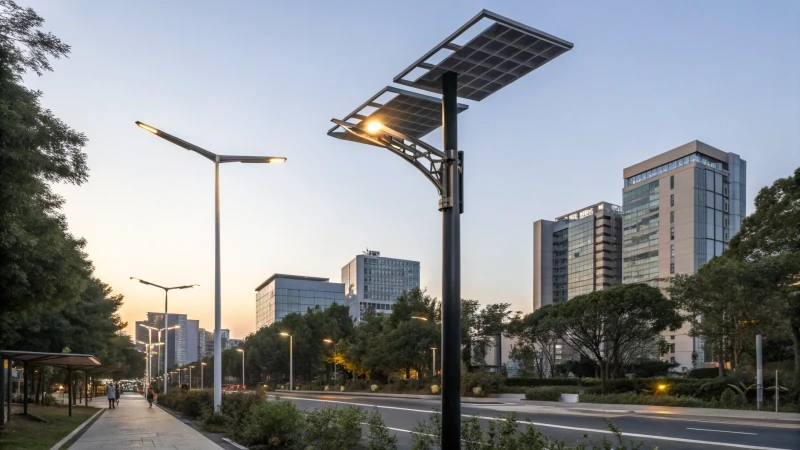
Determining Solar Street Lighting Solutions Based on Optimal Tilt and Azimuth Angles
Optimizing the tilt and azimuth angles of the solar panels for solar street lights balances annual power generation, seasonal performance, and snow or dust removal. Here’s how Power Dream determines the optimal tilt and azimuth angles:
Azimuth Angle: Target due south (180°) in the Northern Hemisphere and due north (0°) in the Southern Hemisphere; if the operational goal is to improve visibility during early morning and late evening hours, a slight eastward/westward deviation may be considered. For roads with heavy traffic at night, a slightly westward azimuth angle may be more advantageous for nighttime visibility.
- Tilt Angle: To obtain maximum annual energy, we set the tilt angle approximately equal to the site latitude ± a specific application adjustment value:
- Latitude as tilt angle ≈ is a good baseline for year-round production.
- Latitude + 10–15° ≈ is favorable for winter energy (valuable in cold, short-day areas at high latitudes).
- Latitude − 10–15° ≈ favorable for summer energy (suitable for areas where summer demand is dominant).
Tilt to facilitate snow shedding: In areas with snowfall, we increase the tilt angle to promote snow shedding and minimize snow coverage on the panels.
Adjustable tilt angle: For some large or critical installation projects, we design brackets with adjustable tilt angles that can be changed seasonally. While this design is uncommon in single-pole solar street light installations, it is attractive for municipal or campus pilot projects.
Daily Power Consumption and Charging Requirements Based on Lighting Duration
Power Dream first determines the daily energy consumption requirements of a single solar street light based on the LED luminaire’s rated power, the actual lighting duration, and the drive system’s energy consumption losses. If the project uses dimming or sensor control strategies, we comprehensively evaluate the power ratio across different operating periods rather than simply applying the full-power condition.
Based on this, we further consider the battery charge and discharge efficiency, the controller’s energy conversion efficiency, and the actual output attenuation of the photovoltaic modules under high-temperature, dusty, and installation-angle conditions to determine the effective charging energy required by the system under normal operating conditions. By combining daily energy consumption requirements with the average daily sunshine conditions of the least favorable month in the local area, we can accurately determine the charging capacity required by the solar panel under limited-sun conditions, ensuring that the solar street lights can maintain stable operation even on cloudy or low-light days.
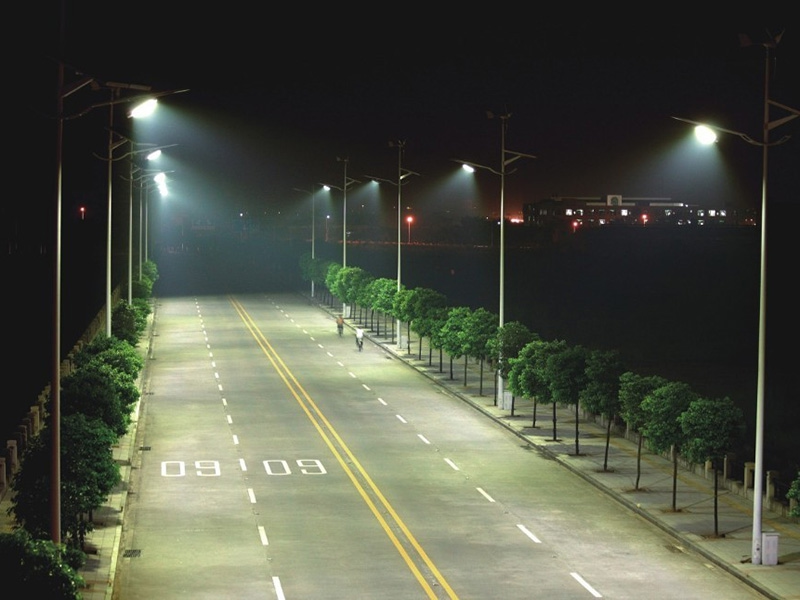
Battery Capacity Configuration Based on the Number of Consecutive Rainy Days
The battery system is the core of the entire solar solution’s risk resistance. When designing the battery capacity, Power Dream explicitly considers the independent operation capability of the solar street lights under continuous rainy or low-irradiance weather conditions. We first determine the number of days the system needs to operate without effective charging, based on the stable daily power consumption of a single solar street light. This “consecutive cloudy days” indicator is typically set based on local long-term meteorological data and the project’s importance. Subsequently, we safely increase the battery capacity, considering the recommended discharge depth and cycle-life characteristics of the selected battery type, to avoid frequent deep discharges that could shorten battery life.
Furthermore, the impact of ambient temperature on battery usable capacity is also included in the design considerations. In cold regions, low temperatures can reduce adequate capacity, so we reserve space for temperature compensation during the capacity selection phase. Through this multi-layered capacity assessment method, Power Dream ensures your solar street lights maintain reliable illumination even on consecutive days without direct sunlight.
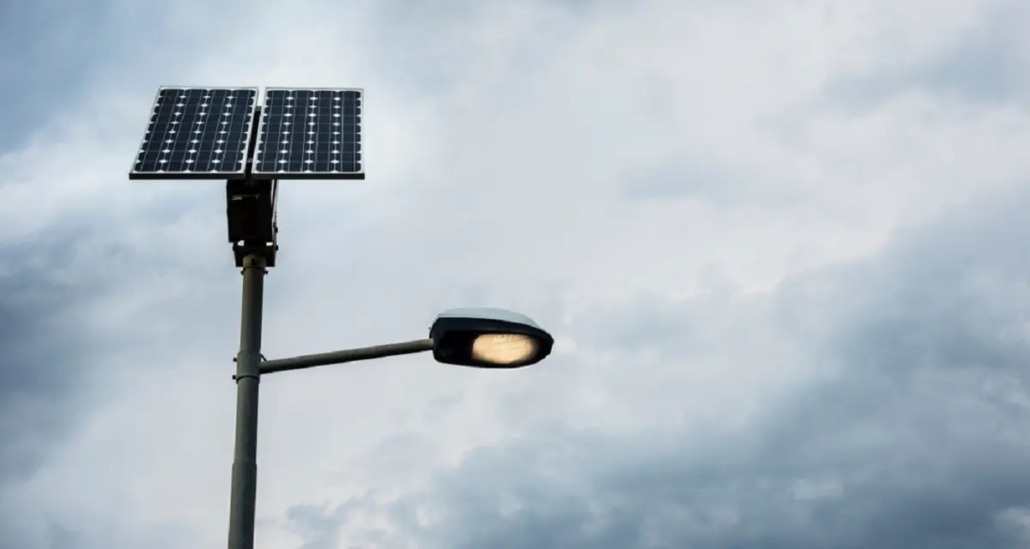
Solar Panel Power Configuration and Power Recovery Capability Assessment
After completing the battery capacity design, Power Dream further verifies whether the installed solar panel power in the solar solution can quickly recover power. Our design goal is not only to “maintain operation,” but more importantly, to restore the battery to a safe power level within a reasonable time after cloudy weather ends.
Therefore, we comprehensively consider the total energy consumption during consecutive cloudy days and set an acceptable power recovery period. Based on this, the solar panel power configuration must meet two conditions: first, to cover the daily lighting power needs of the solar street light, and second, to replenish the previously consumed energy storage within a limited number of daylight hours.
By combining effective daylight data from the least favorable months and the overall system energy conversion efficiency, we can determine the required solar panel power level for each solar street light. At the same time, Power Dream verifies that the solar panel’s working voltage and current range closely match those of the MPPT controller and battery system, ensuring efficient charging even under low-light and cloudy conditions.
Energy Consumption Optimization and Operating Strategies in Different Application Scenarios
In different application scenarios, solar street lighting solutions do not rely solely on simply increasing hardware parameters, but rather on system-level optimization to reduce energy consumption and improve overall reliability. For example, on rural roads or in park settings with low traffic volume, Power Dream typically uses time-based dimming or motion-sensing strategies to reduce average nighttime energy consumption, thereby indirectly extending battery life. This operating strategy effectively reduces the rigid requirements for solar panels and battery capacity without compromising basic lighting safety, thereby increasing the system’s adaptability in cloudy and rainy weather.
By combining intelligent control logic with a reasonable hardware configuration, the solar streetlights can operate stably under complex environmental conditions while balancing cost control and long-term reliability.
Bringing you reliable and efficient solar street lighting solutions
When providing solar street lighting solutions to our clients, Power Dream analyzes latitude, longitude, solar radiation resources, temperature, wind distribution, and historical rainfall patterns. We customize each solar street lighting system to match the specific installation scenario perfectly. From optimizing the tilt angle and azimuth of the solar panels to precisely matching daily energy consumption, battery life, and post-rain recovery, every design decision serves one purpose: to ensure stable, long-term lighting for our customers while minimizing maintenance and maximizing energy efficiency.