
How can 20kW off grid solar systems transform the energy independence of rural farms?
For many small and medium-sized rural farms and other remote areas, choosing off grid solar systems can significantly enhance energy independence. A 20kW off-grid solar system is an ideal choice, as it can simultaneously meet the needs of multiple critical loads such as water pumps, milking machines, refrigeration equipment, lighting, and household electricity, while also being more cost-effective than larger commercial solar arrays. Agricultural production typically combines a continuous base load with intermittent high-power electricity demands. The 20kW peak power generation capacity helps manage daytime peak loads, especially when the solar panels are oriented to maximize power output at midday. At the same time, battery storage compensates for insufficient power on cloudy days and at night.
Off-Grid Solar Systems Design Structure Suitable for Rural Farms
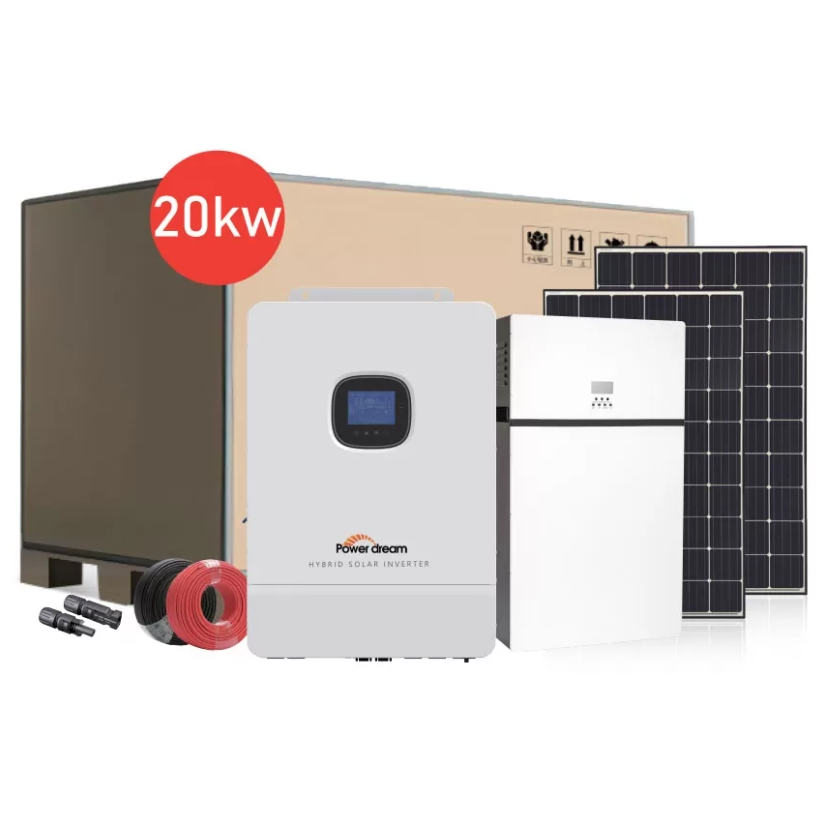
A reliable off grid solar system integrates power generation, conversion, storage, and control. PowerDream’s 20kW off grid solar power system is a prime example of a well-designed system: it consists of 36 x 550W monocrystalline silicon solar panels, 4 x 5kW pure-sine-wave off-grid inverters, and 2 x 51.2V lithium batteries equipped with a smart battery management system.
The 36 x 550-watt monocrystalline silicon solar panels offer high power efficiency and excellent performance in low light conditions. This configuration optimizes rooftop or ground-mounted layouts and concentrates power generation in a compact space, particularly important for farms with limited area. The four 5kW off-grid inverters provide pure sine-wave output, delivering precise, clean power suitable for sophisticated agricultural electronic equipment, variable-speed water pumps, and refrigeration compressors used on rural farms. Pure sine wave output minimizes harmonic distortion, protects motors, and maintains instrument accuracy.
The two 51.2V lithium battery packs provide energy buffering to meet the farm’s nighttime electricity needs and power requirements during consecutive cloudy days. Compared to lead-acid battery systems, lithium batteries offer higher cycle efficiency, longer lifespan, and superior depth-of-discharge characteristics. They can also be monitored in real-time via a mobile application, allowing farm operators to track power generation, consumption, and battery status. These components together form a powerful off-grid solar system that supports continuous farm operations with minimal human intervention.
Matching Off Grid Solar Systems: Generation, Storage, and Farm Load
Performance planning is key to achieving energy independence. A 20kW off grid solar power system must consider not only instantaneous peak power but also long-term energy consumption. A comprehensive energy audit is the first step: listing all equipment, rated power, daily operating hours, and operating cycles. For farms, the main energy-consuming equipment typically includes irrigation pumps, refrigeration equipment, grain dryers, lighting, and ventilation systems.
Under ideal conditions, a 36-panel 550W solar array can generate up to 19.8kW of peak power. Two 51.2V lithium batteries provide sufficient amp-hour capacity for backup energy during nighttime and cloudy days. A smart battery management system maximizes usable capacity while preventing over-discharge and overcharging, thus extending battery life.
This means the 20kW off grid solar system can more reliably meet the typical farm’s electricity needs. For example, a 12kW system might frequently require backup generator power during prolonged cloudy periods or peak irrigation times, while the 20kW system’s larger generation and storage capacity reduces this occurrence.
Bringing Smart Monitoring and Automatic Load Management to the Farm
Intelligent control makes the solar system not only usable but also practical. PowerDream’s mobile monitoring and automatic load management are crucial for ensuring operational stability. A real-time dashboard displays instantaneous power generation, cumulative power generation, battery state of charge (SoC), and load consumption. This transparency allows farm managers to schedule energy-intensive tasks during high-production periods, improving efficiency.
In low-light conditions, automatic load management prioritizes power to critical equipment. For example, in the evening or on cloudy mornings, the system controller maintains power to refrigeration equipment and essential irrigation pumps while reducing or temporarily cutting off non-critical loads, such as workshop heaters or charging stations.
Furthermore, the smart inverter and battery management system can implement time-of-use pricing strategies even in off-grid situations: actively charging during peak sunlight hours and reducing power to non-essential loads at dusk. By combining predictive algorithms that utilize weather forecasts and historical power generation patterns, these control measures enhance reliability. Operators receive alerts via a mobile application for low battery levels, maintenance needs, or abnormal loads, enabling proactive responses. This modular design, coupled with remote monitoring, allows for rapid diagnosis and targeted repairs, minimizing downtime for critical farm operations.
Improving Energy Economics for Rural Farms
For farms with high energy consumption, a 20 kW off grid solar system offers greater economic advantages than smaller systems.
1. Capital Cost Components: These include solar panels, inverters, batteries, balance-of-system components (installation, wiring, combiner boxes), installation, commissioning, and permits. Because PowerDream’s 20kW system uses high-efficiency 550W monocrystalline silicon solar panels and lithium batteries, the initial investment is higher than lower-performance alternatives. Still, it delivers higher energy output and a longer lifespan.
2. Operational Cost Savings: Reduced or eliminated fuel and maintenance costs for diesel generators are the primary ongoing savings. Generators require fuel, oil changes, and regular maintenance. When a 20kW system significantly reduces generator run time, the accumulated savings in fuel and maintenance costs over several years can offset the initial capital expenditure.
3. Payback Period and Lifecycle: The payback period is estimated by comparing the total annual operational savings to the annual capital cost. In many rural areas with high diesel costs or unreliable grid service, the payback period for a system of this size is typically within a manageable timeframe—usually 4-8 years.
Enhancing Energy Independence for Rural Farms
A key advantage of the 20kW off grid solar power system is its scalability and environmental benefits. Farms can gradually expand power generation or storage capacity based on their operational scale: adding solar panels, increasing battery capacity, or deploying more modular inverters. Because PowerDream uses modular 5kW inverter units, this gradual expansion avoids the need to redesign the entire system. From an environmental perspective, replacing diesel power generation with solar power significantly reduces greenhouse gas emissions and local air pollution. For farms using mechanical equipment or employing workers, reduced generator run time improves air quality and reduces noise, creating a better working environment and increasing energy independence.