What power ratings are most suitable for off grid home solar systems for home use?
Choosing the right power rating for off grid home solar systems requires careful consideration, quantifying daily kilowatt-hour (kWh) needs, determining system capacity based on peak load, designing battery capacity based on the required days of autonomy, selecting an inverter capable of handling surges and continuous demands, and properly matching the solar array and charge controller based on the worst-case solar irradiance months. We will guide you step by step through the trade-offs, helping you translate your household electricity habits and climate data into reliable off-grid power.
The Difference Between Power and Energy in Off Grid Home Solar Systems
A robust off grid home solar system design considers both power and energy as primary limiting factors. Power (kW) refers to the instantaneous capacity to run loads—for example, a water heater, refrigerator compressor, or induction cooktop. Energy (kWh) refers to the cumulative demand over a period of time, including the total daily electricity consumption for lighting, cooling, electronics, and HVAC systems. You need sufficient inverter power to handle peak loads and adequate battery capacity (kWh) to meet energy needs during cloudy days.
First, you need to create a household electricity inventory. List all appliances, their power ratings, and the actual daily usage time. Prioritize critical loads over non-critical loads. A typical off-grid small cabin might use 1-3 kWh per day with peak demand below 2 kW; an average family home typically uses 5-15 kWh per day with a peak load of 3-6 kW; and a fully equipped home might require 20-50 kWh or more per day with a peak load of 8-20 kW.
Why are both metrics important? Because a system with a large battery capacity but a small inverter capacity cannot power high-demand appliances, while a system with a large inverter but insufficient battery or PV module capacity will be affected by cloudy days. For a reliable off grid solar system, balancing these two metrics is crucial: the inverter capacity should be sufficient to handle peak loads with some headroom, while the battery and PV module capacity should be determined based on actual daily kWh usage and solar irradiance under specific climate conditions.
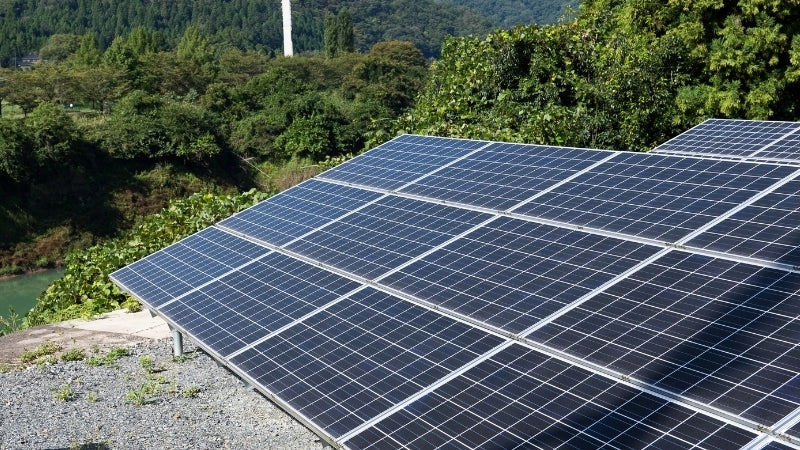
Assessing Household Electricity Consumption: Translating daily electricity usage into kWh and peak kW.
Accurate load assessment is fundamental to any off grid home solar system. The first step is a detailed power audit: measure or estimate the power consumption of lighting, cooling, water pumps, entertainment equipment, kitchen appliances, space heating/cooling, hot water supply, and chargers. Use metered data whenever possible; otherwise, refer to the equipment’s rated power and a conservative duty cycle.
To calculate daily energy consumption, multiply each device’s power by its estimated hours of use. Then, calculate the sum of the power of all loads running simultaneously during peak hours to determine the peak power. Be sure not to overlook starting currents; motors and compressors typically require 2-6 times their rated current during startup, so the inverter’s surge capacity must be sufficient to handle this. Also, consider future growth. Many households increase their electrical load over time. Providing ample inverter capacity and leaving room for expansion in the battery and PV budget can avoid costly retrofits later.
Inverter Selection and System Voltage for Off Grid Home Solar Systems
The inverter is the core component of an off grid home solar system and determines which loads the home can run. When choosing an inverter, consider both its continuous power and surge power to handle the inrush current from motor starts and component startups. For small homes, an inverter with a constant power of 3-5 kW and a surge power of 6-10 kVA may be sufficient; larger homes may require a 6-12 kW inverter or a multi-inverter parallel system.
Select the appropriate system voltage based on power requirements. Low-power systems (<2–3 kW) typically use 12V or 24V, but high current at low voltage requires thicker cables, increasing losses. For typical off-grid homes beyond small cabins, 48V systems are standard because they can efficiently transmit higher power with reasonable conductor sizes.
In inverter selection, pure sine wave inverters are crucial for sensitive electronics and motors. Hybrid inverters combine the functions of an inverter and charge controller and may support AC coupling to a backup generator or grid connection for enhanced future flexibility. Also, consider the inverter’s efficiency and low-load performance. Simply put, when choosing an inverter, select a model with surge-current capability based on the expected maximum continuous load.
Solar Array Sizing Considerations
When choosing a power rating, you also need to determine the capacity of the photovoltaic array for your off grid home solar systems. This requires converting your daily electricity needs into installed peak power, while also considering site climate and system losses. The basic idea is to estimate the minimum photovoltaic power by dividing the daily required photovoltaic generation by the average peak sun hours in the worst month, and then increasing this value based on derating factors.
The rated power of the modules determines how many modules you need to install. For example, if your off-grid solar system requires 10 kWh of electricity per day, and the peak sun hours (PSH) in the worst month are 3 hours, then you need at least 3.3 kW of photovoltaic modules; after applying derating factors, you may need to install 4–5 kW of photovoltaic modules. To ensure reliability during seasonal low-light months, use conservative data from the worst month, rather than annual averages.
Pay attention to the panel orientation, tilt angle, and row spacing to avoid self-shading. East-west orientation can increase power generation in the morning and evening, but may make array installation more complex. For roofs with limited area, high-efficiency panels should be chosen to maximize power generation per unit area. Finally, match the open-circuit voltage and maximum power point voltage range of the photovoltaic cells to the MPPT charge controller and system voltage. Ensure that the MPPT controller can accept the photovoltaic array voltage under low-temperature conditions and provide the required charging current to the battery at the system voltage.
Battery Capacity and Power Rating
Battery capacity selection is critical to the success of many off-grid projects. For off grid home solar systems, the battery capacity must meet the set number of days of autonomous operation, i.e., the number of consecutive low-light days the system can operate without charging. Typical design targets range from 1-3 days of autonomous operation for mild climates and installations primarily for backup power, to 5-7 days or even longer for very remote residences or areas with frequent cloudy days.
The formula for calculating the required usable battery capacity is: daily critical electricity consumption × days of autonomy × safety margin. Then, select a suitable nominal battery capacity based on the allowable depth of discharge for the battery chemistry. For example, if a household needs 6 kWh of electricity per day, desires 3 days of autonomy, and uses lithium iron phosphate batteries with a 90% depth of discharge, after accounting for efficiency losses, the target nominal battery capacity would be approximately 20 kWh.
The battery’s power rating must also be considered. The battery must be able to meet the inverter’s surge current and continuous peak demand without exceeding its C-rate. In practice, parallel battery modules and a suitable BMS design can accommodate both high energy storage and high discharge power.
Choosing the Right Power Rating for a Reliable Off Grid Solar System
Selecting the optimal power rating for an off grid home solar system requires a careful balance between household energy consumption, peak load demands, and local solar resources. By accurately assessing daily kilowatt-hour needs, selecting an inverter capable of handling peak power, and designing a battery bank with sufficient autonomy, homeowners can achieve reliable, sustainable off-grid power. Appropriate solar array sizing, panel orientation, and hybrid charging strategies can further enhance system resilience, ensuring a continuous power supply to the home even during cloudy days.