
Tag Archive for: micro inverter

How can the power rating (500W-700W) of a micro inverter be matched with the capacity of a solar panel?

A customer who installed a 6kW solar system with 15 x 400W solar panels and a 500W micro inverter thought this would be sufficient, but by the end of the year, he had lost nearly $1,200 in potential energy savings. Why? Due to intense sunlight, his 400W solar panels frequently exceeded 450W in peak power, but the 500W inverter cut off 12% of that excess power, wasting it entirely. This situation is not uncommon. When choosing a micro inverter, it’s crucial to balance the capacity of the DC solar panels, the micro inverter’s rated power, and the actual conditions.

Why isn’t “good enough” a good enough solution for micro inverter power matching?

Below, we’ll use PowerDream micro inverters as an example. PowerDream micro inverters have a rated power of 500W-700W. A mismatch between the power of the micro inverters and the capacity of the solar panels can lead to two costly problems—power clipping or underutilization. Both of these scenarios are unacceptable for residential or small business users:

When power clipping occurs, the excess DC power generated by the solar panel exceeds the AC power that the micro inverter can convert, resulting in wasted energy. A 400W solar panel paired with a 500W inverter may seem safe, but in strong sunlight, the panel’s actual power output often exceeds its rated capacity.

Furthermore, underutilization occurs; a 700W micro inverter paired with a 300W solar panel is wasteful. The inverter has higher initial costs, slightly higher standby power consumption, and never operates at optimal efficiency. This will result in unnecessary expenses after 25 years. Simultaneously, overworked microinverters generate more heat, shortening their lifespan by 20% to 30%. If you frequently push a 500W inverter to handle 550W loads, you will cause it to fail several years before the warranty expires.
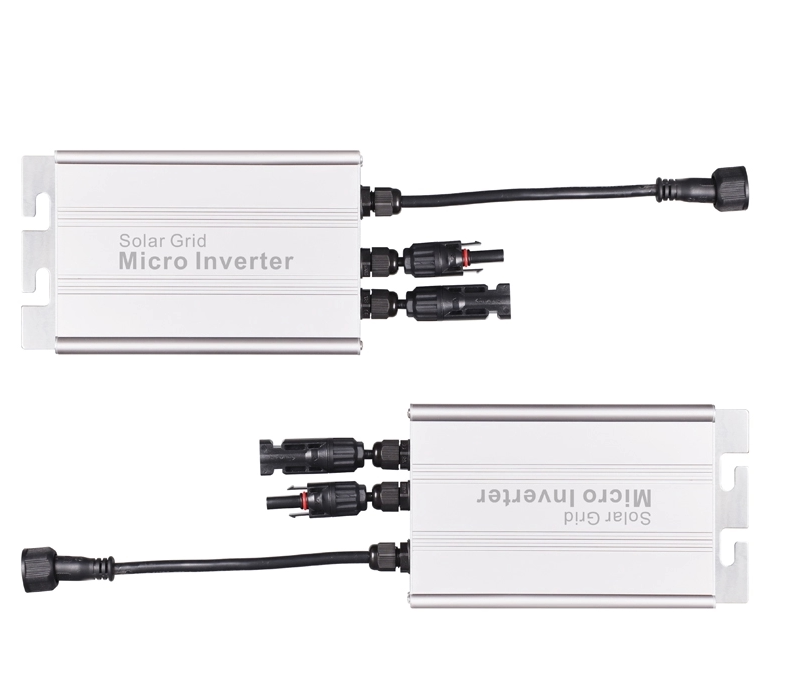
microinverter power matching

Relationship between 500W-700W Micro inverter and Solar Panels

The 500W-700W micro inverter series is designed for residential and small commercial solar systems and can be used with the most common solar panels currently available (350W-600W). The following is a comparison of rated power and panel capacity:

500W Microinverter: Suitable for 350W-450W solar panels. With a DC/AC ratio between 0.7 (350W panel) and 0.9 (450W panel), it is safe, efficient, and ideal for areas with moderate sunlight. A 400W panel paired with a 500W inverter avoids clipping distortion in most climates and fully utilizes the inverter’s capacity.

600W Microinverter: The most versatile option, compatible with 400W to 550W solar panels. The power ratio ranges from 0.67 (400W) to 0.92 (550W), suitable for all climate conditions in the United States. In sunny areas, a 500W solar panel paired with a 600W inverter (power ratio 0.83) can handle power overload without clipping.

700W Microinverter: Designed for large-capacity solar panels (500W-600W) or small solar panel arrays. A 550W solar panel paired with a 700W inverter lets you maximize output in commercial awnings or large residential systems where space is limited.
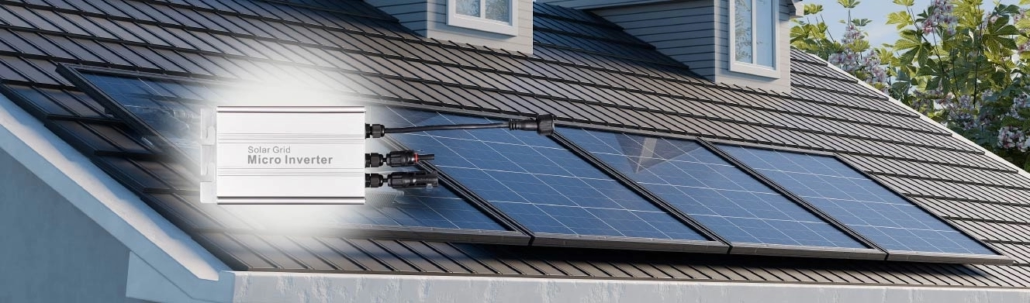
Relationship between 500W-700W Micro inverter and Solar Panels

Checking Matching with Solar Panels

Matching a 500W-700W micro inverter with solar panels is straightforward, following a few simple steps. Check the panel’s specification sheet to find and list the DC capacity of the solar panel. Calculate the target DC/AC ratio; a typical target value is 1.0-1.3. For example, a 450W solar panel requires an inverter with an AC rated power of 346W-450W. In the 500W-700W range, the closest microinverter is 500W (a ratio of 0.9—close enough, as the panel’s output will decrease under real-world conditions).

If you live in a hot climate where solar panel output is 5-10% lower, adjust the ratio to 1.2-1.3. If you live in a cool, sunny area where manufacturers rate solar panels higher, you can set it to 1.0–1.1. Next, check for voltage compatibility. Micro inverters have a DC input voltage range of 20V to 50V. Ensure your solar panel’s Voc is within this range. PowerDream’s 500W-700W microinverters operate over an 18V-55V voltage range and are compatible with 95% of residential solar panels.

Solar Panels 9-6

Practical Application Scenarios for Different Power Capacities

Scenario 1: In scenarios with moderate sunlight and low temperatures, a 400W solar panel can be paired with a PowerDream 500W micro inverter. The DC/AC power ratio is 400/500 = 0.8. Due to the low temperature, the actual power of the solar panel can reach 430W—the power ratio becomes 0.86, and there is no clipping.

Scenario 2: In strong sunlight and high temperatures (e.g., Arizona residences): A 450W solar panel (open-circuit voltage Voc = 38V) is paired with a PowerDream 600W micro inverter. The DC/AC ratio is 450/600 = 0.75. High temperatures cause the panel power to drop to 410W, and the ratio becomes 0.68. In the cooler mornings and evenings, the panel power increases to 470W, the ratio recovers to 0.78, and there is no clipping.

Scenario 3: Small Commercial Awning (Limited Space): Two 320W solar panels (parallel, total DC power 320W). Paired with a PowerDream 700W micro inverter. DC/AC ratio = 320 / 700 = 0.46. However, the parallel wiring maintains a low open-circuit voltage (Voc = 30V), allowing the inverter to handle the load efficiently.

PowerDream Solar Micro inverters—Designed for Perfect Matching

PowerDream’s 500W, 600W, and 700W micro inverters are easy to match and efficient. They all feature a wide input voltage range (18V-55V) and are compatible with 350W-600W panels from all major brands. They also feature intelligent overload protection. Our solar micro inverters automatically adjust to handle panel overloads, reducing clipping distortion by 80% compared to standard models. If a 450W panel actually outputs 500W, the inverter won’t clip; instead, it will increase efficiency to convert more power. Additionally, you can pair our 600W microinverter with 1–2 solar panels (connected in parallel), making it ideal for irregularly sized roofs or expansion projects. PowerDream’s engineering team has tested over 100 panel-inverter combinations, achieving 99.2% compatibility with current residential panels. We designed them for easy matching.

Maximum Energy, Minimal Waste

Matching a micro inverter to the capacity of your solar panels is key to understanding the DC/AC ratio, considering local climate conditions, and choosing a flexible inverter. By following the steps in this guide, you’ll avoid power clipping, underutilization, and premature inverter failure, saving on energy costs. PowerDream’s 500W-700W microinverters are designed to make matching easy and convenient. Whether you are a homeowner installing a 5kW system or a business owner with a small awning, it can be perfectly matched with today’s most common solar panels for maximum efficiency.
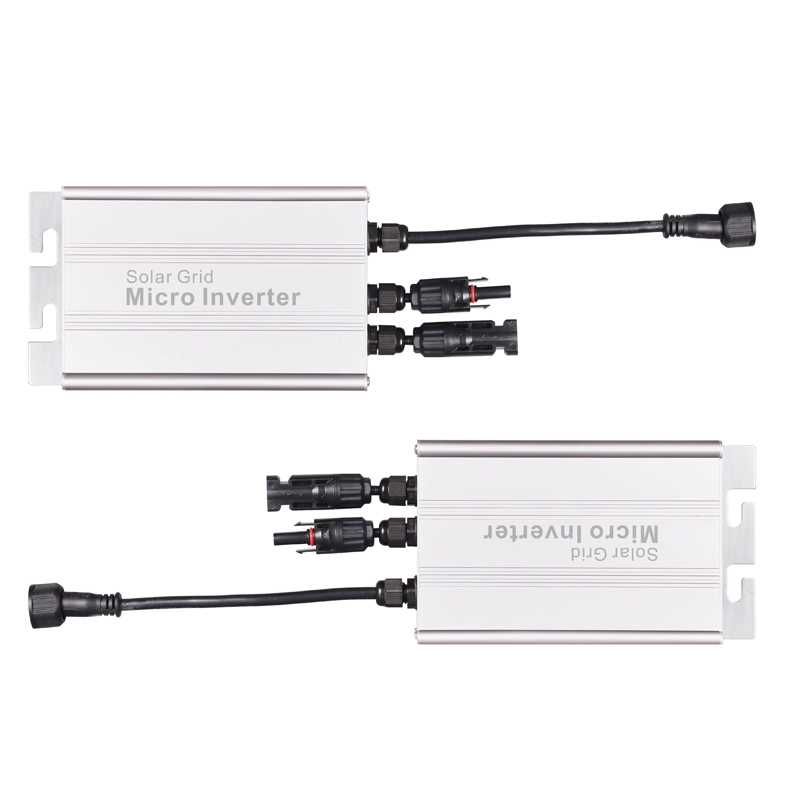
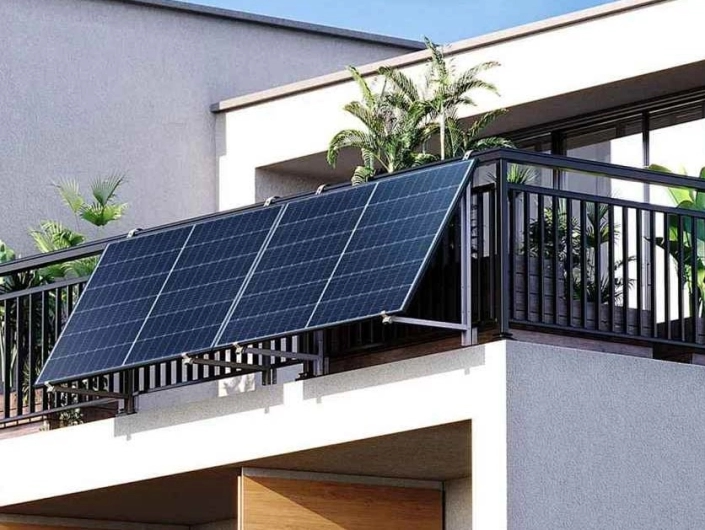
How do solar micro inverter affect the energy yield of a system?

A solar micro inverter transforms energy production from the first rays of daylight to the last kilowatt-hour of output at dusk. Micro inverters perform two key tasks at the module level: extracting the maximum available power from each PV module through MPPT and converting DC power to grid-compatible AC power near module power. Because these functions are performed at the module level, microinverters impact not only instantaneous conversion efficiency but also annual energy production, system reliability, and the economics of the array. Specifically, PowerDream’s micro inverters feature an ultra-wide MPPT voltage range (18–55V) and achieve peak efficiencies of 93%, CEC efficiencies of 92%, and MPPT efficiencies of 99%, maximizing solar energy harvesting.

Solar micro inverters play a fundamental role in energy conversion and module-level optimization.

Solar micro inverter shifts intelligence and conversion functions to each PV module, changing the rules of energy conversion. Unlike centralized inverters that rely on string-level MPPT, microinverters assign an MPPT to each module, independently optimizing its operating point. As a result, even if module output varies due to orientation, contamination, manufacturing tolerances, or partial shading, the overall system can harvest more energy. For this reason, microinverters often outperform string inverters in non-ideal installation environments. Furthermore, on grid micro inverters, in particular, tightly integrate each module’s MPPT performance with DC/AC conversion. This architecture minimizes the Impact of poor performance from a single module on neighboring modules, allowing you to gain incremental energy while mitigating performance risks.

Solar micro inverters play a fundamental role in energy conversion and module-level optimization.

Solar Micro inverter MPPT Voltage Range and Low-Light Start Advantages

To maximize system energy harvesting, PowerDream’s solar micro inverters feature an ultra-wide MPPT voltage range (18-55V). First, the lower startup threshold (18V) allows the solar micro inverter to begin extracting usable power at lower irradiance levels, such as at dawn, dusk, and on overcast days. Second, the higher threshold (55V) supports longer PV strings and a higher number of input modules per microinverter in specific hybrid or paired configurations, reducing wiring and BOS costs.

Why is an 18V startup voltage so important? When irradiance is low, module voltage drops. During these low-voltage periods, the module voltage sits idle, compared to 30V or higher, missing out on the incremental energy that could have been provided during these hours. At the same time, the 55V high-voltage capability frees designers to use strings with more modules in specific system configurations, thereby reducing parallel wiring, plumbing, and labor costs.

The Impact of 99% MPPT Tracking Efficiency on Marginal Revenue

MPPT tracking efficiency determines how closely an inverter extracts the theoretical maximum available power from a solar panel at any given moment. PowerDream’s solar micro inverters offer 99% MPPT tracking efficiency, minimizing energy losses at the point of capture. Compare a microinverter with 97% MPPT efficiency and 92% inverter conversion efficiency to a microinverter with 99% MPPT and 93% peak conversion. The former delivers 5,820 kWh of AC energy. The conversion efficiency is 5,524.2 kW. The latter, on the other hand, produces 5,940 kWh. The difference and relative benefit represent an annual increase of 169.8 kWh, or approximately 3.17%. These data indicate that minor improvements in module-level energy capture combined with modest increases in conversion efficiency can lead to several percentage points of annual energy production growth.

The Impact of 99% MPPT Tracking Efficiency on Marginal Revenue

Conversion Efficiency—Peak Efficiency vs. CEC Efficiency and Their Practical Impact

Conversion efficiency determines how much of the collected DC power can be converted into usable AC power and fed into the grid. Two commonly used metrics are peak efficiency and CEC efficiency. PowerDream’s micro inverter achieves a peak efficiency of 93% and a CEC efficiency of 92%, both demonstrating top-tier conversion performance within the module-level electronics. As previously mentioned, increasing the conversion efficiency from 92% to 93%, combined with a higher MPPT capture rate, can further enhance AC power production. Secondly, weighted metrics like CEC better reflect typical everyday performance because they account for a wide range of operating conditions. High CEC efficiency means the inverter performs well under typical irradiance and temperature cycles, which are key to its lifetime output.

String Length, Cabling Costs, and System Architecture Advantages

The ultra-wide upper MPPT voltage range of solar micro inverters has a tangible impact on the economics of system cabling and overall energy yield. Because the inverter can operate efficiently at higher DC input voltages, designers can configure longer PV strings or connect multiple modules in series to create hybrid configurations. Longer strings reduce the number of parallel connections, shorten wiring lengths, and reduce installation labor and material costs. Furthermore, shorter wiring reduces resistive (I²R) losses, thereby increasing energy output.

Every meter of copper wire reduces resistive losses, especially at higher currents. While the specific value depends on cable size and site geometry, the architectural flexibility afforded by the higher permissible string voltage is significant. Combined with the micro inverter’s module-level optimization and high MPPT efficiency, the net effect is increased AC output power per watt of installed power.

Greater Energy Yield for Homes

Solar micro inverters impact energy output through multiple interlocking mechanisms: module-level MPPT optimization, low-light startup, and an extended MPPT window, improved MPPT tracking efficiency, high conversion efficiency (93% peak / 92% CEC), and architectural flexibility that reduces BOS losses. These features work together to achieve compound gains in AC output—gains that are both measurable and substantial, accumulating over the entire installation and decades of operation.

Micro inverter FAQs

Q1. How much additional energy does a solar micro inverter with 99% MPPT deliver compared to a typical 97% MPPT?
A1: Compared to 97% MPPT, the increase is approximately 3.17%. The specific results will vary by site, but how does a small percentage improvement add up over time?

Q2. Does an 18V startup voltage really matter in my location? A2: Yes, especially if your location has a long twilight period, frequent cloudy days, or you want to capture marginal energy at dawn and dusk. An 18V startup voltage allows the microinverter to start generating power earlier and stop generating power later in low-light conditions.

Q3. Which is more important, peak efficiency or CEC efficiency?
A3: CEC efficiency is generally more representative of actual long-term performance because it accounts for variations in irradiance and temperature. Peak efficiency represents the absolute maximum under ideal conditions, whereas CEC efficiency more accurately reflects daily output.