Can lithium ion solar battery be used with any type of solar inverter?
Lithium ion solar battery represent one of the most efficient methods for storing solar energy; however, they are not simply “plug-and-play” devices. If a battery is incompatible with the inverters currently available on the market, it cannot be utilized. In practical application, a solar battery must precisely match the inverter’s voltage window, charging strategy, communication protocols, and safety logic. While some combinations of inverters and solar batteries work together in perfect harmony, others may require additional configuration to function. Still, you should absolutely never pair some components together. A lithium battery system only works properly when the battery management hardware matches the power electronics—and you typically ensure that compatibility by using certified batteries, setting up proper communication links, and clearly defining the operating parameters.
What Does “Compatibility” Mean for a Lithium-ion Solar Battery?
Lithium ion solar batteries can only be paired with inverters specifically designed to accommodate their unique electrical and control characteristics. A solar battery is not merely a simple energy storage device; rather, it is an integral component of a comprehensive, controlled energy system. Any lithium-ion solar battery intended for use with a specific inverter must comply with relevant local standards, incorporate inherent safety features, use a compatible battery management system (BMS), and maintain an operating voltage within the range permitted by the inverter.
Although many products are compatible with common lead-acid batteries, users intending to use lithium batteries or batteries based on other chemical chemistries must consult the relevant technical documentation and operating guidelines. This is because engineers need to establish a strong communication link between the battery’s management hardware and the power electronics. For the average homeowner, this implies that when selecting a system, the primary question should never be, “Is this a lithium battery?” Instead, the critical questions are, “Is this specific lithium battery certified? Has it been configured for use with this particular inverter model? Do its electrical characteristics precisely match those of the inverter?” If the answers to these questions remain unclear, the system should, without exception, be treated as “incompatible” until explicitly verified by manufacturer-issued documentation.

Inverter Type Matters
Common types of inverters include PV inverters, battery inverters, hybrid inverters, and off grid inverters. The compatibility of a lithium ion solar battery with a given system depends largely on the inverter’s specific topology. A standard PV inverter converts the DC electricity generated by solar panels into AC electricity for household use or the power grid; a battery inverter, conversely, converts the DC electricity stored in a battery back into AC electricity. A hybrid inverter integrates both functions into a single device, simultaneously handling PV and battery conversion. This distinction is crucial, as a standalone grid-tied PV inverter is not the same as a controller designed to support battery-powered or hybrid systems.
This means you can’t just connect lithium-ion solar batteries to any inverter and expect them to work properly. If an inverter is strictly a PV inverter, it may lack the specific battery-charging logic, communication ports, or voltage-control capabilities required by solar batteries. In contrast, engineers design off-grid and hybrid inverters to handle energy storage, battery charging, and grid interactions. A hybrid inverter, specifically, combines the functionalities of both a standard PV inverter and a battery inverter into a single unit.
Four Compatibility Checks
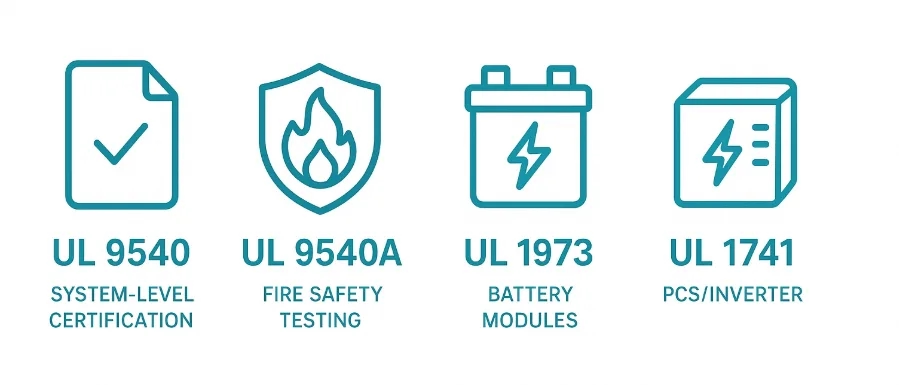
Before connecting a lithium ion solar battery to any inverter, four checks are absolutely critical: voltage range, charge and discharge current, battery safety certifications, and communication compatibility. The battery must be intrinsically safe; its Battery Management System (BMS) must be compatible with the product; the battery’s voltage range must fall within the inverter’s permissible input range; and the battery voltage must never exceed the inverter’s maximum DC input voltage limit. These factors constitute the technical foundation of compatibility.
The same principles apply to solar batteries in real-world project installations. Excessively high voltage can damage the inverter; excessively low voltage may cause the inverter to shut down or refuse to charge; if the inverter cannot handle the current demands of the battery, charging may proceed too slowly, or the inverter may trigger a fault protection mode; finally, if the battery lacks the necessary certifications for the inverter’s operating environment, the manufacturer may refuse to provide installation support.

Battery Management Communication: Often the Deciding Factor
In lithium battery systems, the communication link between the inverter and the Battery Management System (BMS) is often the deciding factor in whether the system qualifies for technical support. This is because engineers need to establish a strong communication link between the battery’s management hardware and the power electronics. For lithium-ion solar batteries, this communication involves more than just exchanging status data. It also informs the inverter when to limit charging, when to cease charging, when temperatures are too high or too low, and when the battery has reached a safe charging state.
How to Select the Right Inverter for Lithium Ion Solar Battery?
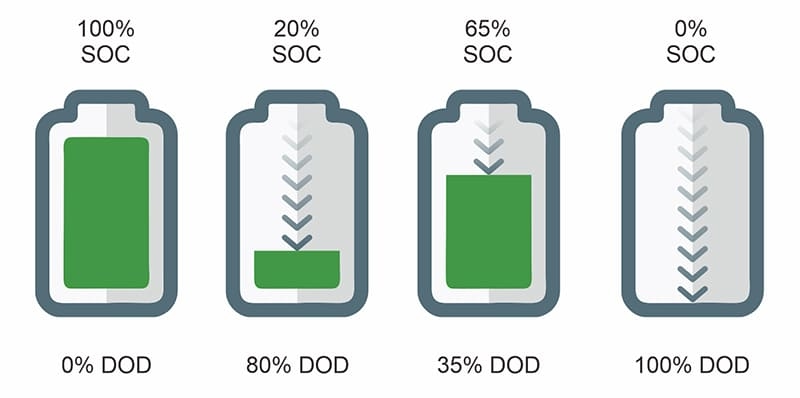
The most common compatibility issues stem from mismatched charging settings. Lithium ion solar batteries charge differently from lead-acid batteries. The inverter or charge controller must support the correct logic for constant current, constant voltage, and float charging; furthermore, in many lithium battery systems, a Battery Management System (BMS) dynamically regulates charging limits based on temperature, state of charge, and individual cell health. Technical documentation often explicitly states that the BMS in a lithium-ion battery dynamically adjusts limit values, such as the charging ceiling, based on component temperature, state of charge, and the condition of individual cells.
Consequently, a solar battery must never be connected to an inverter with a fixed charging profile or a voltage range that does not align with the battery’s specifications. The battery’s operating voltage must fall entirely within the inverter’s permissible input range. It must not exceed the inverter’s maximum allowable DC input voltage. For buyers, the decision is pretty straightforward: you need to choose an inverter that matches the battery’s voltage, current, and communication protocols; otherwise, don’t deploy the system at all.

Pairing the Right Inverter with Lithium Ion Battery
True compatibility between a lithium-ion solar battery and an inverter hinges on several key factors, including voltage matching, charge/discharge parameters, communication protocols, and overall system design. Neglecting any of these factors can lead to diminished performance, system instability, or even safety hazards. If you choose lithium-ion solar batteries that your inverter officially supports or that are technically compatible, you can ensure smooth day-to-day operation, better energy management, and a longer service life. A well-matched combination of solar batteries and inverters fulfills every user’s expectations: efficient charging, stable power output, and reliable system operation under real-world conditions. By adhering to a rigorous selection process and relying on verified compatibility data, users can confidently build a solar energy storage system that is safe, scalable, and built to last.