How to Verify the Quality of Lithium Ion Solar Battery?
As a lithium ion solar battery supplier with years of experience, we have encountered a wide range of lithium ion solar battery quality-related failures—from residential off-grid homes to commercial solar projects. 68% of lithium-ion solar battery failures stem from uncertified production or exaggerated cycle-life claims, and 42% of users lose thousands of dollars due to poor battery quality, resulting in downtime, repairs, or replacements. This guide will focus on two of the most critical checks: CE/UL certification and cycle life verification, explaining their importance, implementation methods, auxiliary quality tests, and PowerDream’s rigorous quality control processes.
Safety Compliance Certification for the Lithium ion Solar Battery
Certification is the primary indicator that a lithium ion solar battery has passed independent safety and performance testing. However, not all certifications are equally valid.
Key Certification Meanings:
CE (Europe): Indicates compliance with EU safety and electromagnetic compatibility requirements. For batteries, the CE mark indicates that the manufacturer has met the relevant EU directives.
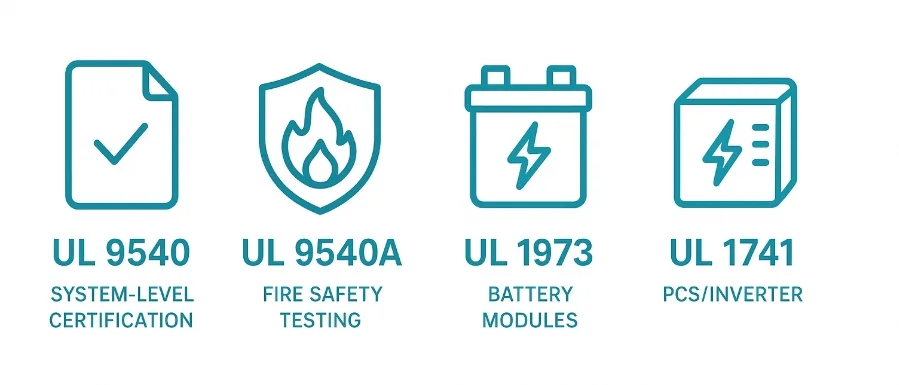
UL (North America): Crucial for the United States and Canada. UL certification covers multiple battery standards: UL 1642 (cells), UL 1973 (batteries for stationary applications), and UL 9540/UL 9540A (energy storage systems and fire resistance testing). UL certification typically includes factory inspections and ongoing compliance checks.
IEC Standards: International standards such as IEC 62619, IEC 62133, and IEC 62933 are crucial in many markets.
UN38.3: A necessary condition for the transportation of lithium batteries. Passing the UN38.3 test means the battery can withstand various risks commonly encountered during transportation (altitude, temperature, vibration, shock).
TÜV/CE, RoHS, REACH: Additional markings for chemical compliance and restricted substances may be related to environmental and import regulations.
How to verify certificates? You can request test reports and certificates with laboratory markings from lithium-ion solar battery suppliers. Authoritative certificates should include the issuing laboratory name, report number, and test date. Verification with the issuing body is also possible. Many laboratories list issued certificates in searchable databases. For UL certification, use the UL online certification database to verify your product or component’s certification information.
Additionally, check the certification scope and model. CE or UL certificates should list the exact part number, rated capacity, and configuration. If a certificate only covers the “battery type” and not the assembled module, it is incomplete for an installed system.
Cycle Life Testing of the Lithium ion Solar Battery
Cycle life determines long-term economic benefits. When suppliers claim “10,000 cycles,” they usually mean “X cycles to achieve Y% capacity under specific conditions.” Therefore, always carefully read the terms and conditions and request concrete evidence from the supplier.
Key Concepts of Cycle Life
Cycle Count: One complete discharge and charge cycle. Manufacturers typically report the number of cycles to reach 80% of rated capacity, which is the industry benchmark.
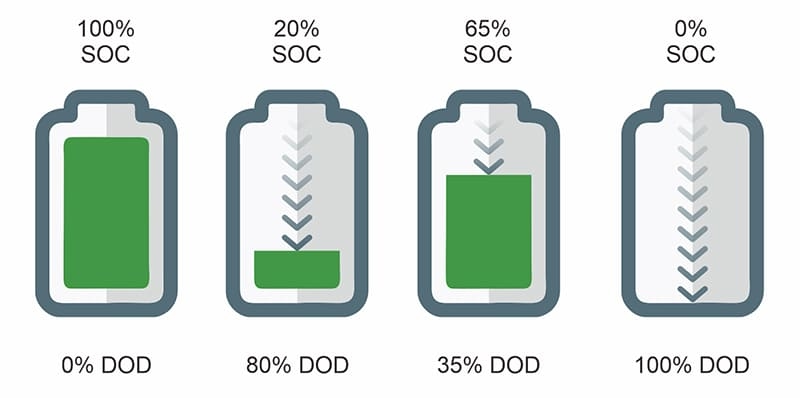
Depth of Discharge (DoD): The depth of discharge of the battery per cycle. 100% depth of discharge degrades the battery faster than 80% or 50% does. Cycle life is closely related to depth of discharge.
C-rate: Refers to the charging/discharging rate. A higher C-rate increases battery stress and shortens cycle life. Typical household battery specifications use a C-rate range of 0.2C to 1C.
Temperature: High temperatures accelerate capacity decay. Cycle life is usually determined under ambient testing temperatures.
How to interpret claims representing cycle life? First, we can look at the test conditions. A specification like “10,000 cycles” is meaningless without information such as the depth of damage (DoD), the cycle rate (C-rate), and the temperature. Ask for details of the test protocol, such as: “10,000 cycles to 80% DoD at 25°C, in 0.5°C increments.” Some reputable suppliers provide cycle-to-remaining-capacity curves that show how capacity decays over time. Examine where and under what conditions the 80% capacity degradation point occurs. Also, consider the chemical composition: lithium iron phosphate (LFP, LiFePO₄) typically offers a longer cycle life and better heat dissipation.
Supplementary Quality Testing for Lithium ion Solar Batteries
CE/UL certification and cycle life are the foundation of quality verification, but not the whole story. The following three supplementary tests ensure your lithium ion solar batteries operate reliably in a real-world solar system:
1. Capacity Retention Test
Capacity retention measures how much of a battery’s initial capacity it retains after many years of use. A high-quality lithium-ion solar cell should retain more than 80% of its rated capacity after reaching its rated cycle life. Therefore, you can request annual capacity retention data—PowerDream batteries retain 90% capacity after 1 year of use, 85% after 5 years, and 82% after 10 years.
2. Battery Management System Quality
The BMS is the “brain” of a lithium ion solar battery, responsible for regulating charging and discharging, preventing overheating, and balancing battery voltage. A poor-quality BMS can cause premature battery failure. Check the following:
Cell Balancing: Ensures all cells in the battery pack charge and discharge evenly (preventing weaker cells from dragging down overall performance). Thermal Monitoring: Shuts down the battery when the temperature exceeds 140°F (60°C) (crucial in hot climates). Overcharge Protection: Stops charging when the voltage exceeds the safe range (prevents battery swelling and fire). PowerDream tests each BMS to ensure it meets UL 1973 standards.
3. Temperature Performance
Lithium-ion solar cells perform poorly at extreme temperatures—unless specifically designed for this. Request temperature performance data:
Cold Weather: High-quality batteries retain over 80% of their capacity at 32°F (0°C) (a standard winter temperature). Inferior batteries will drop to 50% capacity at this temperature. Hot Weather: Retains over 85% of its capacity at 104°F (40°C) (a common summer temperature). Our batteries employ a thermal management system that maintains performance at temperatures up to 140°F (60°C).
PowerDream’s Four-Step Quality Validation Process
PowerDream’s lithium ion solar battery quality verification is conducted at every stage of production. Furthermore, our four-step process ensures that every cell meets CE/UL standards, achieves its expected cycle life, and operates reliably and stably in real-world environments. As a result, 99% of our customers have not reported any quality issues.
Step 1: Raw Material Testing
We only source Grade A lithium ion batteries and test them for the following: Capacity consistency. Cycle life (batteries undergo 500 cycle tests to ensure they meet our 10,000-cycle battery pack rating). Safety (batteries undergo short-circuit and overcharge tests to ensure they do not overheat).
Step 2: Battery Management System (BMS) Integration and Testing
We perform cell balancing tests to ensure all cells charge and discharge evenly. Then, we conduct thermal monitoring tests to assess their response under extreme temperatures. Next, fault detection is performed to ensure the BMS shuts down the battery in case of overcharge/short circuit. Step 3: Cycle Life and Capacity Testing. Each batch of lithium-ion solar cells undergoes 1000 cycle tests to verify capacity retention.
Step 4: Safety and Compliance Testing.
We conduct CE (IEC 62133) and UL 1973 compliance testing on each lithium ion battery to ensure thermal stability, shock resistance, and overcharge protection. Step 5: Final Inspection and Documentation. Each lithium-ion solar cell undergoes visual inspection and final capacity testing. We also provide a comprehensive quality report for each order.

Field Performance, Commissioning, and Continuous Monitoring.
Quality verification continues after purchase. Proper commissioning and monitoring ensure the system operates as expected under real-world conditions.
Commissioning checks require charge-discharge testing of the installed system to verify that its initial usable capacity matches the nameplate reading. A practical acceptance test might involve controlled 0.5 °C discharge under specific conditions. Additionally, a battery management system (BMS) and communication verification are required to ensure the system can report state of charge (SOC), state of health (SOH), temperature, and alarm information, and store logs for warranty verification.
Simultaneously, thermal analysis is performed using thermal imaging technology to detect hot spots in battery cells, connection points, and buses during commissioning. Continuous monitoring and remote diagnostics are also necessary; PowerDream provides a remote SOH control panel and issues alerts when battery aging exceeds expectations.
Certification and Cycle Life are Important Benchmarks
The performance of lithium ion solar batteries depends on their quality. Quality verification is not complicated—it boils down to two indispensable checks: CE/UL certification ensures safety and compliance, and cycle life verification ensures long-term durability. Furthermore, the quality, temperature performance, and manufacturing standards of the battery management system (BMS) must be checked to avoid the costly mistakes that plague 68% of solar energy users.