Market trends and technological advancements in the home solar energy system
In many countries and regions today, rooftops are more than just shelter from the elements—they also collect energy, reduce utility bills, and stabilize the power grid. Over the past decade, the home solar energy system has transformed from a niche green option to a mainstream home investment. Data shows that falling panel costs, improved energy storage economics, and more intelligent electrification are driving this adoption. As a home solar system manufacturer, I see three forces shaping this market: economic, technological, and policy factors.
Market Adoption and Economic Drivers of Home Solar Energy System
Driven by falling costs, rising retail electricity prices, and increased public awareness of energy independence, the adoption of home solar energy systems continues to grow globally and across the United States. Key market drivers include: declining component prices, with monocrystalline PERC and N-type technologies lowering the cost per watt; improved balance-of-system efficiency; and financing innovations such as solar loans, power purchase agreements (PPAs), and leases, which reduce the barrier to entry for upfront costs. Furthermore, utility rate structures, particularly time-of-use (TOU) pricing, increase the value of solar-plus-storage systems by allowing homeowners to shift generation to peak pricing periods. Meanwhile, corporate and municipal commitments to decarbonization, along with local incentives, continue to stimulate residential solar system deployment.
From a manufacturer’s perspective, economies of scale and standardized designs reduce installation costs, while differentiated services—warranties, performance guarantees, and monitoring—become competitive advantages. For homeowners, the result is clear: in many US markets, an appropriately sized and installed home solar system can typically pay for itself within 5-10 years, while also increasing property value and reducing reliance on the grid.
Photovoltaic Module Innovations and Panel Efficiency Trends in the Home Solar Energy System
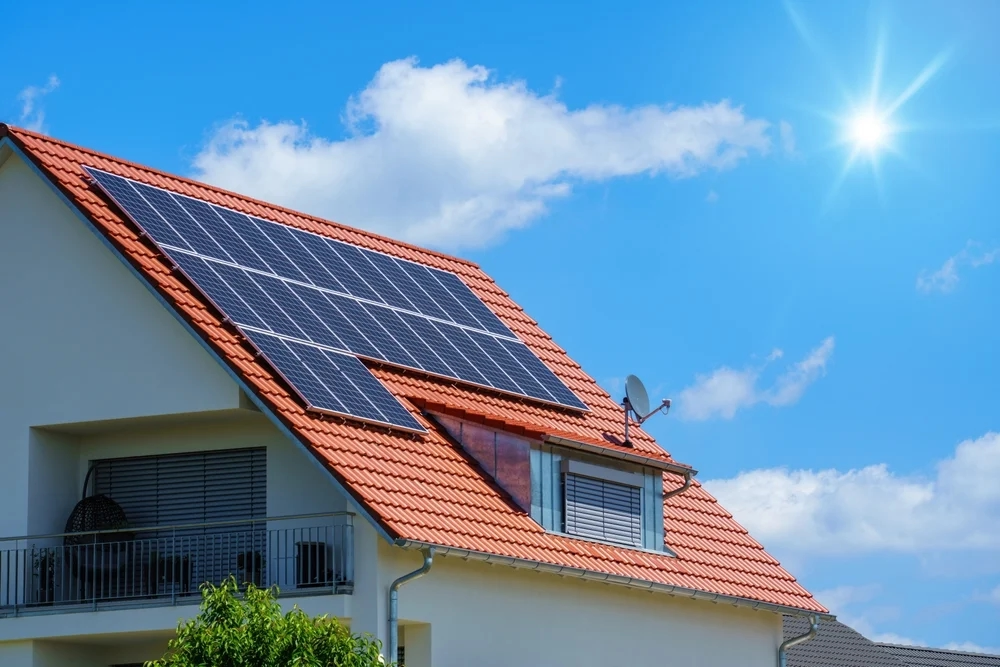
One of the most significant technological advancements in home solar systems is the rapid improvement in photovoltaic module efficiency and reliability. Monocrystalline technologies, including PERC, bifacial, and heterojunction (HJT) cells, have increased module efficiency, while many high-end panels maintain long-term degradation rates of less than 0.5% per year. New N-type cell technology and TOPCon structures further reduce recombination losses and improve module efficiency. Bifacial modules and frameless designs can collect reflected light, resulting in slightly higher energy generation per unit of rated power on specific roof types.
For homeowners, higher-efficiency panels mean fewer components are needed for the same capacity, resulting in less roof space occupied—which is especially important for roofs with limited area or shading. Furthermore, some manufacturers of home energy solar systems are improving reliability by enhancing encapsulation materials and using thicker glass to reduce microcracks and potential-induced degradation. These component-level improvements allow designers to deliver greater system capacity within the same roof area, thus increasing annual electricity generation.
Energy Storage and Battery Integration Trends
The inclusion of home energy storage is transforming the value proposition of home solar systems. Lithium-ion batteries remain the dominant technology for home energy storage due to their high energy density, decreasing costs, and reliable performance.
Recent trends include integrated inverter-battery systems for simplified installation; AC-coupled and DC-coupled storage topologies suitable for retrofit and new-construction projects, respectively; and increased use of secondary battery technologies to achieve circular-economy benefits. Improvements in battery chemistry and economies of scale have reduced the cost per kilowatt-hour, making energy storage economically viable for many homeowners.
Energy storage enables self-consumption, backup power during outages, and time-of-use shifting to avoid expensive peak-hour electricity rates. Software also plays a crucial role, with intelligent energy management systems (EMS) optimizing charging and discharging times based on weather forecasts, electricity price signals, and user preferences. For homes in areas prone to fires or power outages, combining solar with battery backup power enhances system resilience. It can be a decisive factor in choosing a home solar system.
Inverters, Power Electronics, and Grid Interaction
Inverters and power electronics are critical to the performance of a home energy solar system and its interaction with the grid. Technological advancements are primarily evident in three areas:
1. Smarter grid-tied inverters capable of advanced functions such as voltage-reactive power support and fault ride-through; the application of microinverters and power optimizers; and integrated hybrid inverter architectures.
2. Grid-tied inverters support new utility projects and facilitate the widespread adoption of rooftop solar systems by providing reactive power support and frequency response. Microinverters and DC optimizers maximize energy harvesting efficiency on partially shaded or complex-roofed homes by independently managing each component. At the same time, initial purchase costs are higher, but they typically increase energy yield and simplify system expansion.
3. Hybrid inverters reduce the number of components in combined PV and battery storage systems and enable features such as stacked storage, flexible islanding operation, and firmware upgrades. For homeowners, choosing the exemplary inverter architecture depends on roof shape, shading conditions, storage plans, and desired grid services.
Smart Home Integration, Monitoring, and Digital Services
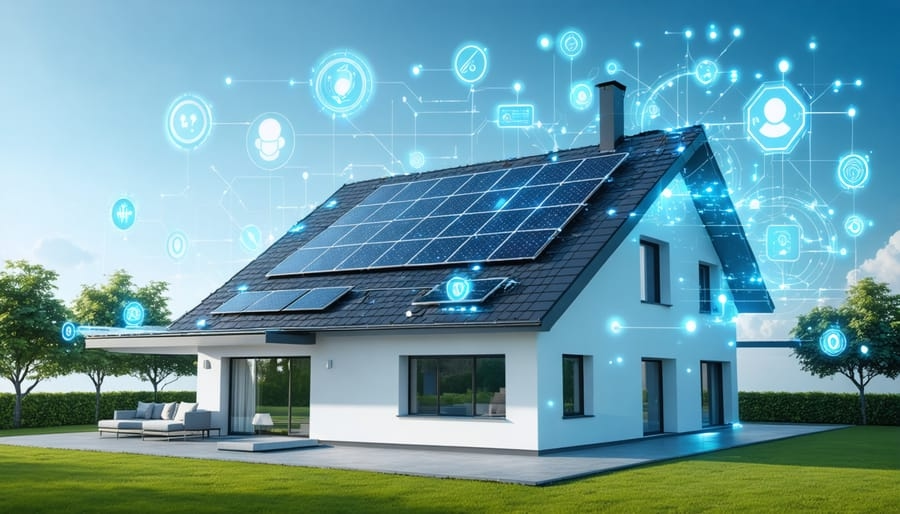
Home solar systems are increasingly integrated into the broader smart home ecosystem. Monitoring platforms now provide real-time generation, consumption, and battery level data, accessible via mobile apps and cloud dashboards. Beyond basic monitoring, innovative energy management platforms enable automated load shifting, EV charging coordination, and demand response participation, monetizing flexible loads. Data analytics and predictive maintenance utilize component-level data and weather forecasts to prevent failures and schedule cleaning.
Furthermore, software enables Virtual Power Plant (VPP) participation, where aggregated residential systems can provide grid services and receive incentives. For homeowners, these digital services mean convenience, reduced O&M costs, and potential additional revenue streams. Privacy, cybersecurity, and interoperability standards remain important considerations when deploying cloud-connected energy devices.
Installation Trends, Design Optimization, and Permitting Streamlining
Home solar system installation methods are evolving to increase energy yield and reduce soft costs. Standardized racking and pre-assembled system balance-of-system kits reduce rooftop labor time. As a result, there is a growing trend towards roof-integrated solar systems and low-profile rail systems that improve aesthetics and reduce wind loading. Additionally, site modeling tools, drone mapping, and 3D shading analysis simplify the design process and enable accurate energy yield estimates before construction.
In some regions, permitting and interconnection delays remain significant obstacles; however, digital permitting processes and streamlined standards are shortening installation times in some advanced cities. For retrofit projects, AC-coupled storage kits and microinverter solutions reduce complexity and avoid running DC wiring through the house. For designers, the focus remains on maximizing power generation per unit of roof area, optimizing string design to cope with shading, and minimizing interference with future expansion.
Future Trends in the Home Solar Energy Storage Industry
Home solar energy systems are becoming increasingly mature, evolving into a flexible and reliable home energy solution. Market trends show a growing adoption of home solar systems, driven by economic benefits and incentives, while technological advancements are enabling more efficient solar panels, integrated energy storage systems, smarter inverters, and higher-quality digital services.