

Modular off grid solar system vs Traditional Off Grid Systems: Scalability & Cost Comparison
A single 3kW inverter and a battery bank evolve into a 30kW microgrid five years later, powering multiple buildings—all without the need to dismantle the original equipment. This seamless scalability precisely highlights the advantage of a modular off grid solar system: users can stack small modules to expand capacity, increase redundancy, and mitigate the risk of over-investment. In contrast, engineers typically pre-design traditional off-grid systems for a specific capacity, which requires organizations to make a substantial upfront investment; as demand grows, they often must replace the systems prematurely or undertake costly retrofits. Consequently, we will analyze component architecture, deployment protocols, BOS differences, lifecycle costs, and practical expansion mechanisms. Additionally, I will quantify typical cost drivers and provide best practices for procurement and commissioning, offering you a clear, intuitive understanding of the distinctions between these two types of off-grid solar systems.
Architecture of Modular Off Grid Solar System: Interoperability and “Plug-and-Play” Expansion
Modular off grid solar systems consist of reusable modules that can operate independently or in concert. Typical modules include: standardized strings of PV panels, stackable 48V or 51.2V battery banks, inverter/charger modules capable of parallel operation, and a communication backbone. Engineers meticulously design each module to be electrically and mechanically interoperable, allowing them to add new modules with minimal reconfiguration.
Key Technical Advantages:
Phased Expansion: As demand grows, additional battery modules or PV strings can be added. This avoids upfront over-construction and mitigates financial risk.
Redundancy and Fault Tolerance: A parallel inverter architecture enables the system to withstand the failure of a single unit; replacing a faulty module is faster and causes less disruption than replacing a monolithic battery bank.
Standardized Commissioning: Repeatable commissioning procedures simplify training and reduce commissioning time, particularly across multiple sites.
From an electrical design perspective, modular systems rely on a clear bus architecture and communication protocols. For instance, vendors may employ a 48V DC battery bus and utilize an enslaver/agent configuration for inverter synchronization. Power distribution is coordinated via inverter firmware and BMS messaging. This design minimizes “single-point” upgrade efforts: to double available capacity, one needs to add matching battery modules and update the EMS settings, without dismantling and replacing the entire power system.
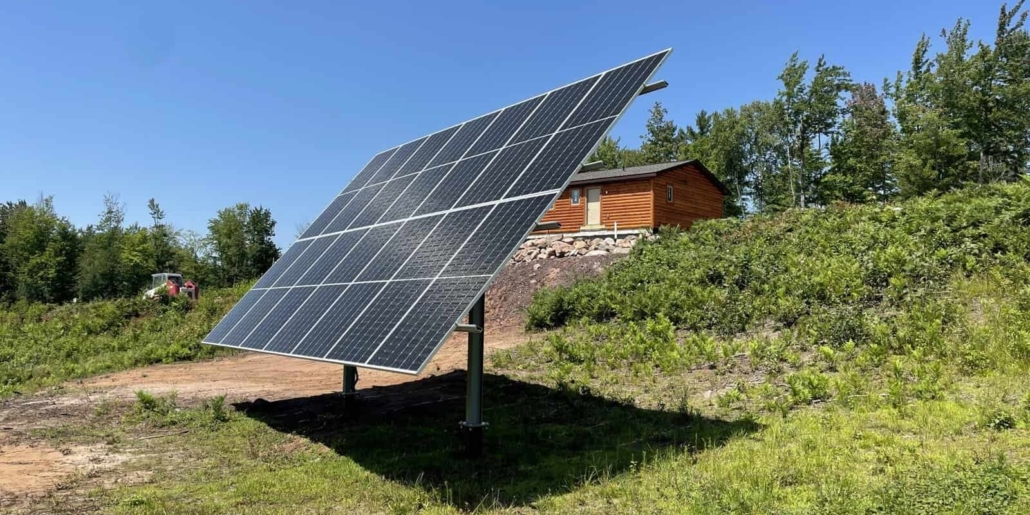
Traditional Off Grid System: Monolithic Design, BOS Impact, and Upgrade Pain Points
Engineers typically design traditional off-grid systems based on the projected peak load and the required days of autonomous operation at the time of installation. Designers select an inverter rated for the peak load, a battery bank sized in Ah relative to the system voltage, and a PV array capable of recharging the battery bank within an acceptable timeframe. While this “right-sizing” approach is highly efficient initially, it presents several drawbacks:
Substantial Upfront Capital Expenditure: Traditional systems require organizations to invest the entire budget upfront—covering batteries, inverters, PV generation, and civil works—which creates a significant barrier for many smaller organizations.
Upgrade Complexity: Increasing capacity later typically necessitates replacing the inverter with a higher-rated unit, fabricating new busbars, and undertaking extensive rewiring. Such upgrades can be costly and prone to causing system downtime.
Limited Operational Flexibility: If load requirements change, a monolithic system may reach its capacity limits or require support from a backup generator.
The impact of Balance of System components is significant. Large, fixed systems require thicker cables, larger combiner boxes, and larger battery rooms—all of which exponentially increase costs and installation complexity. For remote deployments, transporting a single large battery bank can be logistically more challenging than transporting multiple smaller modules.

Cost Comparison of the Two Approaches
At first glance, modular components have a higher unit cost per capacity. A stackable 5 kWh Lithium Iron Phosphate battery module—including its enclosure and BMS—typically carries a higher per-kilowatt-hour cost than a mass-produced, custom-built battery bank. However, to gain a true understanding of the situation, one must consider it from a lifecycle perspective.
Modular Capital Expenditure Model: Organizations start with a smaller initial acquisition scale and pay costs on demand, aligning their investment with business growth. This lowers the barrier to entry and synchronizes expenditure with cash flow. For instance, a medical clinic might initially acquire 10 kWh of usable capacity and then gradually add more modules over three years, as budget permits.
Traditional Capital Expenditure Model: Characterized by high initial investment, though the hardware cost per kilowatt-hour is slightly lower, and the number of interconnection components is fewer.
Crucially, modular systems can minimize wasted capacity. If demand is expected to grow slowly, building a massive battery system right from the start means capital will sit idle for years. Conversely, phased procurement better aligns with actual consumption patterns and yields a higher short-term ROI. NPV models from many vendors demonstrate that, when accounting for financing costs and operational flexibility, modular systems can result in lower total financing costs over 10 years.
Differences in BOS and Installation Costs
Differences in BOS costs are most evident in on-site expenses. Traditional off grid solar systems typically utilize fewer but larger-gauge cables, centralized junction boxes, and require substantial civil engineering work—such as constructing dedicated battery rooms and installing cable trays. While the installation work is physically demanding, it is relatively concentrated in time.
Modular off grid solar system shift labor away from heavy civil engineering tasks toward repetitive, smaller-scale installation work—specifically, mounting modules, inserting standardized connectors, and securing lugs to busbars. Although the total number of connectors increases, each connector is smaller and simpler. Since there is no need for specialized heavy lifting equipment or large construction crews, labor costs become more predictable—and, in remote locations, typically lower. Furthermore, while a traditional 100 kWh system might require a full day of heavy lifting and the presence of one or two electricians, a modular approach—combining ten 10 kWh modules—allows the same crew to complete the installation in multiple smaller visits, thereby simplifying logistics and avoiding costly on-site mobilization fees.
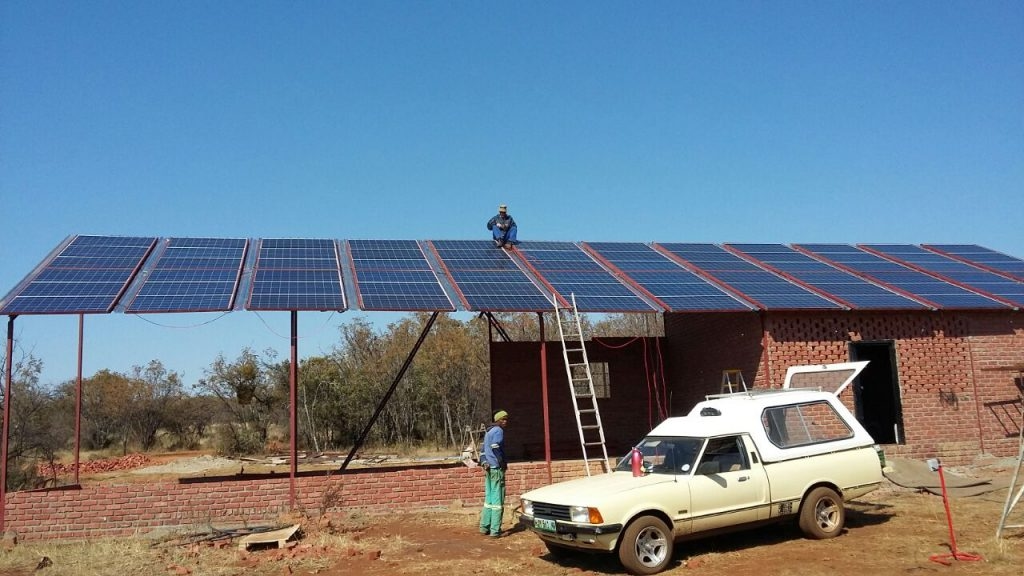
Optimal Use Cases for Each Off-Grid Solar System Type
Choose a modular off-grid solar system under the following circumstances:
- Stakeholders expect demand to grow or fluctuate unpredictably—for instance, during community electrification projects or when organizations scale up pilot projects to full-scale deployment.
- Budget constraints necessitate a phased investment strategy.
- Redundancy, backup capabilities, and maintaining uptime in the event of partial system failure are top priorities.
Choose a traditional off-grid system under the following circumstances:
- The load profile is known, stable, and unlikely to change significantly.
- The site offers easy access, making a single, large-scale installation event a cost-effective option. Reducing hardware costs per kilowatt-hour is a top priority—one that is well-funded.
- Operators tend to enter into comprehensive maintenance contracts under which a single party assumes full responsibility.
More Flexible, Reliable, and Scalable Energy Solutions
While traditional off grid solar systems remain effective for projects with stable and predictable energy demands, they typically require substantial upfront investment and offer limited flexibility when energy requirements fluctuate. In contrast, modular off grid solar system introduce a more adaptable architecture, enabling users to incrementally expand system capacity, optimize capital expenditure, and mitigate operational risks over time. By leveraging standardized components, scalable battery storage, and parallel inverter configurations, modular systems allow energy infrastructure to scale in alignment with actual demand growth.
