
How to Choose a Monocrystalline Silicon Solar Panel for High-Temp Areas?
When you’re on a rooftop in Phoenix or at a solar farm in the Mojave Desert, solar panels are baking under the intense sun, with ambient temperatures far exceeding 38°C (100°F). Under these conditions, the difference between a good monocrystalline silicon solar panel and an excellent one can amount to tens of percentage points in annual energy production and several years of service life. Therefore, choosing the right monocrystalline silicon solar panel for high-temperature regions is not a trivial matter; it’s a technical decision that impacts energy yield, operating costs, and asset lifespan.
The Importance of Electrical Characteristics and Temperature Coefficients of Monocrystalline Silicon Solar Panel
When evaluating monocrystalline silicon solar panel for hot climates, the first consideration is their electrical characteristics. Key parameters in the datasheet include Pmax, Vmp, Imp, Voc, Isc, and the temperature coefficients of power, Voc, and Isc. The temperature coefficient of Pmax (usually expressed in %/°C) is the most critical indicator of how much the output power of a monocrystalline silicon solar panel decreases as the cell temperature increases. In hot regions, a lower (less negative) temperature coefficient means higher daily and annual energy production.
For example, if panel A has a temperature coefficient of -0.30%/°C and panel B has a temperature coefficient of -0.45%/°C, panel A will maintain a higher rated power at higher module temperatures, resulting in better energy harvesting efficiency in high-temperature regions. Electrical compatibility is another crucial factor. High-temperature environments increase the modules’ operating voltage and current due to temperature-induced changes. Therefore, string capacity design must consider the Voc at the lowest expected temperature and the reduced Vmp at high temperatures. Furthermore, the MPPT window of the inverter and the charge controller’s functionality must match the expected operating range of the monocrystalline silicon solar panel string. For off-grid systems or systems with battery energy storage systems, ensure that the nominal operating cell temperature (NOCT) and the maximum system voltage of the battery pack are within the inverter/charge controller ratings.
Materials, Cell Technology, and Thermal Management Design of Monocrystalline Silicon Solar Panel
Material science and cell structure largely determine the performance of monocrystalline silicon solar panels under sustained high temperatures. Manufacturers design high-quality monocrystalline silicon solar panels with advanced wafer passivation techniques, multi-busbar or half-cell structures, and, in some cases, larger wafer sizes (M6/M10/M12) to reduce resistive losses and manage thermal stress. These cell-level choices affect internal resistivity, hotspot formation, and the module’s overall thermal distribution.
Encapsulation materials and backsheets form a protective barrier between the cells and the external environment. EVA has been widely used, but newer encapsulation materials offer lower moisture ingress and superior thermal aging performance. For example, POE exhibits better resistance to discoloration and potential-induced degradation (PID) under high temperature and pressure. Therefore, for use in high-temperature, high-UV environments, solar panels should use POE encapsulation materials or enhanced EVA with UV stabilizers.
Modules with thinner frames or thermally conductive backsheet materials can dissipate heat more quickly. Selecting anti-reflective coatings and selective glass treatments minimizes infrared absorption while maximizing visible light capture, thus reducing thermal load. For utility-scale and large commercial projects, active cooling solutions may be feasible, but for rooftop and residential solar arrays, adequate ventilation and selecting a monocrystalline solar panel with low temperature coefficients usually provide the best cost-effectiveness.
Mechanical Durability, Testing Standards, and Thermal-Related Failure Modes
High temperatures accelerate several mechanical and chemical failure pathways in photovoltaic modules: thermal cycling stress, delamination, backsheet embrittlement, discoloration, and connector degradation. Therefore, mechanical durability is a core criterion when selecting monocrystalline silicon solar panels in hot climates. Ensure the panels have passed rigorous IEC tests, including thermal cycling (IEC 61215), damp heat (85°C/85% RH), UV irradiation, and mechanical load tests, with minimal performance loss after accelerated aging.
Potential-induced degradation (PID) is a significant failure mode in high-temperature, high-humidity environments. When selecting monocrystalline silicon solar panels with PID resistance, request laboratory test reports demonstrating their effectiveness in suppressing PID. At the same time, inspectors should check delamination risks: high temperatures can weaken the adhesion between the glass, encapsulant materials, and backsheet, leading to moisture ingress and corrosion. Mechanical features such as anodized aluminum frames, thickened tempered glass, and certified thermal expansion load ratings help ensure structural integrity. This frame can accommodate thermal expansion and contraction without compromising seal integrity. In addition, junction boxes and cable terminations must withstand continuous high-temperature operation.
Best Installation Practices to Minimize Heat Loss and Risk
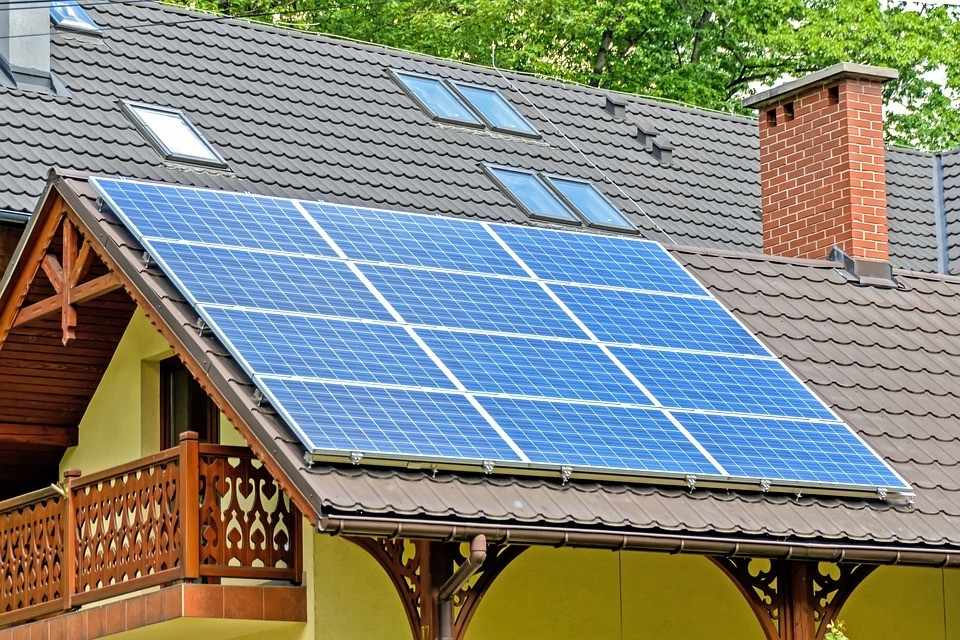
Choosing the right monocrystalline solar panel is only half the battle; the installation method significantly impacts its thermal performance and long-term reliability. One of the simplest and most effective methods is to maximize airflow beneath the modules by using ventilated mounting or elevated brackets. Even a few inches of air gap can lower operating temperatures by several degrees, reducing the negative temperature coefficient and increasing power generation.
When planning the installation, orientation and tilt angle can be used as auxiliary methods for heat dissipation. In hot, low-latitude regions, reducing midday overheating by slightly increasing the tilt angle or using reflective mounting surfaces can shift more incident energy to the cooler morning and afternoon hours when the solar panels operate more efficiently. If roof space is limited, designers can design arrays with sufficient spacing between rows to prevent heat buildup on the back and allow heat to dissipate between adjacent panels. For ground-mounted installations, installers should maintain a non-reflective, light-colored surface beneath the array to reduce heat absorption and radiant heating of the modules.
Warranties and Certifications in High-Temperature Climates
When purchasing monocrystalline silicon solar panels in hot regions, in addition to technical specifications, attention should also be paid to warranty terms and the supplier’s reputation. Two types of warranties are typically offered: product warranty and performance warranty. In high-temperature environments, prioritize suppliers with longer warranty periods and less performance degradation. Certifications are also necessary, as they demonstrate that the product has undergone standardized testing and third-party verification. For US installation environments, look for IEC 61215, IEC 61730, UL 61730, or UL 1703 certifications; for agricultural environments, PID testing, salt spray testing, and ammonia resistance testing are also necessary.
Reliability even in high-temperature environments
Selecting suitable monocrystalline solar panels for high-temperature regions requires a holistic approach, not just focusing on nominal power. Careful evaluation of temperature coefficients, cell and encapsulation materials, thermal durability, and proven testing standards during the selection process can significantly reduce heat-related performance losses and long-term degradation. When installers combine these technical factors with proper installation practices, adequate ventilation, and a strong manufacturer’s warranty, high-quality monocrystalline silicon solar panels become reliable, high-yield solar assets even in extreme heat.

