
550W monocrystalline solar panel: High power density solves the problem of limited rooftop space
For homeowners, business owners, and municipalities looking to maximize rooftop solar energy capture, a 550W monocrystalline solar panel is a better option. Because these high-power-density solar modules deliver higher power within the same footprint as older, lower-power modules, they directly address the fundamental limitation of limited rooftop space. In fact, choosing 550W monocrystalline solar panels can maximize kilowatt-hour generation per square meter, simplify system design on constrained rooftops, and often reduce the balance-of-system costs per watt. High-efficiency monocrystalline solar panels typically utilize larger, more efficient cells and optimized cell interconnection methods to increase module output power without increasing area. Therefore, 550W monocrystalline solar panels outperform many 300-400W counterparts in terms of power per unit area.
Technical Advantages and Energy Yield of 550W Monocrystalline Solar Panel
550W monocrystalline solar panels offer numerous technical advantages that significantly improve the performance of rooftop solar systems. First, monocrystalline solar panels generally have higher conversion efficiency compared to traditional polycrystalline modules. This means higher DC power generation per square meter, which is especially important when rooftop space is limited. Second, many modern 550W modules incorporate cell-level technologies such as half-cut cells, multi-busbar designs, and improved wafer processing; these technologies collectively reduce resistive losses, improve shade tolerance, and enhance performance under partial shading conditions.
For systems with limited rooftop space, several technical parameters significantly impact annual energy yield: temperature coefficient, low-light sensitivity, and module degradation rate. Monocrystalline solar panels typically have better temperature coefficients than older designs, which is crucial for hot rooftop environments. Furthermore, modules optimized for low-light conditions can improve kilowatt-hour output in diffuse light environments.
In practice, choosing the right 550W monocrystalline solar panels can increase the annual energy yield from the same rooftop compared to lower-power options, thereby lowering the levelized cost of energy (LCOE) and shortening the payback period. Overall, the technical advantages of 550W monocrystalline solar panels help rooftop systems extract more usable energy within limited space while maintaining reliability and long-term performance.
Design and Installation Considerations on Limited Rooftops
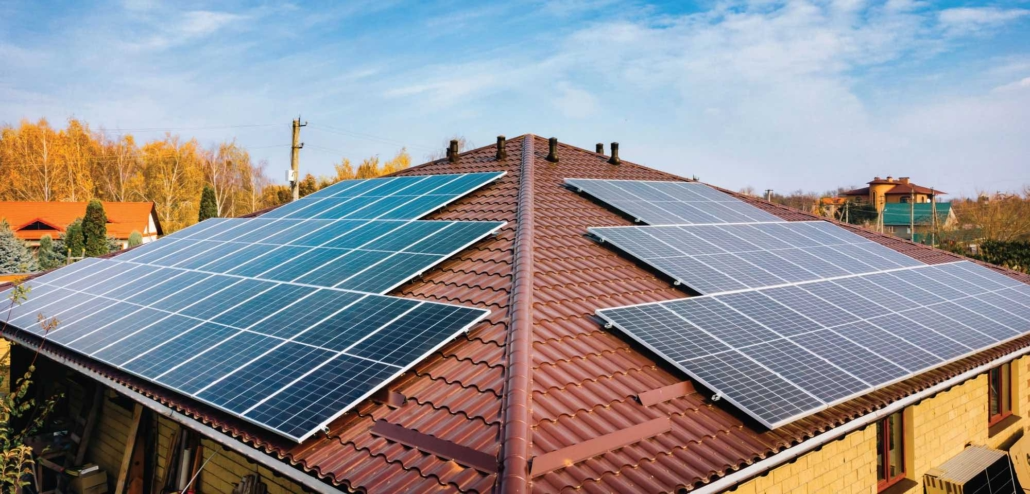
Installing high-power 550W monocrystalline solar panel on limited rooftops requires careful design to maximize benefits and avoid potential problems. First, structural load assessment is crucial. While the weight per unit area of modern modules is roughly the same as that of many traditional panels, the final mounting structure layout will alter the point-load distribution and wind-load characteristics. Therefore, it is essential to engage a structural engineer or qualified installer.
Rooftop layout planning should prioritize module orientation, tilt angle, and shading analysis. Requiring fewer modules allows greater flexibility in array orientation and enables optimal irradiance capture; however, designers must avoid partial shading because it significantly reduces system performance. If partial shading is unavoidable, designers should use module-level power electronics to help ensure that each 550W monocrystalline solar panel operates near its maximum power output even when adjacent modules are shaded.
For mechanical installation on limited rooftops, custom mounting solutions may be more advantageous. Efficient cable management is also essential; fewer modules result in shorter wiring lengths to the combiner box and shorter rooftop conduit runs. When installing high-power modules in limited spaces, safety distances, maintenance access, and rooftop access requirements mandated by fire codes must not be overlooked.
Electrical Compatibility, Inverters, and System Optimization for 550W Monocrystalline Solar Panel
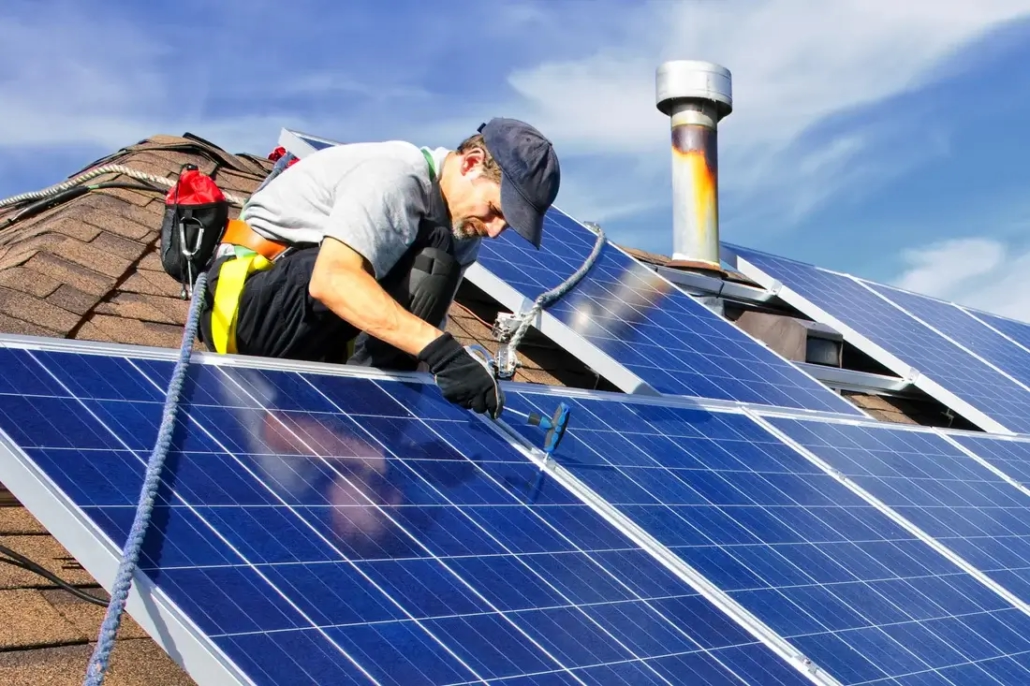
Integrating 550W monocrystalline solar panels into a complete photovoltaic system requires electrical compatibility checks and adherence to best-practice optimization. Because these modules typically offer higher Voc and Imp than lower-power modules, string sizing and inverter selection must account for this difference. System designers should verify the inverter’s maximum input voltage, maximum string current, and maximum power point tracking (MPPT) voltage window to ensure safe and efficient operation.
For rooftop PV systems with limited space, maximizing the DC/AC ratio is a key strategy for increasing annual energy production. By using higher-power components, designers can achieve the desired AC output with fewer component strings, and a slight increase in the DC/AC ratio can often improve energy harvesting during off-peak hours.
For systems using 550W components, appropriate safety devices must be included, such as rapid-shutdown devices, arc-fault protection devices, and appropriately rated combiner boxes. Furthermore, for battery-based or hybrid power systems, pairing high-power-density solar panels with appropriately sized charge controllers and inverters maximizes energy capture within limited rooftop space for backup power or off-grid applications. Therefore, electrical compatibility and system-level optimization translate the inherent advantages of 550W monocrystalline silicon solar panels into reliable, efficient energy to meet the needs of constrained rooftop applications.
Durability, Warranty, and Long-Term Performance Considerations
Choosing a 550W monocrystalline solar panel requires considering not only short-term power density but also long-term reliability. Users should prioritize components from reputable solar panel manufacturers. Since rooftop-mounted solar panels are long-term assets, their degradation rate and ability to withstand environmental stresses are crucial.
High-quality monocrystalline silicon solar panels utilize tempered glass, robust frames, and improved encapsulation materials to reduce the risk of moisture ingress and delamination. Some 550W components employ advanced cell passivation and backsheet technologies to slow down cell performance degradation. It is essential to require third-party IEC testing to verify mechanical load (wind and snow), PID (Potential Induced Degradation), and thermal cycling performance. Furthermore, designers should consider the power temperature coefficient: a lower (less negative) temperature coefficient means better cell performance under the hot summer conditions common in many rooftop environments.

Addressing Limited Rooftop Space with Higher Density
Typical applications for a 550W monocrystalline solar panel include: small residential rooftop systems, commercial buildings with limited but valuable rooftop space, carport installations with structural limitations, and retrofit projects where existing rooftop hardware or penetrations limit layout flexibility. For users with restricted roof space, these components offer higher power density, higher energy output per unit area, and potentially lower balance-of-system costs, enabling rooftop solar power generation in areas where traditional solar panels are not feasible.

