Will a solar on grid system Work During Power Outages? Backup Solution Guide
How can you ensure your home still has power during a power outage when using a solar on grid system? This is one of the most frequently asked questions by grid-tied solar users. Therefore, this guide will explain whether a standard solar on grid system can provide power during a power outage and introduce reliable backup power solutions to ensure you have electricity even when the grid fails. You will learn about anti-islanding safety regulations, inverter and battery technologies for backup power, the differences between AC-coupled and DC-coupled configurations, and design strategies (whole-house backup power vs. critical-circuit backup power).
Can a solar on grid system provide power during a power outage?
Standard on grid solar systems are designed to work in conjunction with the utility grid. Their inverters convert the DC electricity generated by the solar panels into AC electricity, synchronizing the frequency and voltage with the grid. This synchronization is crucial for safe and efficient grid connection. Still, it also introduces a safety rule: when the grid goes down, the inverter must stop supplying power to the grid. This behavior is called anti-islanding.
Why is anti-islanding necessary?
Because it’s necessary to protect line maintenance personnel, if the inverter continues to supply power to a de-energized line, technicians working on the line could be injured by back-fed current. Utility workers need to ensure that de-energized lines are completely de-energized. Additionally, it protects equipment. An islanded system operating without control could produce unsafe voltages and frequencies, potentially damaging household appliances and the inverter itself.
How does the inverter force a shutdown?
On grid inverters continuously monitor the grid’s voltage and frequency. When they detect a grid outage, such as a step change in frequency or the disappearance of the voltage waveform, they stop producing AC power within a few cycles. Therefore, a typical on grid solar system without batteries or other special equipment cannot provide any useful power to the home during a power outage.
Anti-Islanding, Regulatory Requirements, and the Need for Inverters with Islanding Capability
If you want your solar on grid system to power loads during a power outage, your system must intentionally create and control an electrical island independent of the grid. This capability involves regulations, standards, and inverter functionality.
Key Standards and Regulations:
UL 1741 / IEEE 1547 (USA): These standards specify the safety and grid interconnection requirements for inverters. Modern testing requires “smart inverters” to exhibit specific behaviors. IEEE 1547 specifies how distributed power sources interact with the grid.
Utility Interconnection Agreements: Utilities require clear documentation of system behavior, how the system disconnects during power outages, how it limits power output when the grid is present, and how it resynchronizes after grid restoration.
Local Electrical Codes: National and local electrical codes specify transfer equipment, circuit breakers, and wiring requirements for backup circuits.
What is an Inverter with Islanding Capability?
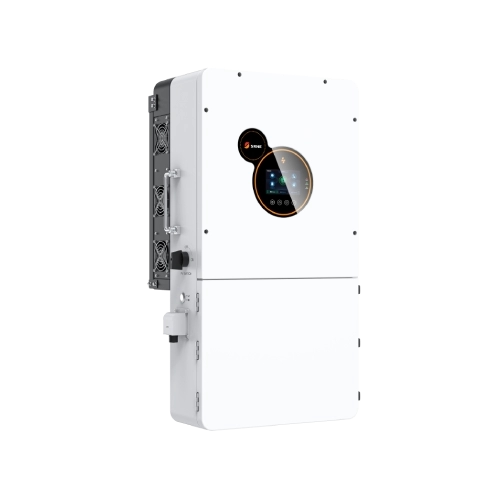
Hybrid Inverters: These can form a grid in a standalone state. They include control functions for setting island voltage and frequency, accepting solar and battery inputs, managing charging and discharging, and interfacing with transfer switches. Depending on their functionality, they are sometimes referred to as on grid or off-grid inverters.
Transfer Switches and Safety Devices:
To safely provide backup power, the system must disconnect from the grid using an automatic transfer switch (ATS) or manual transfer switch, which isolates the home’s circuits from the grid before powering them. The ATS monitors the grid status and seamlessly switches the load to the battery/inverter when the grid fails. Simply put, to ensure your on grid solar system provides reliable backup power, you must use code-compliant equipment and configurations that intentionally isolate and prevent dangerous backfeeding.
Batteries and Hybrid Inverters: How They Provide Backup Power During Power Outages
Adding energy storage can transform a on grid solar system into a more resilient power source. Batteries store excess solar energy when the grid is operational and power the home when the grid is down. The core components include batteries, a battery-compatible hybrid inverter or separate inverter/charger, and transfer/control logic.
How do Batteries Enable Backup Power?
Energy Buffering: When there is ample sunlight but the grid is down, the battery can immediately power loads that would otherwise be without power. During the day, PV generation powers the loads and charges the battery, and at night, the battery provides the stored energy. Seamless Switching: A hybrid inverter with an automatic transfer switch (ATS) automatically switches the house to island mode in the event of a grid failure. At this point, the inverter manages the battery output and any available photovoltaic input.
Load Management: Due to limited battery capacity, the system typically implements load prioritization (critical load panel) or automatic load shedding to extend backup time.
Hybrid Inverter Architecture:
Integrated hybrid inverters combine an MPPT solar inverter and a battery inverter/charger in a single enclosure, simplifying installation and control. Many commercially available inverter models for residential systems fall into this category.
An inverter + separate battery inverter/charger combination allows for the use of dedicated components, such as a high-performance PV inverter with a dedicated battery inverter/charger. This offers greater flexibility for retrofit projects.
When a battery is added to a on grid solar system with a suitable inverter, it can be transformed into a backup power system. The quality of the user experience largely depends on the inverter’s performance and system design.
The Impact of AC-Coupled vs. DC-Coupled Battery Systems on Backup Power Performance
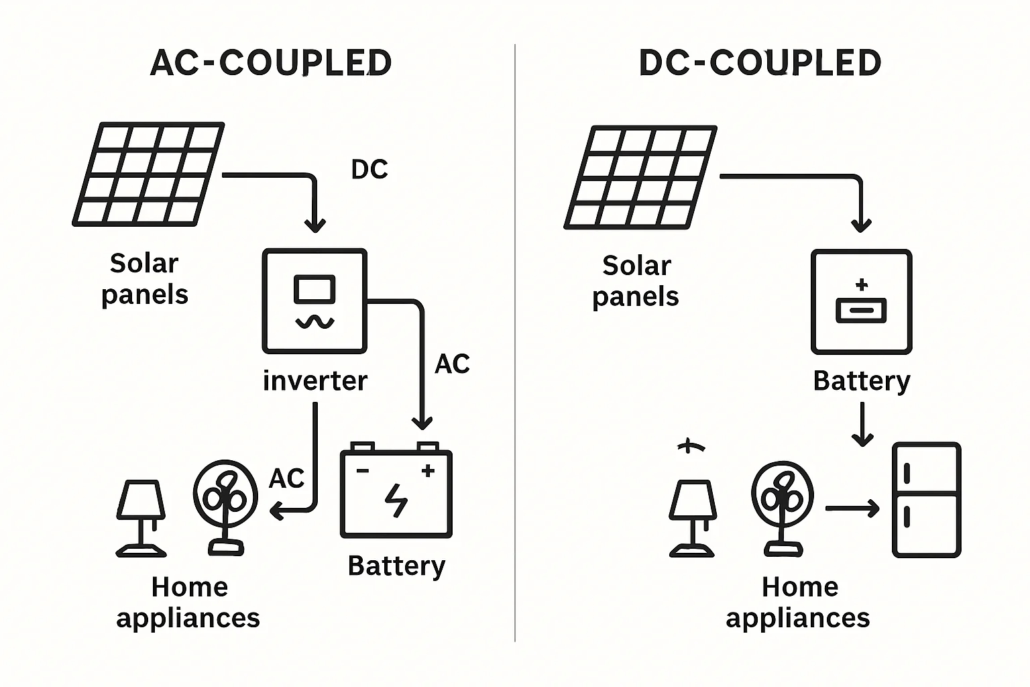
When integrating batteries into an on grid solar system, you will encounter two primary coupling methods: AC coupling and DC coupling. Each method impacts performance, efficiency, and upgrade flexibility.
AC-Coupled Systems:
Architecture: The solar array is connected to the grid via an inverter; the battery is connected to the AC side via a battery inverter/charger or a hybrid inverter. The energy generated by the PV system is converted to AC power, which can then be used, sent to the battery inverter to be converted to DC power to charge the battery, or exported to the grid.
Advantages: Ideal for retrofitting existing systems; you can add batteries and a battery inverter to an existing on grid solar system. Compatible with a wide range of inverters and has lower initial investment costs.
Considerations: The slightly more conversion steps when charging the battery from the PV system may reduce round-trip efficiency. However, modern hybrid inverters minimize losses, and flexibility is often more important than efficiency losses.
DC-Coupled Systems:
Architecture: The PV DC power is connected to a charge controller or a DC-coupled inverter, directly supplying the battery DC bus, and then a single inverter converts the DC power to AC power for the load. Advantages: Direct photovoltaic charging can be more efficient. Tight integration can reduce losses in specific operating modes and provide better battery charging control.
Considerations: Retrofitting may be more complex; system design is crucial for maximizing benefits. DC coupling is often the preferred solution when optimizing PV charging efficiency in off-grid or tightly integrated systems.
Hybrid Approach:
Some modern systems use a combination of AC and DC coupling to optimize retrofit flexibility and charging efficiency. For example, a hybrid inverter can accept both PV DC input and AC-coupled battery inverter input, and coordinate energy flow.
So, which is best for backup? For on grid solar system owners who want to add backup power to an existing array, AC-coupled solutions are generally more straightforward and quicker to deploy. For new projects where maximizing round-trip efficiency is a priority, DC-coupled systems may be attractive. Both methods can provide reliable backup when properly designed.
Backup Power Design for Solar on grid system
When you decide to add backup power to an on grid solar system, you must choose a strategy: power the entire house or only critical circuits. Each choice impacts cost, complexity, and user experience.
Essential Load Method:
Approach: Install a transfer switch that connects a portion of the circuits to the inverter/battery during a power outage. A separate sub-panel powers these critical loads.
Advantages: Lower battery capacity and inverter power requirements, resulting in lower overall cost. Faster deployment is commonly used in residential installations.
Limitations: Non-critical circuits remain off during a power outage.
Whole-House Backup:
Concept: The inverter/battery system provides sufficient capacity and power to run all or most household circuits. Larger battery banks and higher-powered inverters are needed to handle heavy loads (e.g., HVAC, electric water heaters, EV chargers).
Advantages: Complete resilience – the house functions normally during many power outages.
Limitations: Significantly increased cost and space requirements. Inverter and battery capacity must meet peak load and surge requirements (for motors and compressors). Cost and Return on Investment Considerations
Backup batteries significantly increase project costs, requiring planning for equipment, installation, permitting, and potential electrical service upgrades. Evaluate the benefits: the value of power outage protection, optimized energy bills, reduced demand charges, and possible incentives.
For many homeowners, a critical load power supply solution offers a balance of reliability and cost. For those seeking complete energy independence, a whole-house power system is the best option, though it comes at a significantly higher price.
Recommended Methods for Achieving Reliable Backup Power
solar on grid systems cannot power your home during a power outage because the on grid inverter automatically shuts down for safety reasons. This protects utility workers and equipment, but leaves homeowners vulnerable during outages. The good news is that adding a properly designed battery storage system and appropriate inverter/conversion hardware can transform your on grid system into a reliable asset that provides backup power.
Therefore, we recommend adding a battery inverter or hybrid inverter and an automatic transfer switch (ATS) to your existing on grid solar system to create critical load backup power. This method is cost-effective and quick. For new systems, an integrated hybrid inverter and appropriately sized battery should be used to maximize efficiency and performance. When designing on grid solar systems with backup capabilities, we prioritize safety, clarity, and practicality.