
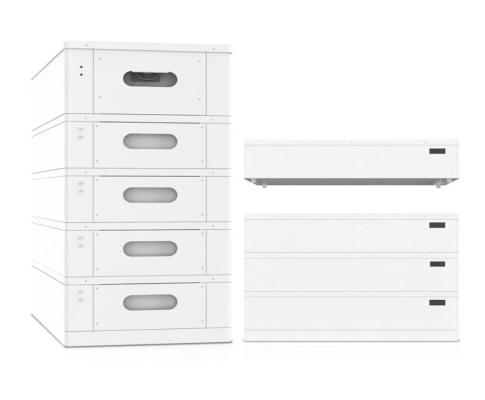
Supported communication protocols for solar backup batteries: CAN/RS485/RS232 compatible
Solar panels, inverters, battery banks, and home energy management systems (HEMS) not only need to function correctly but also work in tandem. Communication acts as an invisible bond, connecting these devices into a reliable and resilient energy system. Reliable communication is crucial for solar backup batteries: it relates to safety, performance optimization, warranty support, and grid interaction. In this guide, I’ll walk you through three of the most common wired protocols—CAN, RS485, and RS232—and explain how they can be applied to solar backup batteries for home.
Communication Protocol Requirements for Solar Backup Batteries
When evaluating solar backup batteries, communication requirements can be categorized as follows:
- Real-time monitoring and telemetry: State of charge (SoC), voltage, current, temperature, state of health (SoH), and fault codes.
- Control commands: Charge/discharge setpoints, reserve capacity limits, grid connection mode switching, and emergency disconnection.
- Configuration and services: Firmware updates, parameter tuning, logging, and diagnostics.
- Energy Management Integration: Exchanges data with inverters, smart meters, or battery storage systems to enable demand response, peak shaving, and time-of-use pricing strategies.
- Safety and Protection Coordination: Quickly exchanges alarm information (overcurrent, overtemperature) and remote shutdown.
Three main wired communication standards are used in battery applications:
CAN: A robust, low-latency multi-node bus widely used in battery management systems (BMS), microgrid controllers, and automotive applications. It excels at handling deterministic messages for safety-critical controls.
RS485: A multi-point differential serial link commonly used in inverter-storage integration and industrial telemetry. It is ideal for connecting multiple devices over medium distances and is common in SunSpec and many commercial energy systems.
RS23: A traditional point-to-point serial interface primarily used for local configuration, service consoles, and short-range device-to-PC connections.
They each play different roles: CAN typically handles internal BMS and high-speed safety messages; RS485/Modbus connects the battery to the inverter, EMS, and meter; RS232 provides service-level access. Powerdream’s solar backup battery typically supports all three interfaces to maximize interoperability with a wide range of inverters, gateways, and monitoring tools.
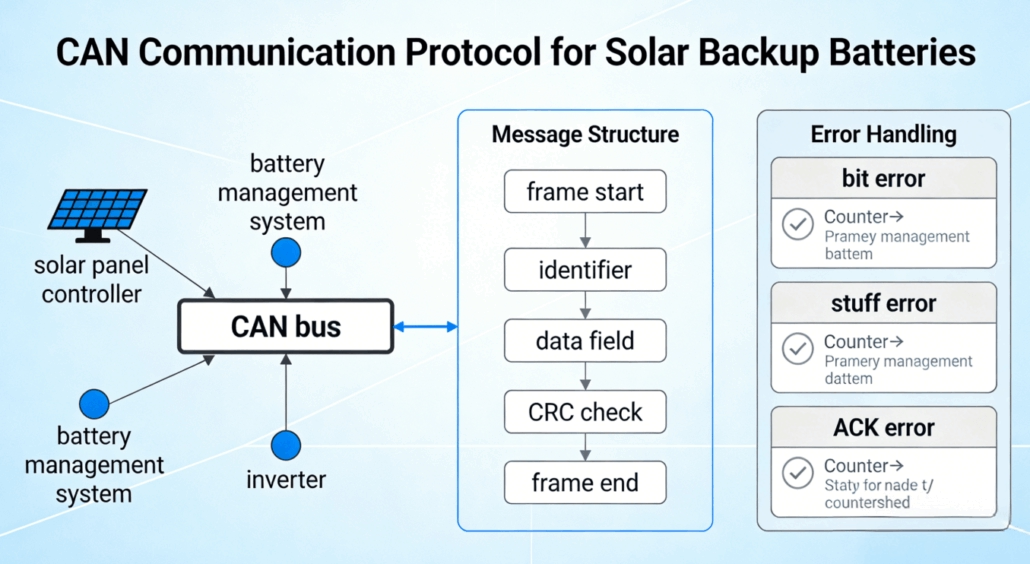
CAN Communication Protocol for Solar Backup Batteries
What is the CAN bus, and why is it suitable for batteries?
The CAN bus is a fieldbus developed initially for automotive networks. It uses differential signaling and an open arbitration/priority mechanism, so messages from high-priority nodes can deterministically gain bus access. For residential solar backup batteries, the CAN bus offers several advantages:
- Low latency and real-time behavior: Very useful for safety-critical switching.
- Strong differential signaling: Good noise immunity over the cabling commonly found in battery boxes or cabinets.
- Multi-node architecture: Allows multiple BMS modules, inverters, and battery controllers to share a single bus.
Common CAN Implementations in Solar Backup Battery Systems
CANopen: An application layer protocol containing an object dictionary, device profiles, and standard service types. CANopen BMS profiles standardize SoC/SoH message and parameter access.
J1939: Originally used in heavy vehicles, J1939 is also used in mobile and industrial applications and supports priority data transmission.
Proprietary CAN: Many battery vendors use custom CAN frames to implement advanced functions, meaning integration may require vendor-provided mappings or gateway conversions.
In practical applications, the CAN bus in solar backup batteries can connect the internal BMS network to the battery monitoring module, thermal sensors, and the central BMS. It enables control from the battery to the inverter/protected device and supports clustered battery arrays, where multiple battery cells function as a single energy source, requiring rapid synchronization.
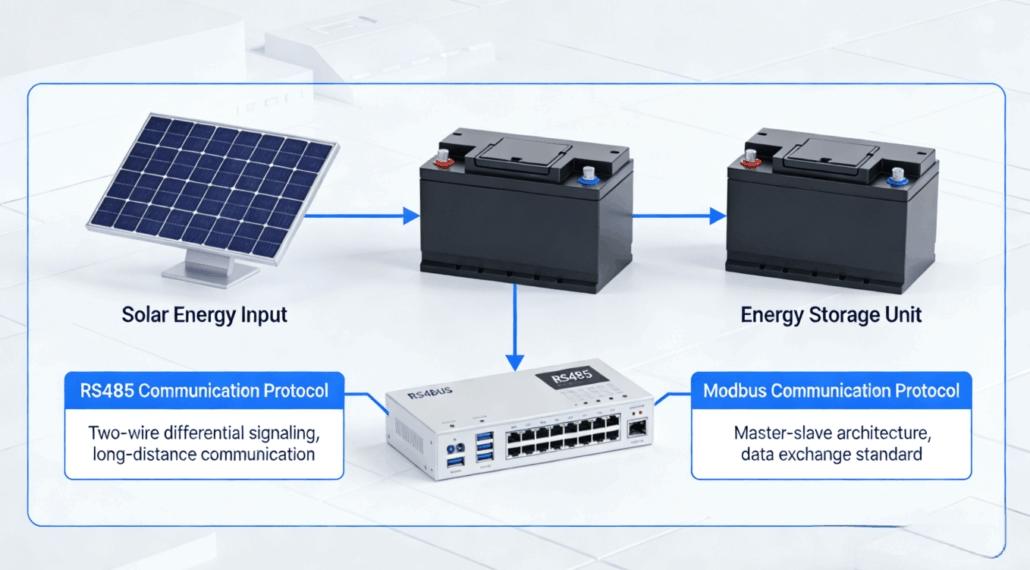
RS485 and Modbus Communication Protocols
Why are RS485/Modbus so popular? Because RS485 is a physical-layer standard, it provides balanced differential signaling over a two-wire bus. When used in conjunction with Modbus RTU (a simple master-slave protocol), RS485 becomes the standard language for industrial energy equipment. Inverters, meters, and gateways also widely support RS485/Modbus for solar backup battery applications.
In battery systems, they are primarily used for battery inverter integration, enabling the inverter to query the battery’s state of charge (SoC) and available capacity, and issue charge/discharge commands. They also facilitate EMS and SCADA connections, allowing the energy management system to poll the battery for telemetry data and coordinate system-wide policies. Furthermore, they enable multi-device networking; RS485 supports multi-point networks, allowing multiple devices to be connected to the same pair of wires.
RS232: Traditional Integration for Service Consoles and Installers
RS232 is an earlier, simpler point-to-point serial communication protocol. While not suitable for multi-node networks, its role in a solar backup battery is:
Local configuration and debugging: Connecting a laptop to the battery controller for firmware updates, log retrieval, or parameter configuration.
Diagnostics and Repair: RS232 is still typically used as a service port for software packages that do not require continuous telemetry.
Legacy Support: Some older inverters and controllers still use RS232 for single-point telemetry.
In practice, we recommend using RS232 only for commissioning and troubleshooting; for production telemetry, RS485 or CAN is preferable. Use a USB-to-RS232 adapter known to be compatible with battery drivers and terminal software. When using RS232 in noisy environments, optical isolation or a temporary USB adapter should be used for service sessions.
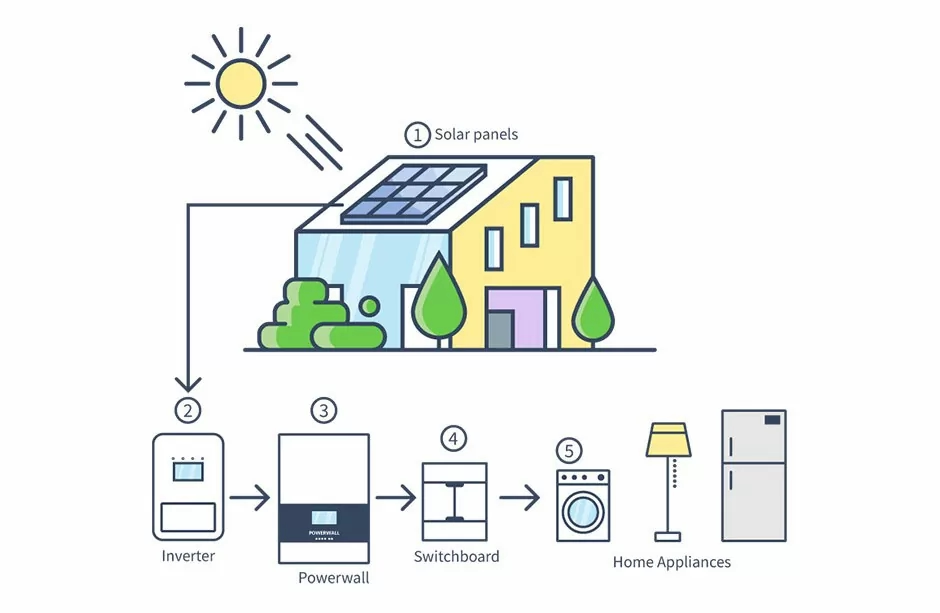
Which Protocol Should Be Chosen? When Should a Gateway Be Used?
Interoperability is a frequently asked question by customers: “My inverter supports Modbus, but the battery supports CAN. What should I do?” The answer is to match each protocol to its functionality and apply a gateway where needed.
Typical Architecture Options:
Native Modbus/RS485 Battery + Modbus Inverter: Best practice – The inverter polls the battery directly. Use SunSpec whenever possible to simplify register mapping.
CAN Native Battery + CAN Native Inverter: This is the preferred solution when both devices support the standardized CAN protocol (CANopen or a vendor-defined protocol). It provides low-latency, stable control.
Hybrid Environment (CAN Battery + Modbus Inverter): Utilizes a protocol gateway or converter. The gateway converts CAN messages into Modbus registers or higher-level templates. PowerDream solar backup batteries typically include optional gateway modules or firmware layers to provide necessary telemetry data via Modbus.
Cloud/IoT Assist: Some systems use a local gateway to convert RS485/CAN signals to MQTT/HTTPS signals for cloud monitoring; a cloud service then coordinates the setpoint. This facilitates remote updates but increases reliance on internet connectivity and requires security considerations.
Choosing a Reliable Communication Method for Secure and Flexible Solar Backup Batteries
Communication is central to a secure and efficient solar backup battery. The CAN bus provides a low-latency, deterministic link, ideal for battery management systems (BMS) and fast, secure signal transmission. RS485 (supporting Modbus and SunSpec) is the primary interface for interoperability between inverters and energy management systems (EMS). RS232 remains a vital service port for commissioning and diagnostics. A reliable solar backup battery solution typically supports all three interfaces, providing flexibility during installation and enabling long-term integration with a wide range of inverters and energy management systems.

