
What is the Ideal tilt angle for a rooftop solar panel?
Consider two identical houses. Both have the same monocrystalline solar panel model and the same solar panel kit installed, but one house has its roof panels installed flat, while the other uses the optimal tilt angle. After a year, the tilted system generates significantly more clean energy, resulting in lower electricity bills and a faster return on investment. Therefore, subtle changes—adjusting a few degrees, slightly altering the direction—can accumulate into significant differences in performance, cost-effectiveness, and carbon reduction. As a supplier, PowerDream can help customers make these small but crucial design choices. So we’ll tell you how to determine the optimal tilt angle for your rooftop solar panel.
How does the tilt angle affect rooftop solar panel output?
To choose the ideal tilt angle, you first need to understand that the sun’s apparent movement across the sky varies with latitude, season, and time of day. The tilt angle determines the angle at which sunlight strikes the panel surface. The more perpendicular the sunlight, the more energy the panel converts; conversely, a smaller angle results in greater reflection losses and lower instantaneous power output.
Key concepts to understand:
Angle of Incidence: The angle between the incoming sunlight and the panel surface. The smaller the angle of incidence (the more perpendicular the sunlight hits the panel), the more power is generated.
Latitude Rule of Thumb: For fixed (non-adjustable) rooftop solar panels, a common starting point is to set the tilt angle approximately equal to the latitude of the location. This approach maximizes annual energy production in many places.
Seasonal Adjustment Rule of Thumb: To increase winter energy production, the tilt angle can be increased by approximately 15 °; to increase summer energy production, it can be decreased by approximately 15°. These adjustments help match seasonal load patterns.
Panel Orientation (Azimuth): Both tilt angle and azimuth are essential. In the US, rooftop solar panels facing due south (azimuth ≈ 180°) with a tilt angle equal to the local latitude typically achieve the highest annual energy production. East or west-facing arrays can also perform well, but may require adjusting the tilt angle and slightly increasing capacity to achieve the same annual energy production.
Tilt Angle Recommendations for Rooftop Solar Panel Based on Climate and Latitude
Different climates and load profiles require distinct tilt-angle strategies. Here are some practical starting points and examples:
1. Temperate Mid-Latitude Regions (approximately 30°–45° North or South latitude)
Recommended fixed tilt angle: Approximately equal to the latitude.
Reason: Balances summer and winter power generation, making it suitable for year-round residential electricity needs.
Seasonal adjustment: If your household uses more electricity in winter (heating, lighting), increase by 10°–15°. If you use more electricity in summer (air conditioning, pool pump), decrease by 10°–15°.
2. Low-Latitude/Tropical Regions (approximately 0°–25°)
Recommended fixed tilt angle: Latitude or slightly less than the latitude (latitude minus 5° to latitude).
Reason: The sun is higher in the sky throughout the year; near-horizontal or low tilt angles capture diffuse sky radiation and provide stable summer power generation.
Seasonal adjustment: Usually not necessary; minor adjustments can be made if considering the rainy season.
3. High-Latitude/Subpolar Regions (>45°)
Recommended fixed tilt angle: Latitude or latitude plus 10° to optimize winter power generation.
Reason: The sun angle is lower in winter, so a larger tilt angle helps capture low-angle sunlight and promotes snow shedding.
Seasonal adjustment: For systems designed to generate more winter energy or for roofs with significant snow accumulation, consider increasing by 20°.
4. Snowy Climates
Tilt angle priority: A larger angle (> the latitude) helps snow slide off and prevents long-term dust accumulation. Steeper roof solar panel tilt angles reduce snow cover time and allow for faster recovery of power generation after snowstorms.
5. Sunny, Dry Climates
Tilt angle priority: Optimize at the latitude location for maximum annual power generation. Be aware of dust accumulation – the tilt angle affects cleaning frequency and power losses from dust. Remember: These are just initial suggestions. Always conduct a site-specific solar resource assessment and horizon/shading analysis when finalizing the tilt angle for your solar panel system design.
Why do roof and mounting systems limit the angle of rooftop solar panels?
Pitched Roofs
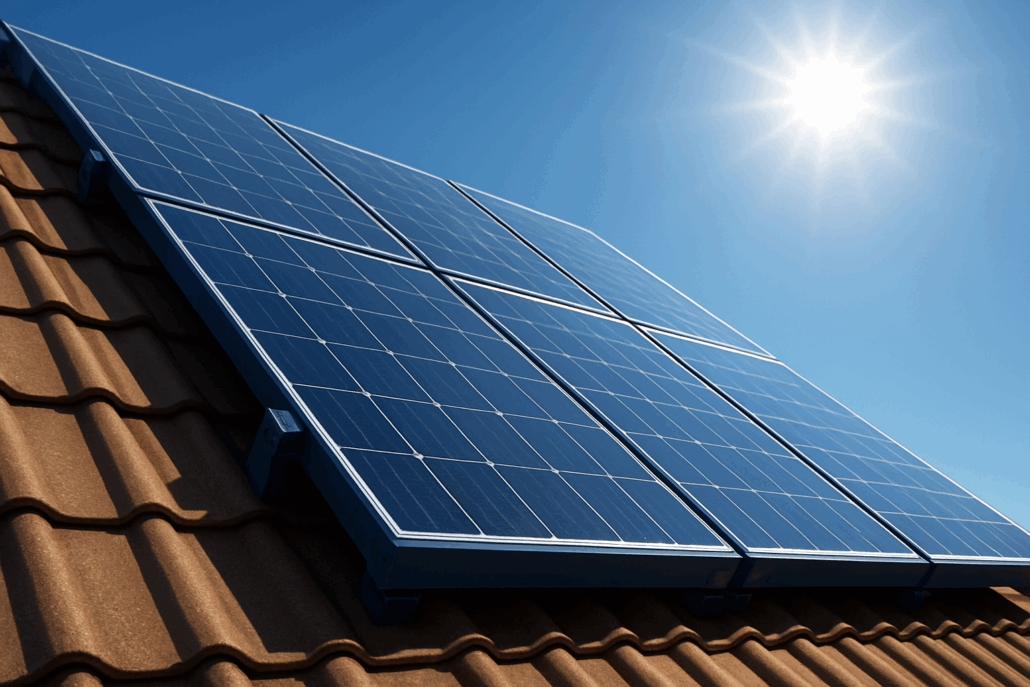
In most cases, the roof pitch equals the tilt angle of the panel array: the panels are mounted flush with the roof surface, so the tilt angle of the panels is the same as the roof pitch. If your roof pitch is close to the recommended angle (latitude), you will get optimal performance at the lowest cost. Otherwise, consider using small-angle mounting brackets to slightly adjust the tilt angle, while accounting for structural and drainage implications.
The advantages include low installation costs, an aesthetic appearance, and lower wind loads when mounted flush. The disadvantage is that if the roof pitch deviates significantly from the optimal angle, you will lose some annual power generation.
Flat Roofs
Adjustable brackets are standard: you can set the panels to an angle and orientation close to the optimal tilt angle. For rooftop solar panels on flat roofs, the angle of the tilt brackets is typically between 10° and 30°, depending on structural factors, wind load, and aesthetic requirements.
Exceptional Cases: Dormer Windows, Mansard Roofs, and Obstacles
Micro-tilt or multi-array layouts can help. Instead of forcing all arrays to have the same tilt angle, the system can be divided into multiple sub-arrays, each facing a different roof plane. The solar panel kit may include various small inverters or micro-inverters to ensure that each sub-array operates near its maximum power point.
In practice, many residential rooftop solar panel installations use the roof pitch as the actual working tilt angle. The performance loss due to a few degrees of deviation from the latitude is usually slight, especially for monocrystalline solar panel modules, which have relatively high temperature stability and performance at different angles of incidence.
Seasonal Tilt, Tracking, and Technology Choices
If you want to improve performance from your rooftop solar panels, consider seasonal adjustments, single-axis trackers, or panels that respond differently to tilt and shading (e.g., monocrystalline silicon).
Seasonal Tilt Adjustment:
Manually adjustable racks allow you to adjust the tilt angle twice a year (summer and winter). This is a low-cost compromise solution to improve seasonal output: a tilt angle of -15° in summer and +15° in winter.
Cost-effectiveness:
For many residential systems, the annual gains from seasonal adjustments are not significant, but if your household’s seasonal load fluctuates considerably, the extra gains can be valuable.
Tracking Systems:
Single-axis trackers allow solar panels to rotate throughout the day, increasing annual energy production by 10% to 25% compared to fixed-tilt installations in many climates. Due to structural, wind, and roof-penetration limitations, tracking technology is less common in rooftop solar systems. Ground-mounted solar panel kits more frequently utilize tracking technology. Dual-axis trackers maximize instantaneous output but are rarely practical on rooftops due to their complexity and cost.
Monocrystalline Silicon Solar Panels and Tilt Sensitivity
Monocrystalline silicon Panels have higher module efficiency and tend to perform better under high irradiance and partial shading conditions. Their higher efficiency makes them ideal for situations where roof space is limited, and the tilt angle cannot be optimized.
Bifacial modules can utilize reflected light (albedo) for additional power generation and typically require a higher mounting height (to utilize ground reflection). The tilt angle affects the power output of bifacial modules; generally, a moderate tilt angle combined with appropriate ground treatment can improve the power generation from the back side.
Final Tilt Angle Recommendation
For most residential users, set the tilt angle of your rooftop solar panels to approximately your latitude and focus on high-quality monocrystalline silicon modules and a robust solar panel kit. If winter energy consumption (heating, lighting) is a priority, increase the latitude by approximately 15°. If summer energy consumption (air conditioning) is a priority, decrease the latitude by approximately 15°. In many cases, it’s better to accept a moderate loss in output rather than making complex structural changes; panel area and orientation are often more important than minor tilt differences.
While the tilt angle is essential, it is only one of many factors that determine the actual performance. As a supplier of rooftop solar panels, PowerDream recommends that you first determine your latitude and then optimize the tilt angle based on your home’s electricity load, roof limitations, and a simple financial model.

