
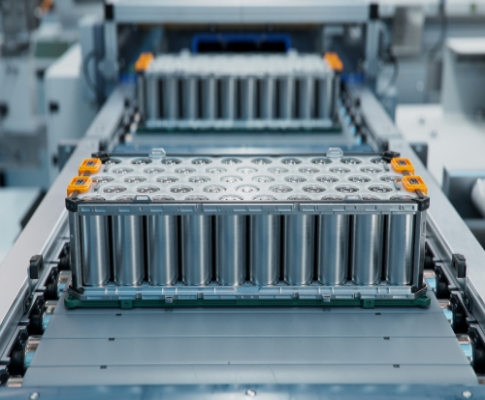
A complete guide to compliance for lithium ion solar batteries
When you install a row of aesthetically pleasing battery racks behind your solar panels, expecting them to operate quietly for years, you might encounter shipping delays, failed inspections, or even worse, avoidable safety incidents. Compliance isn’t just a buzzword; it’s fundamental to the reliable performance, legal market access, and long-term reputation risk management of lithium ion solar batteries. Both manufacturers and users need to understand which rules apply, why they exist, and how to comply with them to ensure a reliable solar battery solution.
Global Compliance Landscape for Lithium Ion Solar Batteries
Regulations and standards for lithium ion solar batteries cover multiple areas: cell and battery pack safety, system-level fire performance, electrical codes for installation, transportation regulations, and environmental/sustainability obligations. Each regulation serves a purpose. Cell and battery pack standards set basic safety requirements for electrical, thermal, and mechanical abuse. System-level standards address thermal runaway propagation and fire behavior in assembled battery energy storage systems. Installation codes dictate safe electrical connections and disconnections at the building level. Transportation regulations ensure the safe transport of lithium batteries by road, rail, sea, and air.
A compliant lithium ion solar battery should incorporate compliant international and regional standards, specifically IEC 62133 for portable cell/battery safety and IEC 62619 for industrial and stationary applications; these standards define tests for electrical abuse, short circuits, mechanical shock, and thermal behavior, thus forming the foundation of a compliant lithium ion solar battery. Certification to these standards demonstrates that your lithium-ion solar battery meets recognized safety performance benchmarks. At the system level, UL 9540A widely serves as a test method for evaluating the thermal runaway fire characteristics of battery energy storage systems—a critical consideration when installing in buildings or enclosed spaces.
Cell and Battery Pack Safety Standards
At the heart of every compliant lithium ion solar battery are tested and certified cells and battery packs. Standards such as IEC 62133 (portable batteries) and IEC 62619 (industrial/stationary batteries) define minimum safety performance for batteries through a series of tests, including electrical cycling, overcharging, forced discharge, thermal stability, short-circuiting, vibration, shock, and mechanical crushing. These standardized tests simulate reasonably foreseeable misuse and abuse scenarios, ensuring that the cells and battery packs can operate safely under these conditions without catastrophic failure.
Why is this so important in practical applications? If a lithium ion solar battery cell or battery pack fails during these tests, thermal runaway can occur. To ensure safety standards, PowerDream’s lithium batteries feature cells with complete test records and a compliant Battery Management System (BMS) that provides cell-level protection: overvoltage, undervoltage, overcurrent, and temperature limits. We also provide documentation and test evidence at the battery pack level, demonstrating that the assembled battery pack meets the IEC 62619 or IEC 62133 standards required for the target application.
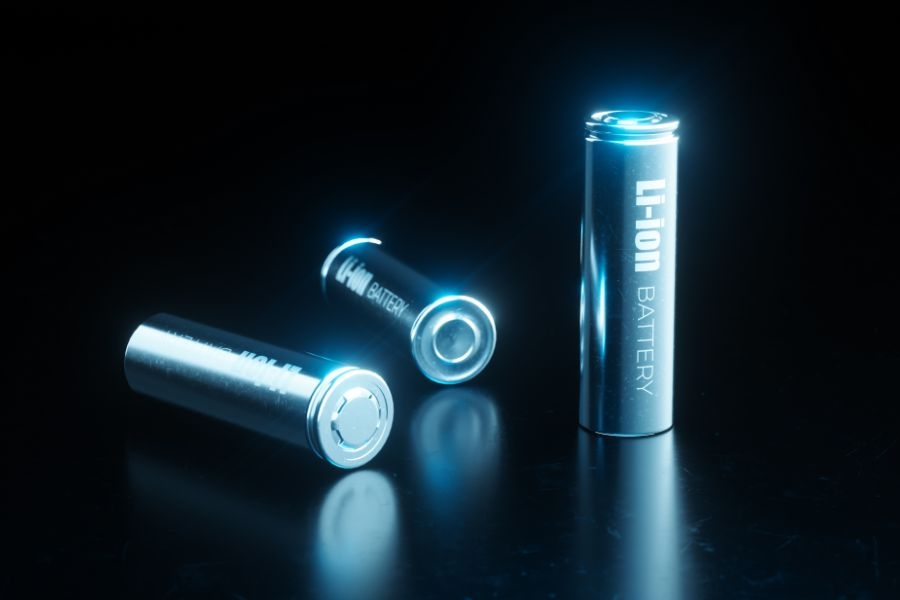
System-Level Safety and Fire Testing
Even if individual battery packs meet cell and pack standards, system-level risks can still arise in multi-pack configurations. Thermal runaway can propagate between modules. Therefore, system-level testing and risk mitigation measures are crucial for large-scale stationary lithium ion solar batteries.
The UL 9540A battery test method characterizes the thermal runaway fire behavior of a complete battery pack or typical components. It tests how a single-cell or module failure propagates, releases gases, and the challenges it poses to fire suppression or control measures. Building code officials often require UL 9540A test evidence or system design justification for indoor energy storage systems or systems installed in enclosed spaces. Furthermore, NFPA 855 and updated electrical codes also impose requirements on the installation and fire safety of energy storage systems, including spacing, ventilation, fire suppression, and emergency disconnect devices. In short, system-level testing addresses the question of “what happens in large-scale applications,” and regulators require data and mitigation strategies before approving the installation of lithium ion solar batteries.

Electrical Codes, Installation Rules, and Site Compliance for Lithium Ion Solar Batteries
Electrical installation codes ensure that your lithium solar batteries are safely integrated into building and grid systems. National and local electrical codes specify requirements for wiring, grounding, circuit breakers, emergency shutdowns, and labeling. In the United States, the National Electrical Code (NEC) has added and refined sections on energy storage; for example, Article 706 covers energy storage systems and includes provisions for circuit breakers, enclosures, and system-specific labeling. Similarly, many jurisdictions supplement the NEC with local amendments or by adopting relevant standards (such as NFPA 855) to address fire and safety concerns.
To ensure compliance at the installation site, follow this practical checklist:
- Ensure the system design meets local code requirements for overcurrent protection, circuit breakers, and wire ratings.
- Provide written documentation for emergency isolation and emergency responder procedures—clearly marking disconnect locations and providing hazard signage.
- Implement monitoring interfaces and remote shutdown capabilities as required by code or the authority having jurisdiction. Many jurisdictions require readily accessible emergency shutdown devices to disconnect the system from power.
- Collaborate with licensed electricians and code consultants during the design and commissioning process. Early coordination with the authority having jurisdiction helps avoid unexpected requirements and expedites the approval process for lithium-ion solar battery installations.
Shipping, Packaging, and International Transport Compliance
The transportation of lithium solar batteries—whether cells, battery packs, or replacement modules—is subject to strict transportation regulations. Section 38.3 of the UN Manual of Tests and Criteria (UN38.3) specifies test items such as altitude simulation, thermal cycling, vibration, shock, external short circuit, impact, overcharge, and forced discharge. Passing UN38.3 testing is typically a prerequisite for air, sea, and road/rail transport. Carriers and freight forwarders will require test documentation before accepting shipments, and non-compliant shipments may be delayed or refused.
Best practices for transportation compliance include:
- Ensure that each cell or battery type shipped has a UN38.3 test report and certification. Keep test records readily available for customs and carrier inspection.
- Use approved packaging to prevent short circuits and physical damage. For large modules or racks, frames and transportation restraints typically secure them.
- Properly classify the goods and apply the required hazard labels and documentation according to the International Air Transport Association Dangerous Goods Regulations (IATA DGR) and the International Maritime Dangerous Goods Code (IMDG). Note that airlines and shipping companies are often conservative—some even prohibit lithium battery shipments entirely.
The Importance of Battery Compliance
Compliance is crucial for lithium ion solar batteries, which must adhere to applicable standards and regulations: IEC 62133 / IEC 62619 for battery/battery pack safety; UL 9540A and UL 1973 for system-level and battery energy storage system (BESS) regulations; UN38.3 for transportation; and regional environmental regulations such as the EU Battery Regulation for fulfilling lifecycle obligations. A structured compliance documentation package should be built, including third-party test reports, supplier traceability, firmware control logs, and clear installation documentation. As a professional lithium-ion battery manufacturer, we ensure that the lithium batteries we provide feature robust battery management systems (BMS) and undergo certified testing.

