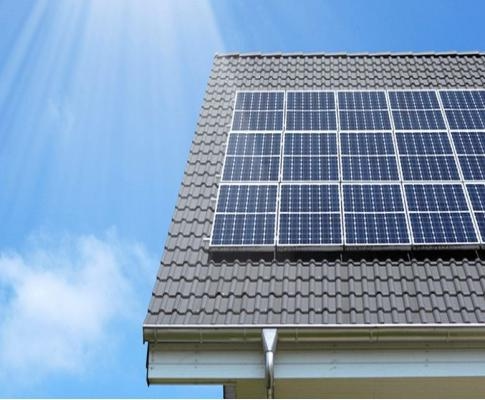
How to Select PV Module Technology for On Grid Solar Systems: Mono vs Multi vs PERC
Suppose you have 1000 square feet of usable roof space. If you choose inefficient photovoltaic modules, you might generate only a fraction of your energy needs; if you choose high-efficiency modules, you might meet or exceed your household electricity needs and shorten the payback period. This simple trade-off is at the heart of photovoltaic module technology selection for on grid solar systems. With increasing pressure to reduce energy costs and achieve sustainability goals, the choice of module technology directly determines the system’s power generation, site suitability, and overall life-cycle economic benefits.
Component Performance and Efficiency of On grid Solar Systems
When purchasing an on grid solar system, module efficiency is the primary technical indicator you need to consider. Efficiency determines how much electricity a solar panel can generate per square foot of installed area. Monocrystalline silicon modules typically have a nominal efficiency between 18% and 22%; polycrystalline silicon modules typically have an efficiency between 15% and 17%; and PERC modules (which can be based on monocrystalline silicon cells) have slightly higher efficiency than traditional cell structures, typically improving efficiency by 1% to 2%. In practice, PERC monocrystalline silicon modules can achieve efficiencies of 20% to 22%, while standard monocrystalline silicon modules are slightly less efficient.
Why this is important for on grid systems:
Limited roof space: High-efficiency modules (monocrystalline silicon or monocrystalline PERC) maximize power generation in limited space. More kilowatt-hours (kWh) are obtained per square meter, resulting in higher system capacity per roof.
Ground-mounted or large arrays: If land is abundant, efficiency is less critical, so lower-cost polycrystalline silicon modules can be considered if capital expenditure per watt is the primary metric.
System capacity: High-efficiency modules allow you to achieve your target DC nameplate power (kWp) with fewer modules, simplifying string layout and racking installation.
In summary, for most residential and many commercial on grid solar systems, monocrystalline silicon or monocrystalline PERC modules are practical choices when the goal is to maximize roof power generation and minimize installation footprint.
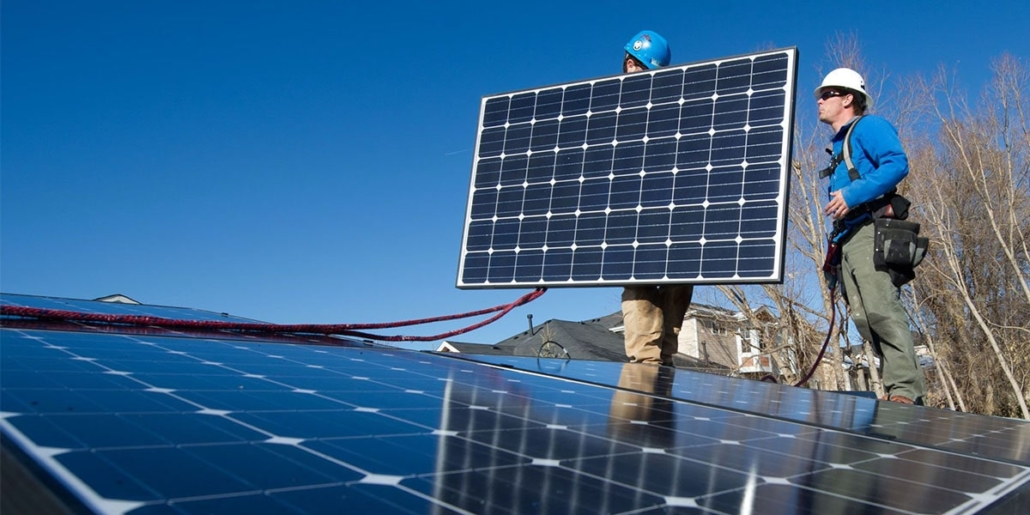
Temperature Coefficient, Low-Light Response, and Actual Power Generation of On Grid Solar Systems
The nominal power of a photovoltaic module is not the same as its actual power generation. Two additional technical parameters, temperature coefficient and low-light response, have a particularly significant impact on power generation in practical applications.
The temperature coefficient indicates the extent to which module power decreases as the battery temperature rises. Since module batteries are typically 20-40°C above ambient temperature in the summer, a better temperature coefficient helps maintain output power at high temperatures. Monocrystalline silicon modules and PERC designs generally have slightly better temperature coefficients than older polycrystalline silicon modules. This difference becomes even more significant in hot weather. Over the course of a year, this represents a considerable difference.
Low-light performance is also important. Monocrystalline silicon cells generally perform better than polycrystalline silicon cells under diffuse light and at low sun angles in the morning and evening, thereby generating more energy on cloudy days or during periods of weak solar radiation. Therefore, if your location is hot or has high solar irradiance, prioritize module technologies with good temperature coefficients. Consider using PERC/monocrystalline cells to improve yield during high temperatures and low-light periods.
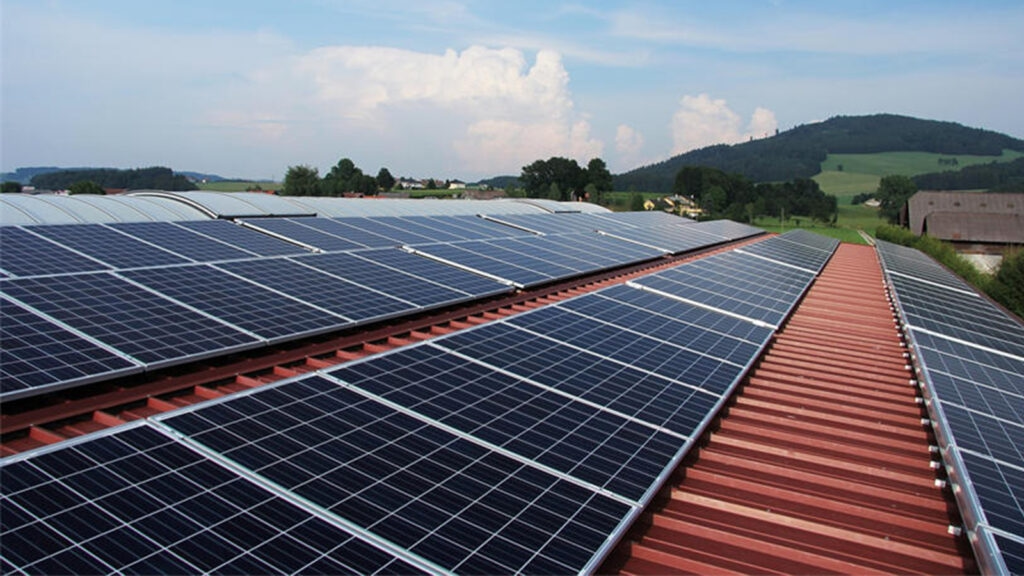
Performance Degradation, Reliability, and Long-Term Warranty Considerations
On grid photovoltaic systems are a long-term investment in solar energy. Module degradation directly affects the power generation of the installed system over its lifespan, thus impacting its levelized cost of energy.
Typical degradation behaviors include:
Initial light-induced degradation: Some modules, particularly older p-type cells and some PERC variants, may experience 1-3% early light-induced degradation in the first year. Modern manufacturing processes have reduced light-induced degradation, but it still affects performance predictions.
Annual degradation rate: High-quality monocrystalline silicon modules typically have an annual degradation rate between 0.25% and 0.7%. Polycrystalline silicon modules usually degrade slightly faster. Over a 25-year warranty period, an annual degradation rate of 0.5% results in a final power output of approximately 88% of the initial rated power, while a 0.7% annual degradation rate reduces the power to approximately 82%.
For on grid solar systems, long-term reliability requires selecting modules with conservative degradation specifications, robust anti-PID design, and reputable third-party testing and certification. PowerDream’s grid-tied solar systems use field-proven monocrystalline silicon modules with conservative warranty coverage to minimize lifetime energy uncertainty for grid-tied customers.
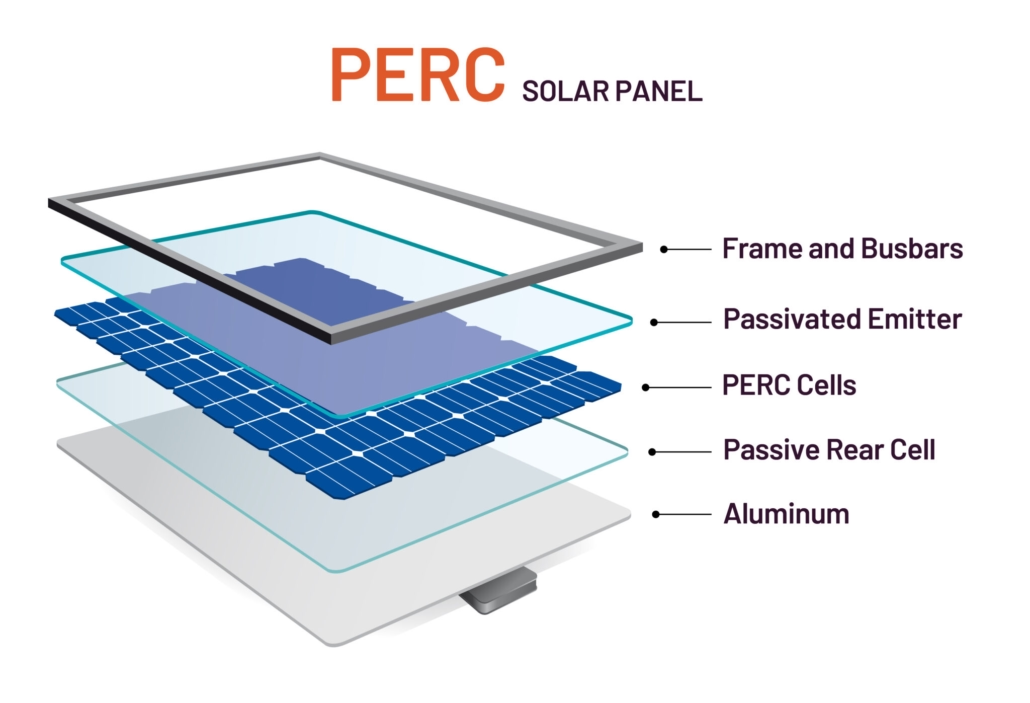
What is PERC, and when is it relevant?
PERC is a cell-level innovation that adds a thin passivation layer to the back of the cell, reflecting otherwise lost photons back into the cell, thus improving absorption and conversion. PERC is not a different material, but rather a process upgrade applied to silicon cells—typically used in conjunction with monocrystalline silicon wafers.
Advantages of PERC for on grid solar systems:
Higher power output in the same area.
Improved low-light response and slightly improved temperature performance in many cases.
Compatibility with bifacial designs.
In some PERC designs, the likelihood of LID (light-induced degradation) or high-temperature-induced degradation is increased. Manufacturers have addressed most of these issues, but production quality and process control are important. PERC monocrystalline modules have a lower premium per watt compared to standard monocrystalline or polycrystalline modules, but this premium has narrowed as PERC has become mainstream. If you need extra watts per square meter, PERC monocrystalline silicon is an excellent choice for grid-tied systems.
Practical Installation Considerations and System Integration
Module technology choices also impact system design choices: string/inverter layout, tilt, mounting, shading strategies, and monitoring.
Key considerations for solar on grid system integration:
Inverter Matching: Higher-power monocrystalline/PERC modules may increase string voltage and current; ensure the inverter MPPT range, maximum input current, and series string size account for module Vmp/Voc at the coldest temperatures.
Roof Tilt and Layout: With more efficient modules, you may need fewer strings and shorter arrays, simplifying wiring and reducing BOS costs.
Shading and Mismatch: If panels face different directions, consider using microinverters or optimizers for maximum yield. Monocrystalline modules with higher shade tolerance still benefit from module-level electronics.
Bifacial Options: For ground mounts or reflective roofs, some monocrystalline/PERC bifacial modules can collect additional energy from albedo. Incorporate the module backside gain into yield models. Monitoring and Data: Choose modules that support reliable firmware and monitoring integration—on grid systems require accurate power generation data for billing and performance optimization.
PowerDream integrates monocrystalline silicon modules with appropriately sized inverters and balance-of-system components to ensure high power generation, reliable grid interaction, and predictable economic benefits.
Why Monocrystalline Silicon is the Preferred Choice for on grid Systems
Choosing photovoltaic modules for an on grid solar system means balancing efficiency, site constraints, yield over lifespan, and supplier reliability. In most residential and commercial on grid scenarios, monocrystalline modules offer the best overall value. They maximize energy per unit area, typically exhibit better temperature and low-light performance, and, when sourced from reputable on grid solar system manufacturers, offer conservative degradation rates and reliable warranties. PERC can provide a meaningful boost when limited roof space requires extra wattage, while polycrystalline silicon can still play a role when cost per watt and ample space are the dominant decision factors.