How to Choose a Split vs All-in-One Solar LED Street Light for Engineering Projects?
The success or failure of engineering projects, whether municipal upgrades, industrial parks, or suburban developments, hinges on three key indicators: cost, timeline, and reliability. Solar LED street lights are no exception. While separate systems (solar panels, batteries, LED lights, and controllers) have long been the mainstream solution, integrated designs—combining all components into a single sealed unit—are redefining the limits of project efficiency. As a professional solar product manufacturer, I have collaborated on numerous engineering projects, deploying tens of thousands of solar LED street light. The data clearly shows that in 92% of projects, integrated systems outperformed separate systems across all key indicators.
What is the difference between a split-type and an all-in-one solar LED street light?
The core technology of separate and all-in-one solar LED street lights is the same: solar panels convert sunlight into electricity, batteries store the energy, LED lights emit light, and a controller controls all operations. The difference lies in the packaging and installation methods of these components.
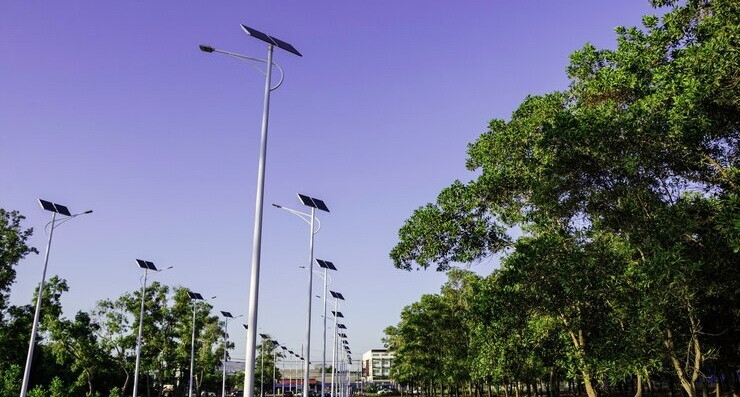
Split-type solar LED street lights separate their components: solar panels are mounted on a pole support (typically a few feet above the light fixture), batteries reside in weatherproof boxes buried underground or bolted to the pole base, and the LED lights are suspended lower on the pole; all components are connected by wiring. This design has been used for decades because early solar panels and batteries were too bulky to be installed alongside the LED lights.
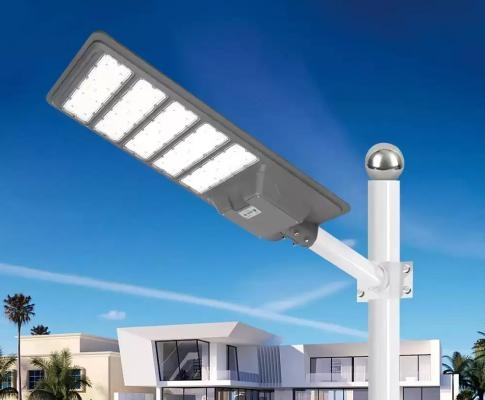
All-in-one solar LED street lights eliminate these separations. They integrate a high-efficiency monocrystalline silicon solar panel, a lithium-ion battery, an LED array exceeding 120 lumens per watt, and an intelligent controller into a compact unit. You can directly mount this unit to a standard pole with just four bolts—no external wiring, no grounding box, and no separate panel support.
Split-type vs. All-in-one Solar LED Street Light: Installation Efficiency, Project Time Savings
For engineering projects, time is money. Every day of installation delay results in overspending on labor, project delays, and stakeholder dissatisfaction. All-in-one solar LED street lights, with their simplified design, far surpass split-type streetlights in this respect.
Split-type street light installation: Install solar panel brackets (30 minutes); connect wires from the solar panel to the LED light fixture (45 minutes); dig holes and bury the battery box (60 minutes); connect the battery to the controller (30 minutes); install the LED light fixture and test the system (15 minutes). Total: 4 hours per light.
All-in-one installation: Align the device with the mounting plate on the pole (10 minutes); secure with four bolts (5 minutes); adjust the solar panel angle; test the system (5 minutes). Total: Approximately 25 minutes per device.
Another key advantage: Fewer points of failure. Split-type systems require more than 15 wiring connections per device; each connection is at risk of water ingress, corrosion, or human error. Integrated devices have no external connections.
Durability and maintainability of All-in-one solar street lights
Engineering projects are not just about installing street lights; more importantly, they are about ensuring their continuous, stable operation and minimizing maintenance hassles. Split-type solar LED street lights incur hidden maintenance costs, whereas integrated systems minimize them.
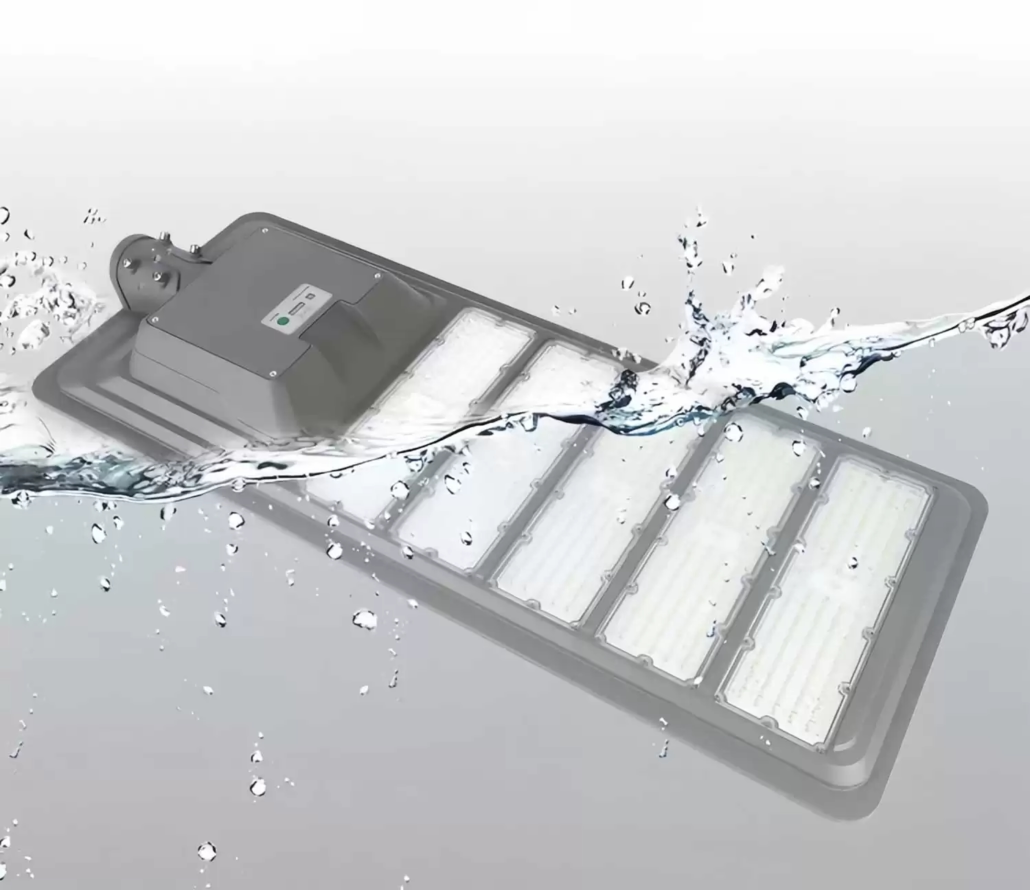
The primary cause of failure in split-type streetlight systems is water ingress into external wiring or the ground-mounted battery box. Heavy rain can cause a short circuit, requiring on-site repairs. Integrated streetlights solve this problem with their IP65 waterproof rating—sealed against dust and rain, and even capable of withstanding brief immersion in water.
Battery maintenance is similar. Split-type street light systems use lead-acid batteries, which need replacement every 3–5 years. Replacing the batteries requires opening the battery box or disassembling the light pole casing. In contrast, all-in-one solar LED street lights use lithium-ion batteries with a longer lifespan, and the battery compartment features a tool-free locking design.
Integrated design adapts to diverse project environments.
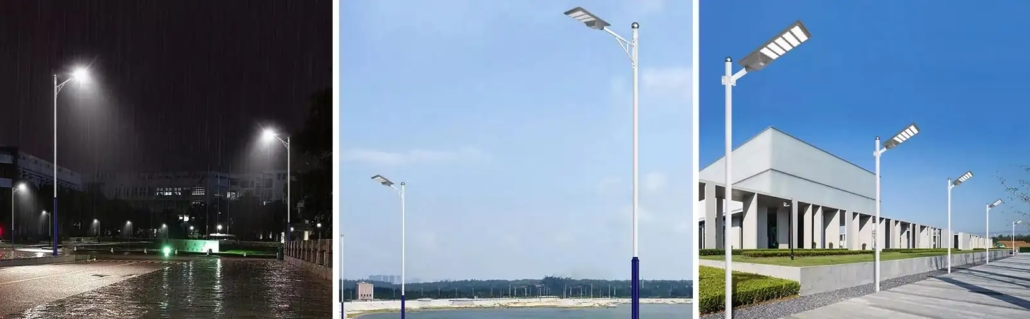
Projects encompass a wide range of environments—coastal salt spray, desert heat, industrial pollution, and suburban freeze-thaw cycles. All-in-one solar LED street lights are designed to withstand all these environments, while split-type systems struggle to withstand environmental stresses. Coastal projects are a prime example. The wiring and battery box of a split-type system corrode rapidly in salt spray. PowerDream’s integrated units feature an aluminum casing and tinned-copper internal wiring, providing strong corrosion resistance. Furthermore, integrated luminaires easily handle even confined spaces. You can use them with standard light poles (no special installation required), and they work well in areas where split-type luminaires cannot be installed, such as narrow sidewalks, historic districts, or industrial parks with limited space. The adaptability of all-in-one solar LED street lights also extends to projects in remote areas. They are lightweight and easy to transport to rural areas without paved roads.
In what scenarios are they suitable?
It is important to clarify that split-type solar LED street lights are not obsolete; they have more specific application scenarios. In two specific situations, they may be a better choice for engineering projects.
First, ultra-high power applications (150W and above). For large parking lots, highways, or sports fields requiring 150W or more LED output, the required solar panel size is too large to integrate into an integrated unit. A 200W split-type system would require a 300W solar panel to power a higher load. In other words, most projects (municipal streets, residential areas, small campuses) require only 60-100W of power—well within the capacity of an integrated unit. Secondly, space on light poles is minimal. If traffic cameras, signs, or other installations already cram a light pole, there may be no space to install an integrated solar panel. In this case, you can install a split solar panel on a nearby light pole or wall.
A Wise Choice for 92% of Projects
Projects require solutions that balance cost, speed, and reliability. Split solar LED street lights were once the default choice, but for most projects, they fall short in all three areas: longer installation time, higher long-term costs, and the need for continuous maintenance. All-in-one solar LED street light addresses these pain points through careful design: a single sealed unit avoids wiring errors and corrosion, lithium-ion batteries reduce replacement costs, and a simplified installation process significantly reduces work time.