Hybrid Inverter Compliance Guidelines: VDE4105/EN50549 Certification
A global solar compliance survey of 1,200 EU installers and owners found that 42% had encountered hybrid inverter compliance issues, with each incident costing an average of thousands of euros. For any business installing hybrid inverters in Europe, VDE4105 and EN50549 certifications are not optional; they are legal requirements to ensure safety, grid compatibility, and performance. Therefore, this article provides a guide to VDE4105/EN50549 hybrid inverter compliance, explaining the certification requirements, their importance, and how to ensure your hybrid solar inverters meet these standards.
What are VDE4105/EN50549 hybrid inverter certifications, and why are they so important?
VDE4105 is a German national standard (published by the German Association for Electrical, Electronic & Information Technology, VDE) that specifies the safety and grid compatibility requirements for grid-connected hybrid inverters. Industry experts widely consider it the gold standard for installation in Germany, and German grid operators often mandate it. EN50549 harmonizes with EU standards, aligns with VDE4105, and applies to all EU member states. It ensures that hybrid inverters can seamlessly integrate with the EU grid, meet safety regulations, and provide stable performance.
Both certifications cover three core priorities:
Safety: Protecting installers, users, and electrical systems from hazards such as overvoltage, short circuits, or fire.
Grid Compatibility: Ensuring that the hybrid inverter does not disrupt grid stability when supplying solar energy to the grid.
Performance: Guaranteeing minimum efficiency levels and reliable operation with batteries.
Key Requirements of VDE4105: Safety and Grid Compatibility
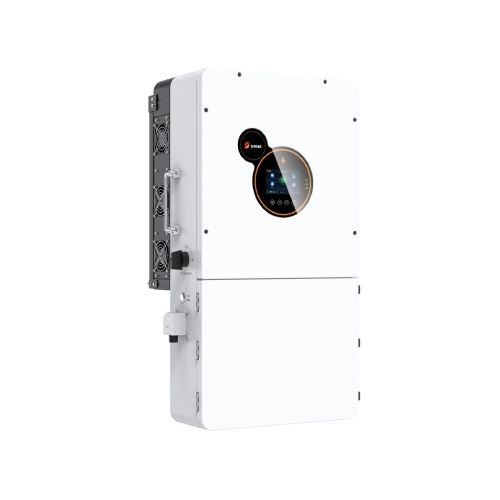
VDE4105 places great emphasis on safety and grid stability, certifying specific requirements that hybrid inverters must meet. Firstly, they must have overvoltage/undervoltage protection; the hybrid inverter must automatically disconnect from the grid when the voltage exceeds 110% of the nominal grid voltage or falls below 85% of it. This prevents damage to the grid or connected equipment. In addition, frequency control also requires the inverter to operate within a strict frequency range (47.5Hz to 51.5Hz for the German power grid). If the grid frequency exceeds this range, the inverter must shut down within 2 seconds to prevent system instability.
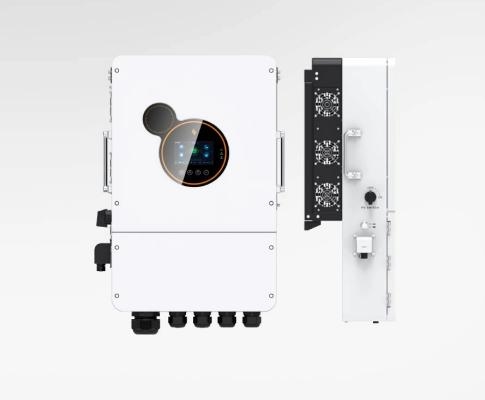
Islanding detection is also required, as islanding operation is hazardous for electrical workers. VDE4105 requires hybrid inverters to detect islanding and disconnect within 2 seconds. Furthermore, safety isolation is needed; the inverter must have reinforced insulation between the DC and AC sides to prevent electric shock. PowerDream’s VDE4105-certified hybrid inverters can detect islanding within 0.8 seconds and employ double insulation, not only meeting the standard but also incorporating a built-in safety buffer.
EN50549 Standard: Performance and Interoperability Guidelines
EN50549 expands upon VDE4105, adding EU-wide performance and interoperability requirements that a hybrid solar inverter must meet. It requires a minimum efficiency; the EN50549 standard specifies a weighted efficiency of at least 94% for hybrid inverters. This ensures maximum energy savings for your solar system. Battery interoperability also requires hybrid inverters to support common battery chemistries (lithium-ion, lead-acid) and communication protocols (CANbus, Modbus). The EN50549 standard avoids compatibility issues by testing this interoperability.
Furthermore, regarding electromagnetic compatibility, the inverter must not emit excessive electromagnetic interference that could interfere with other equipment, and must be resistant to external electromagnetic interference. Low-voltage ride-through also requires the inverter to remain connected during grid voltage dips to maintain grid stability, rather than shutting down abruptly. For EU-wide installations, EN50549 is mandatory: “Utilities in France, Spain, Italy, and all other EU countries will not allow you to connect a hybrid inverter that lacks EN50549 certification.”
How does PowerDream ensure its hybrid inverters meet VDE4105/EN50549 standards?
Compliance with VDE4105/EN50549 standards is no easy feat; it requires rigorous testing and engineering design. PowerDream follows a four-step process to ensure our hybrid inverters are fully compliant with the standards:
Compliance Design: We meticulously design our hybrid inverters from the outset in accordance with VDE 4105/EN 50549 standards. For example, we use high-quality voltage sensors for accurate grid monitoring and EMI filters to meet EMC requirements.
Internal Laboratory Testing: Our ISO-certified laboratory performs over 100 tests, including overvoltage simulation, islanding detection, efficiency measurement, and electromagnetic compatibility testing. We simulate real-world power grid environments to ensure product performance.
Third-Party Certification: We collaborate with independent, VDE-certified testing organizations (such as TÜV Rheinland) to verify product compliance. These third-party tests are essential for obtaining official certification—any self-declared “compliance” is invalid.
Post-Certification Verification: We conduct on-site testing in EU countries (Germany, Spain, France) to ensure our hybrid inverters perform excellently in real-world grid environments. This step uncovers any extreme cases that were missed during laboratory testing.
Risks of Non-Compliant Hybrid Solar Inverters
Ignoring VDE4105/EN50549 compliance with hybrid inverters to save costs is a disastrous mistake. The risks far outweigh the initial savings. Some EU countries impose fines of 5,000 to 50,000 euros on individuals and businesses installing non-compliant inverters. Fines can amount to euros. In Germany, grid operators can also completely disconnect your solar system. Furthermore, non-compliant inverters can cause voltage spikes or frequency fluctuations, potentially damaging your home/business’s power system or the entire grid.
Meanwhile, non-compliant inverters, lacking proper overvoltage protection or insulation, increase the risk of electric shock, short circuits, or fire. In 2022, a homeowner in Spain experienced a house fire, traced to a non-compliant hybrid inverter. Moreover, using non-compliant solar inverters voids the warranty; most solar installers and manufacturers void their warranties if non-compliant inverters cause damage. You will be responsible for repair or replacement costs.
Choose a hybrid inverter that meets VDE4105/EN50549 standards.
VDE4105 and EN50549 certifications are not just legal requirements; they also guarantee the safety, reliability, and grid compatibility of hybrid inverters. While non-compliant models may seem cheaper at first glance, they can result in fines, safety hazards, and costly downtime losses.
PowerDream Our hybrid solar inverters undergo rigorous testing, third-party certification, and real-world application validation, and are designed to exceed these standards. Whether you install your system in Germany (VDE 4105 standard) or elsewhere in the EU (EN 50549 standard), our inverters ensure seamless grid connection, maximize energy savings, and provide peace of mind.