How can the power rating (500W-700W) of a micro inverter be matched with the capacity of a solar panel?
A customer who installed a 6kW solar system with 15 x 400W solar panels and a 500W micro inverter thought this would be sufficient, but by the end of the year, he had lost nearly $1,200 in potential energy savings. Why? Due to intense sunlight, his 400W solar panels frequently exceeded 450W in peak power, but the 500W inverter cut off 12% of that excess power, wasting it entirely. This situation is not uncommon. When choosing a micro inverter, it’s crucial to balance the capacity of the DC solar panels, the micro inverter’s rated power, and the actual conditions.
Why isn’t “good enough” a good enough solution for micro inverter power matching?
Below, we’ll use PowerDream micro inverters as an example. PowerDream micro inverters have a rated power of 500W-700W. A mismatch between the power of the micro inverters and the capacity of the solar panels can lead to two costly problems—power clipping or underutilization. Both of these scenarios are unacceptable for residential or small business users:
When power clipping occurs, the excess DC power generated by the solar panel exceeds the AC power that the micro inverter can convert, resulting in wasted energy. A 400W solar panel paired with a 500W inverter may seem safe, but in strong sunlight, the panel’s actual power output often exceeds its rated capacity.
Furthermore, underutilization occurs; a 700W micro inverter paired with a 300W solar panel is wasteful. The inverter has higher initial costs, slightly higher standby power consumption, and never operates at optimal efficiency. This will result in unnecessary expenses after 25 years. Simultaneously, overworked microinverters generate more heat, shortening their lifespan by 20% to 30%. If you frequently push a 500W inverter to handle 550W loads, you will cause it to fail several years before the warranty expires.
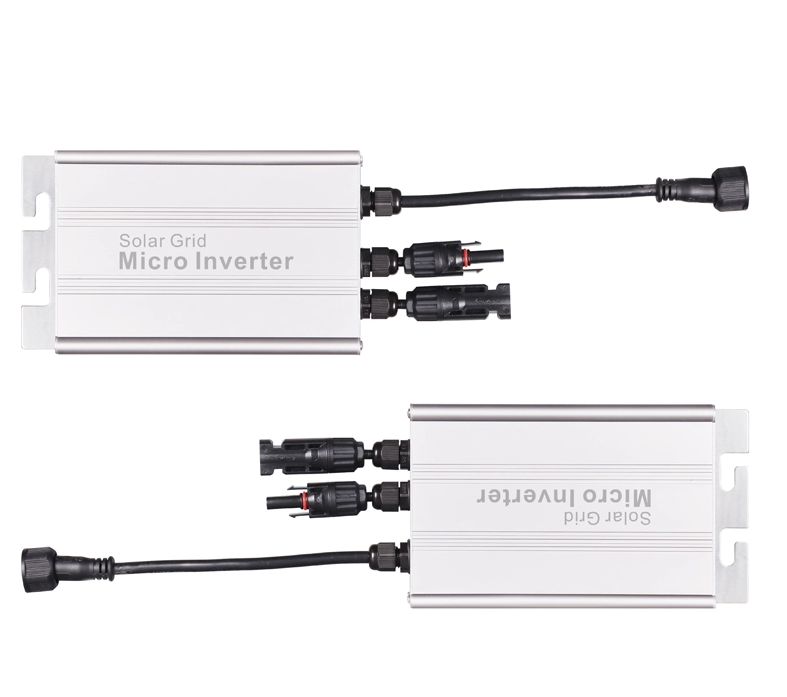
Relationship between 500W-700W Micro inverter and Solar Panels
The 500W-700W micro inverter series is designed for residential and small commercial solar systems and can be used with the most common solar panels currently available (350W-600W). The following is a comparison of rated power and panel capacity:
500W Microinverter: Suitable for 350W-450W solar panels. With a DC/AC ratio between 0.7 (350W panel) and 0.9 (450W panel), it is safe, efficient, and ideal for areas with moderate sunlight. A 400W panel paired with a 500W inverter avoids clipping distortion in most climates and fully utilizes the inverter’s capacity.
600W Microinverter: The most versatile option, compatible with 400W to 550W solar panels. The power ratio ranges from 0.67 (400W) to 0.92 (550W), suitable for all climate conditions in the United States. In sunny areas, a 500W solar panel paired with a 600W inverter (power ratio 0.83) can handle power overload without clipping.
700W Microinverter: Designed for large-capacity solar panels (500W-600W) or small solar panel arrays. A 550W solar panel paired with a 700W inverter lets you maximize output in commercial awnings or large residential systems where space is limited.
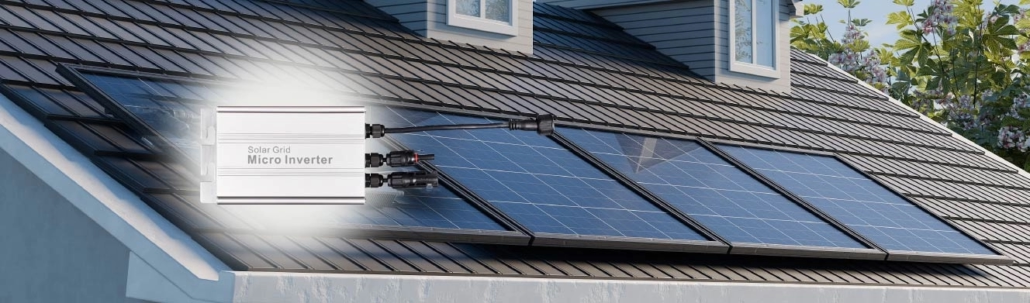
Checking Matching with Solar Panels
Matching a 500W-700W micro inverter with solar panels is straightforward, following a few simple steps. Check the panel’s specification sheet to find and list the DC capacity of the solar panel. Calculate the target DC/AC ratio; a typical target value is 1.0-1.3. For example, a 450W solar panel requires an inverter with an AC rated power of 346W-450W. In the 500W-700W range, the closest microinverter is 500W (a ratio of 0.9—close enough, as the panel’s output will decrease under real-world conditions).
If you live in a hot climate where solar panel output is 5-10% lower, adjust the ratio to 1.2-1.3. If you live in a cool, sunny area where manufacturers rate solar panels higher, you can set it to 1.0–1.1. Next, check for voltage compatibility. Micro inverters have a DC input voltage range of 20V to 50V. Ensure your solar panel’s Voc is within this range. PowerDream’s 500W-700W microinverters operate over an 18V-55V voltage range and are compatible with 95% of residential solar panels.
Practical Application Scenarios for Different Power Capacities
Scenario 1: In scenarios with moderate sunlight and low temperatures, a 400W solar panel can be paired with a PowerDream 500W micro inverter. The DC/AC power ratio is 400/500 = 0.8. Due to the low temperature, the actual power of the solar panel can reach 430W—the power ratio becomes 0.86, and there is no clipping.
Scenario 2: In strong sunlight and high temperatures (e.g., Arizona residences): A 450W solar panel (open-circuit voltage Voc = 38V) is paired with a PowerDream 600W micro inverter. The DC/AC ratio is 450/600 = 0.75. High temperatures cause the panel power to drop to 410W, and the ratio becomes 0.68. In the cooler mornings and evenings, the panel power increases to 470W, the ratio recovers to 0.78, and there is no clipping.
Scenario 3: Small Commercial Awning (Limited Space): Two 320W solar panels (parallel, total DC power 320W). Paired with a PowerDream 700W micro inverter. DC/AC ratio = 320 / 700 = 0.46. However, the parallel wiring maintains a low open-circuit voltage (Voc = 30V), allowing the inverter to handle the load efficiently.
PowerDream Solar Micro inverters—Designed for Perfect Matching
PowerDream’s 500W, 600W, and 700W micro inverters are easy to match and efficient. They all feature a wide input voltage range (18V-55V) and are compatible with 350W-600W panels from all major brands. They also feature intelligent overload protection. Our solar micro inverters automatically adjust to handle panel overloads, reducing clipping distortion by 80% compared to standard models. If a 450W panel actually outputs 500W, the inverter won’t clip; instead, it will increase efficiency to convert more power. Additionally, you can pair our 600W microinverter with 1–2 solar panels (connected in parallel), making it ideal for irregularly sized roofs or expansion projects. PowerDream’s engineering team has tested over 100 panel-inverter combinations, achieving 99.2% compatibility with current residential panels. We designed them for easy matching.
Maximum Energy, Minimal Waste
Matching a micro inverter to the capacity of your solar panels is key to understanding the DC/AC ratio, considering local climate conditions, and choosing a flexible inverter. By following the steps in this guide, you’ll avoid power clipping, underutilization, and premature inverter failure, saving on energy costs. PowerDream’s 500W-700W microinverters are designed to make matching easy and convenient. Whether you are a homeowner installing a 5kW system or a business owner with a small awning, it can be perfectly matched with today’s most common solar panels for maximum efficiency.