What conditions should a wind-resistant solar mounting system meet?
In severe weather, many solar system failures stem from insufficient wind resistance in the solar mounting system. For American homeowners, this means that each wind-related repair costs a significant amount of money. At the same time, commercial projects can suffer tens of thousands of dollars in losses due to downtime and energy production losses resulting from mounting failures. The root cause of these poor wind resistance systems is that they fail to meet three non-negotiable conditions: load-bearing capacity, safety standards, and regulatory compliance. Wind-resistant solar mounting system do more than “support solar panels”; they protect your solar products by distributing wind force, withstanding gusts, and adhering to strict engineering specifications.
Load Capacity Requirements and Solar Mounting System
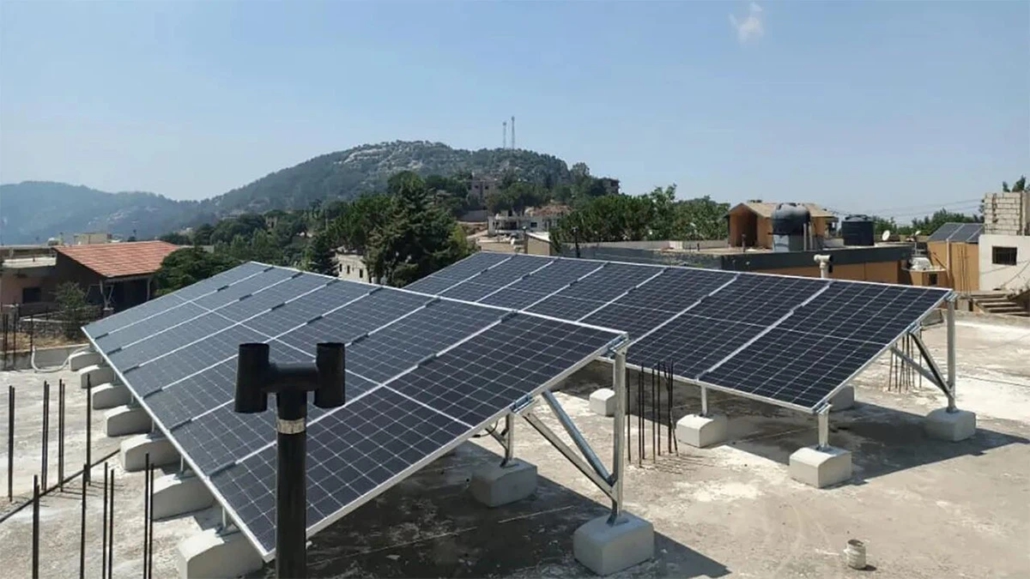
Wind exerts two types of forces on solar mounting systems: static loads and dynamic loads. A wind-resistant system must be able to withstand both wind and rain. Load-bearing capacity is critical to every component, from the solar mounting brackets to the fasteners. The first step is to calculate the wind load using industry standards such as ASCE 7-16 to determine the maximum wind speeds in your area. This value determines the load the system must withstand. The solar panel mounting brackets are the “pillars” for load distribution. These mounts secure the solar panels to rails, which in turn connect to anchor points. Well-designed brackets distribute wind loads throughout the system, rather than concentrating them at a weak point. For example, PowerDream’s aluminum mounting brackets use a “T-bar” design, distributing 30% more load than flat brackets, thus reducing stress on anchor points.
Additionally, pull-out forces must be considered. Wind not only pushes the panels but also pulls them upwards. Wind-resistant systems must include pull-out fasteners to secure the system to a stable structure. Neglecting these fasteners is a leading cause of installation failure in strong winds.
Safety Factor Standards and Solar Mounting System
While a solar mounting system meets basic load requirements, a safety factor is also needed to handle unexpected stresses, such as stronger-than-expected gusts. Wind-resistant systems must meet stringent safety factor standards. First, a minimum safety factor must be met; international standards such as IEC 62738 require solar mounting systems to withstand 1.5 times the expected wind load. In high-wind areas, a safety factor of 2.0 or higher is required. For example, in hurricane or tornado zones, PowerDream recommends a 2.0 safety factor. This extra buffer helps withstand turbulence, debris impact, and long-term wear and tear.
PowerDream verifies the safety factor of these solar panel mounting brackets through testing. We measure the forces that the solar mounting brackets and fasteners can withstand before failure. Engineers conduct wind tunnel simulations to replicate real-world wind conditions, ensuring the system remains stable and does not bend or break. Simultaneously, the aluminum rails, steel fasteners, and plastic components are verified to meet tensile strength requirements.
Compliance with Building Codes is Essential
A wind-resistant solar mounting system must not only be “robust” but also comply with local, national, and international building codes. Codes ensure that the system’s design and installation protect homes, businesses, and workers; violations can lead to failure. Here’s what you need to know:
Key International Standards: IEC 62738 and ISO 12944 set global benchmarks. These standards specify everything from material thickness to fastener spacing.
US National Standard: ASCE 7-16. This standard utilizes factors such as topography and building height to calculate wind loads in various regions of the United States. Engineers must design solar mounting systems to comply with ASCE 7-16 for wind load calculations specific to your area.
Local regulations are paramount: Many regions have stricter rules. For example, Florida requires all solar mounting systems to meet TAS 100 (Hurricane Test) standards.
California mandates that mounting brackets must be wind-resistant and fire-resistant; therefore, the brackets must be non-combustible.
Check certifications: UL or Intertek certification proves the system complies with regulations.
Wind-Resistant Material Selection
Even the best design will fail if the materials are poor. Wind-resistant solar mounting systems rely on specific materials that strike a balance between strength, weight, and corrosion resistance, which is crucial for long-term performance. PowerDream uses 6061-T6 aluminum alloy for its rails and brackets. This lightweight alloy is strong enough to withstand tensile strength of 30,000 psi, making it ideal for solar panel mounting brackets. Furthermore, it is corrosion-resistant, unlike carbon steel, which rusts and loses its strength in the presence of rain or saltwater.
316 stainless steel is used for fasteners. While ordinary steel fasteners are prone to rust, 316 stainless steel is resistant to seawater and moisture, which is crucial for coastal areas. Additionally, reinforced plastic is used for the clips used to secure the panels. We use glass-fiber-reinforced nylon (GRN), not cheap plastic, to make the panel clips. GRN can withstand UV damage and drastic temperature changes, ensuring the clips won’t crack due to excessive wind force and cause the panels to detach.
Ensuring Installation Precision
The performance of a wind-resistant solar mounting system depends on the quality of installation. Even the strongest brackets and rails will fail if improperly installed—for example, being secured to roof linings instead of rafters, or bolts that are too loose (or too tight). Here are the requirements for precise installation:
Secure to Structural Support: Solar mounting brackets must be securely fastened to roof rafters or ground stakes, never to roof or wall panels. Roof panels cannot withstand wind loads, which can cause the system to detach from the roof.
Follow torque specifications: Each bolt and fastener has specific torque requirements. Too loose a torque will cause bolts to loosen due to wind vibrations; too tight a torque will cause threads to strip or brackets to crack. PowerDream equips each system with a torque wrench to ensure torque accuracy.
Adjust angles to minimize wind resistance: Panels should be tilted to the optimal angle for your area and evenly distributed. Misaligned panels create wind “pockets,” increasing wind resistance and putting extra stress on the system.
Three essential conditions for wind resistance
A wind-resistant solar mounting system must meet three core conditions: load-bearing capacity, safety factor standards, and compliance with regulations. Additionally, it requires high-quality materials, precise installation, and rigorous long-term durability testing to ensure your investment is protected for over 25 years. As PowerDream’s technical engineers, we fully consider wind resistance when designing every solar installation system, not only meeting standards but also ensuring that the solar mounting system you purchase can withstand the worst weather conditions.