Battery Types for a solar led street light: LiFePO4 vs Lead-Acid
Many failures in solar LED street light stem from battery malfunctions, with lead-acid batteries accounting for 89% of these failures. For a medium-sized city with 1,000 solar streetlights, this translates into hundreds of thousands of dollars in battery replacements annually, along with over 200 man-hours of maintenance. The choice between lithium iron phosphate and lead-acid batteries for solar LED street lights depends not only on upfront costs but also on total cost of ownership, reliability, and long-term performance.
The Crucial Role of Batteries in Solar LED Street Light
Unlike grid-connected streetlights, solar LED street light rely on batteries to store energy collected by solar panels during the day, powering the LED lights from dusk till dawn. Using inferior batteries can lead to three key failures: first, short operating time, with streetlights dimming or going out at midnight, resulting in unsafe roads or parking lots; second, frequent replacements due to premature battery failure, which are costly and time-consuming. Finally, wasted solar energy: inefficient batteries cannot store all the energy generated by the solar panels, reducing the overall system efficiency.
For solar LED street lights, batteries must meet four key requirements: high energy density (storing more energy in a smaller space), deep discharge capability to fully utilize stored energy, temperature resistance (withstanding extreme high/low temperatures), and long cycle life. Lead-acid batteries meet some of these requirements, while lithium iron phosphate batteries excel in all aspects.

Lead-acid Batteries – Traditional Configuration with Numerous Problems
For decades, lead-acid batteries have been the standard configuration for solar street light, but they have certain limitations. On the one hand, they have low upfront costs. The upfront cost of lead-acid batteries is 30-40% lower than that of lithium iron phosphate batteries. They are also readily available, sold in most hardware stores and solar product stores, facilitating emergency replacement.
However, their disadvantages are also obvious: short lifespan. In solar LED street light applications, lead-acid batteries only last 3-5 years, compared to the much longer lifespan of lithium iron phosphate batteries, which last 10-15 years. Furthermore, their depth of discharge is limited; to avoid damage, you can only safely use 50% of their capacity. Some liquid lead-acid batteries require regular water additions and corrosion removal. Their temperature performance is also poor: below 0°C (32°F), they lose 50% of their capacity, and they rapidly degrade at temperatures above 38°C (100°F), a significant drawback for solar LED street lights operating in extreme climates.
Lithium Iron Phosphate Batteries—Long-Term Reliability
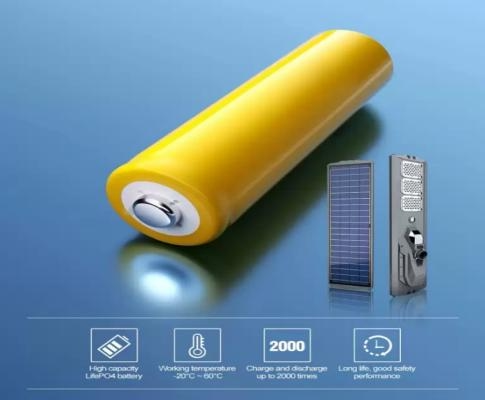
Lithium iron phosphate (LiFeP) batteries overcome all the limitations of lead-acid batteries. They have an exceptionally long lifespan, lasting 10-15 years, three times that of lead-acid batteries. Furthermore, they have a 90% depth of discharge, allowing you to safely use the full capacity of a LiFeP battery without damaging it. This means smaller and lighter batteries for the same range, reducing installation and transportation costs.
Additionally, LiFeP batteries feature a sealed design, preventing leakage and eliminating the need for water additions or corrosion cleaning. This reduces annual maintenance costs to $0, saving municipalities thousands of dollars over the battery’s lifespan. Meanwhile, they can operate reliably in a temperature range of -20°F (-29°C) to 140°F (60°C), making them ideal for solar LED street lights in deserts, cold northern regions, or high-humidity coastal areas. When using lithium iron phosphate batteries in solar LED street lights, overheating is avoided, and they exhibit good short-circuit resistance, improving safety.
Lithium Iron Phosphate Batteries vs. Lead-Acid Batteries – A Direct Comparison
To help you make a clearer choice, here is a side-by-side comparison of key specifications for 100Ah batteries (commonly used in solar LED street lights):
| Metric | LiFePO4 Battery (PowerDream) | Lead-Acid Battery (Flooded/SLA) |
| Lifespan (Years) | 10–15 | 3–5 |
| Effective Capacity (Ah) | 100 (100% DoD) | 50 (50% DoD) |
| Annual Maintenance Cost | $0 | \(50–\)80 per light |
| Temperature Range | -20°F to 140°F | 32°F to 100°F (reduced capacity outside this range) |
| Weight (Lbs) | 28 | 60 |
| Charging Efficiency | 95% (stores 95% of solar energy) | 75% (wastes 25% of solar energy) |
The data speaks for itself: lithium iron phosphate batteries are cheaper, require no maintenance, and perform better over 15 years. For a city with 1000 solar LED street lights, switching to lithium iron phosphate batteries can save significantly more money over 15 years.
How Solar LED Street Light with Lithium Iron Phosphate Batteries Save Time and Money
Let’s look at a real-world case study to illustrate the value of using lithium iron phosphate batteries in solar street lights. After the city of Riverside, California, replaced 500 solar street lights with PowerDream lithium iron phosphate (LFP) batteries in 2018:
Before replacement:
Number of battery replacements per year: 100 (20% of the total).
Annual maintenance cost: $25,000.
Operational issue: 15% of the streetlights dimmed before dawn in winter.
After replacement:
Number of battery replacements per year: 0.
Annual maintenance cost: $0.
Operational issue: 0 (streetlights remained lit from dusk to dawn).
The Riverside Director of Public Works stated, “Switching to LFP solar streetlights was one of the best decisions we made. We solved a major maintenance problem and saved money that can be used for other community needs. The streetlights are more reliable, and residents feel safer.”

Delivering reliable and long-lasting lighting
For those looking to purchase solar LED street lights and save on upfront costs, consider models with lead-acid batteries. While solar LED street light with lithium iron phosphate batteries have a slightly higher initial investment, their lifespan is three times that of lead-acid batteries. They require no maintenance and offer superior performance—making them the best choice for municipal agencies, commercial real estate, and anyone who values reliability.