Uniformity and glare limitation techniques for installing solar street light on sidewalks
Sidewalk lighting does more than illuminate pedestrian paths; it also shapes public perceptions of safety and accessibility. As a solar street light manufacturer, Power Dream applies the same rigorous engineering to sidewalk lighting as we do to our commercial and residential solar products. Our goal is straightforward: to provide uniform, glare-limited lighting that saves energy, minimizes light spillage, and supports modern features such as remote monitoring and adaptive dimming. Therefore, when installing solar street light, we consider photometric planning, luminaire optical design, pole location and height, adaptive lighting controls, glare metrics and mitigation strategies, installation best practices, and operational considerations for long-term performance.
Photometric Planning for Solar Street Light
Achieving uniform sidewalk lighting begins with rigorous photometric planning. Uniformity is not an aesthetic objective; it is a measurable safety parameter, and visual and audio studies have shown that it correlates with reduced trip hazards and improved perceived safety. As a solar street light manufacturer, Power Dream conducts precise site surveys before each sidewalk project. Then, we perform photometric simulations to map lux levels for the sidewalk, adjacent curbs, and building facades.
Key indicators and design objectives include:
1. Average illuminance: The average horizontal illuminance (lux) at the pedestrian level. For typical sidewalks, the design target range is 5 to 20 lux, depending on urban density and usage.
2. Uniformity ratio: The ratio of minimum illuminance to average illuminance. A typical target for sidewalks is a uniformity ratio of U0 ≥ 0.4, or a ratio of average illuminance to minimum illuminance of no greater than 2.5; stricter uniformity ratios are more desirable in high-security areas or areas with dense retail concentrations.
3. Glare index: The limit used to control uncomfortable and disabling glare. For pedestrian environments, Power Dream uses a lower unified glare level and bug level to minimize uplighting and glare while allowing adequate backlighting to protect exterior walls.
Determining the location, mounting height, and spacing of solar street light poles
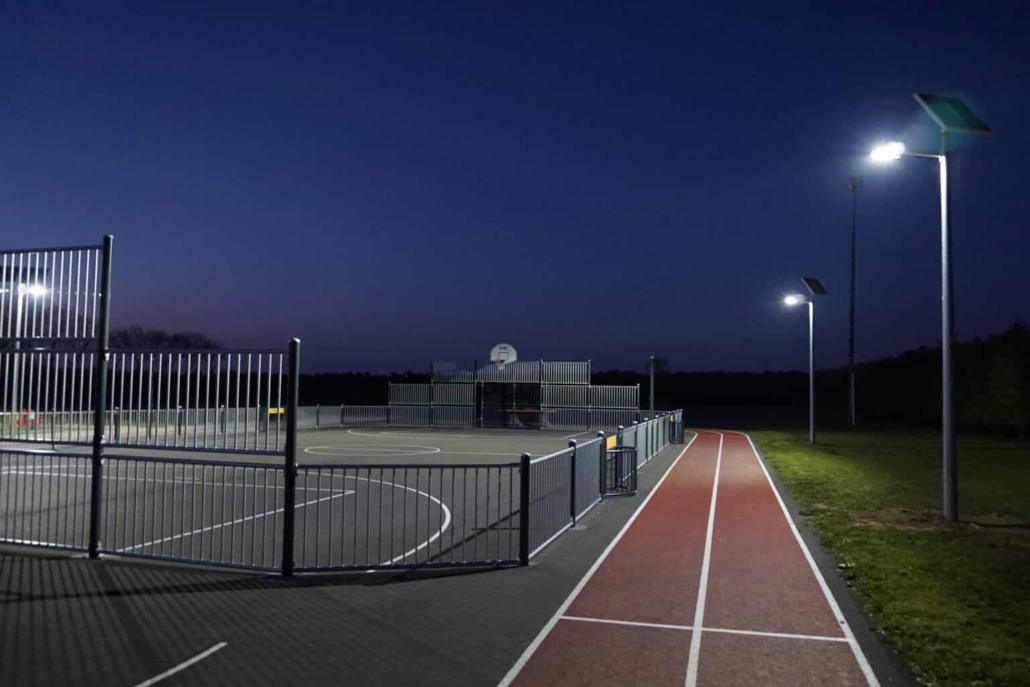
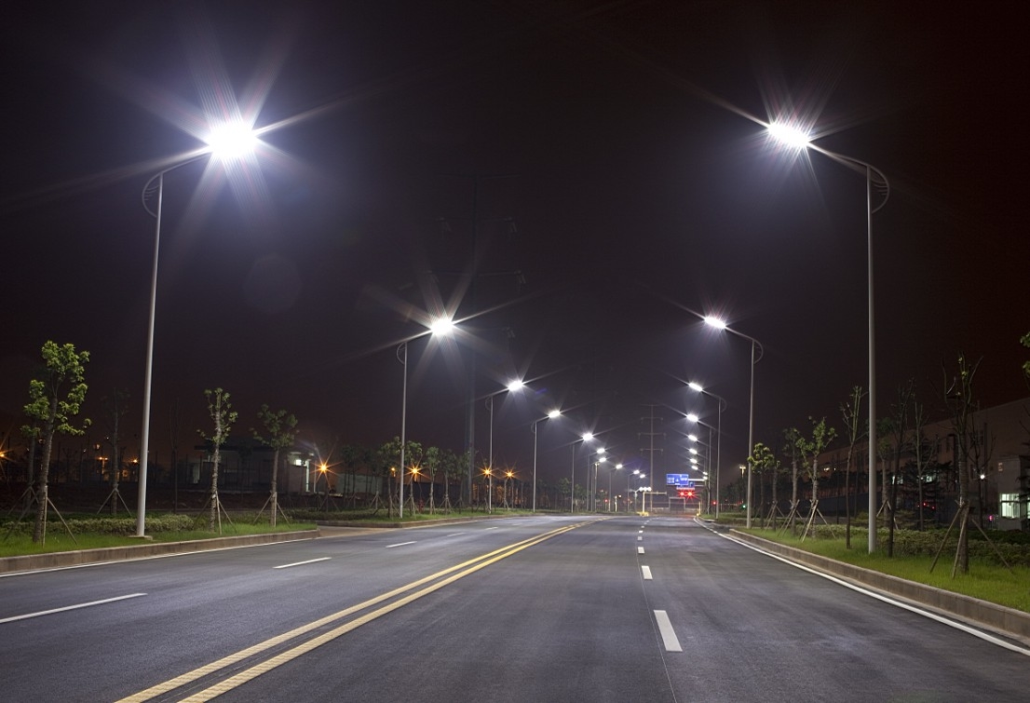
The height, lateral offset, and spacing of solar street light poles significantly impact the achieved uniformity and glare. There is a trade-off between height and spacing. Increasing pole height increases light penetration and smooths the illuminance distribution, but it also widens the beam spread and may increase spillage onto adjacent buildings. Conversely, while lower mounts close to the ground provide higher luminous intensity, more poles are required to achieve the same uniformity. Power Dream typically recommends sidewalk mounting heights between 3.5 and 6.0 meters, depending on the specific site conditions.
Additionally, offsetting the luminaire from the curb toward the street alters the viewing angle and reduces glare into adjacent windows. For narrow sidewalks on either side of buildings, mounting the luminaire perpendicular to the curb with a slight lateral offset can reduce direct glare into storefront windows. Linear spacing should also be aligned with the desired average illuminance. A staggered layout can improve uniformity and reduce shadows cast by street furniture.
Adaptive Control and Dimming Strategies
Uniformity is not a one-time achievement; it changes over time as luminaires age, dust accumulates on the optics, and vegetation grows. Smart controls combined with remote monitoring dynamically manage performance and reduce glare events. Therefore, it is crucial to purchase smart solar street lights with remote monitoring capabilities. Remote monitoring provides real-time insights into luminaire output, energy harvesting, battery charge status, and fault alerts. If the luminaire output decreases due to pollution or LED aging, an alert is triggered, and maintenance can be initiated before uniformity falls below a specified threshold. Adaptive dimming reduces glare during low-traffic hours and increases brightness when occupants are detected, balancing safety and energy efficiency.
Glare Limiting Technology at Installation
Glare is not only measurable but also has social impacts, with neighbors and business owners reacting strongly to perceived glare. Power Dream employs a layered glare control approach that integrates optics, installation practices, and human-centric operational controls.
The standardized glare levels used for indoor lighting also apply to outdoor lighting, with similar regulations that include discomfort thresholds and incremental thresholds for disabling glare. While there is no unified global outdoor standard, local thresholds are set based on specific circumstances. On the other hand, higher correlated color temperatures can increase visual glare, while warmer color temperatures (2700-3000 K) can reduce glare while maintaining color rendering. For residential sidewalks, Power Dream prefers warm white LEDs with a high color rendering index (CRI). For traffic areas with higher requirements for signage or facial recognition, a slightly cooler correlated color temperature (3500-4000 K) may be appropriate.
Installation, Commissioning, and Maintenance Practices
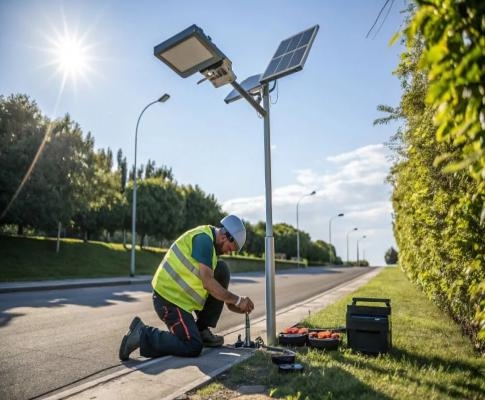
Good design must be accompanied by proper installation and maintenance. If installation tolerances are excessive or maintenance is reactive rather than preventative, uniformity and low-glare performance will be compromised. During the installation of solar street lights, we verify the verticality of the poles, the luminaire aiming angle, and the orientation of the photocell. Commissioning includes on-site lux measurements of the sidewalk at the target height and comparisons with simulated values. Dirt can also reduce effective lumen output, alter beam distribution, and impair uniformity. Local authorities can arrange for cleaning based on environmental conditions. Trees should be pruned appropriately to maintain sightlines and uniformity.
Ensure safe sidewalks with limited glare
The installation of uniform, low-glare sidewalk lighting encompasses every aspect, from product selection to ongoing operation. Power Dream’s approach combines precise photometric planning, asymmetric optics, carefully selected mounting geometry, adaptive dimming with remote monitoring, and standardized maintenance to ensure visual comfort and public safety. Municipalities and property owners considering this investment can purchase commercial-grade solar street lights designed for photometric consistency. If long-term uniformity and efficient operation are crucial, consider smart solar streetlights with remote monitoring.