
Comprehensive analysis of factors that determine the solar battery price
Our services range from purchasing solar battery raw materials and battery chemistry to system integration, installation, certification, and service contracts. From a solar battery supplier perspective, we categorize cost drivers into component-level inputs (batteries, modules, and battery management systems); system-level specifications (available kilowatt-hours, round-trip efficiency, cycle life, and warranty); and soft costs. Furthermore, we demonstrate how market forces (brand, scale, location, incentives, and total lifecycle cost) can influence the effective price of your solar battery purchase and the value you receive. Finally, we translate technical specifications into purchasing metrics, such as available $/kWh and levelized cost of energy storage, allowing you to compare options across suppliers and regions objectively.
Battery chemistry and raw materials are cost drivers of solar battery price.
Battery chemistry is the most important component-level determinant of solar battery price. Lithium-ion batteries make up the vast majority of modern stationary batteries. However, there are also important subtypes within lithium-ion batteries, such as lithium iron phosphate (LFP), nickel manganese cobalt (NMC), and nickel cobalt aluminum (NCA), which influence both upfront costs and long-term economics.
First and foremost, raw materials are crucial. The prices of nickel, cobalt, and manganese significantly impact NMC and NCA batteries. Cobalt price fluctuations increase NMC costs and supply chain risk premiums. LFP uses iron and phosphate, which are lower-cost and more abundant. Therefore, LFP-based batteries generally offer a lower cost per kilowatt-hour of solar cells and greater price stability. Secondly, their energy densities differ. NMC/NCA batteries offer higher energy density per kilogram for the same capacity and a smaller footprint, which can reduce balance-of-system and transportation costs, but typically come with higher raw material prices.
In addition to chemical composition, battery specifications and module structure are also crucial. Prismatic batteries are mechanically more robust and easier to assemble into modules, while pouch cells maximize packaging density but require careful thermal and mechanical management.

Performance Metrics Affecting Cost and Value
These metrics significantly impact the price per kilowatt-hour of active solar batteries. Two batteries with a rated capacity of 10 kWh can have very different economics depending on their usable capacity, depth of discharge (DoD), round-trip efficiency, and decay rate.
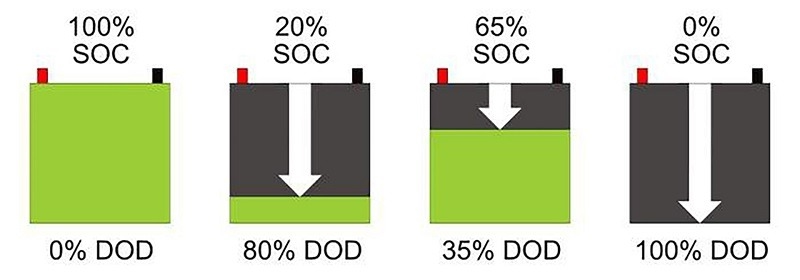
Depth of discharge (DoD) is the percentage of nominal capacity that can be safely used per cycle. A battery pack at 90% depth of discharge provides more useful energy than one at 50%, thus reducing the effective solar battery cost per usable kilowatt-hour (kWh) even at a similar nominal cost per kilowatt-hour (kWh). Round-trip efficiency further impacts energy output: a 95% efficient system loses 5% of its energy per cycle, while an 85% efficient system loses 15%, which is important for solar cell users in daily cycling.
Cycle life and degradation curves also determine the duration of usable capacity. Manufacturers typically specify the number of cycles as a percentage of the original capacity. Batteries with higher upfront costs but slower degradation can reduce lifecycle costs because they require less frequent replacement. Therefore, it is important to calculate not only the nominal cost but also the usable cost over the expected lifetime, taking into account degradation and the expected number of cycles per year.
The impact of battery management, safety systems, and certification on solar battery price
The battery management system (BMS), thermal management, and safety architecture also have a substantial impact on solar battery prices and determine risk exposure and operational limitations. A complex BMS increases upfront costs, but it can protect assets, enable precise state-of-charge (SoC) control, support cell balancing, and provide telemetry, thereby reducing operations and maintenance (O&M) expenses.
BMS features that need to be evaluated include cell-level monitoring, overcharge/discharge protection, battery balancing methods, software-controlled depth-of-discharge limiting, and rapid fault isolation. Meeting certifications and safety testing also adds to the price. For many installations, compliance with UL 1973, UL 9540A (thermal runaway testing), IEC 62619, and local grid interconnection or fire regulations is essential. Obtaining and documenting these certifications requires laboratory testing and engineering changes, and reputable solar battery manufacturers factor these costs into the price of their solar batteries. Conversely, a system without comprehensive certifications may initially appear cheaper, but it can be less secure and carry significant risks.
Balance of system, inverter compatibility, and installation labor costs are also important.
The price of the solar battery is only part of the cost of installing a solar battery. Balance-of-system (BOS) components, including bidirectional inverters, AC/DC coupling equipment, switchgear, circuit breakers, enclosures, wiring, and energy management software, typically represent a significant portion of the total system cost. In residential projects, their cost often matches or exceeds that of the battery modules.
Bidirectional inverters must be compatible with the battery chemistry and BMS communication protocol. Some solar battery suppliers offer integrated inverter-battery systems. This integrated solution often reduces the overall BOS cost and simplifies warranty claims, but may limit supplier selection and future upgrades. Therefore, when purchasing solar battery hardware, clarify the scope of integration and whether the quote includes the inverter, monitoring gateway, and commissioning.
Installation labor is a significant soft cost and varies by location and permit complexity. In highly regulated regions, permitting, inspection, and interconnection fees can significantly increase the cost of solar cell installation. For large commercial projects, crane access, grounding, fire suppression, and isolation from other electrical infrastructure add complexity. Space and civil engineering are also considerations, for outdoor rack-mounted systems, foundations, concrete pads, and enclosures add costs. For indoor installations, HVAC conditioning, seismic restraints, and firewall isolation can also increase costs.
Market Dynamics, Brand Premiums, and Supply Chain Impacts
Market forces and supplier reputation can influence the price of your solar batteries. Brand premiums exist for a variety of reasons: proven field performance, local support networks, and lower long-term risk. Premium brands typically have higher upfront prices, but they can reduce the risk of unexpected failures and typically offer better warranty enforcement. Tariffs, shipping costs, factory capacity, and exchange rates can all lead to regional price differences. For example, cells manufactured in Asia and shipped to North America or Europe face additional costs, including shipping, tariffs, and inland logistics fees, which can increase solar cell costs. Even geopolitical unrest or raw material shortages can cause prices to spike dramatically. Finally, consider second-order market effects. The growing demand for electric vehicles and stationary energy storage will spark competition for battery-grade raw materials, impacting prices.
Making the Right Sourcing Decisions
The solar battery price you see on a quote is just one starting point, not the whole picture. To make a sound purchasing decision, it is necessary to translate technical specifications into commercial metrics, such as the cost per kilowatt-hour available over the expected lifetime, the levelized cost of energy storage, the expected number of annual cycles, and the warranty period. Then, using standardized metrics, you can evaluate various quotes side by side during the purchase process to select the solar cell that best suits your needs.

