How to choose solar panel mounting bracket for carport electric vehicle charging station?
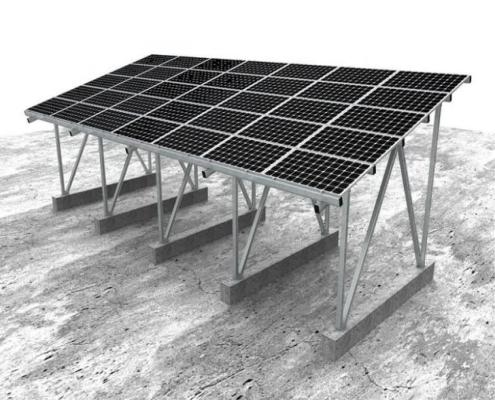
Choosing the right solar panel mounting bracket for a carport-type EV charging station requires careful consideration of site loads, module layout, foundation type, and operational requirements. The Power Dream solar carport mounting system features a modular structure that allows for vertical or horizontal PV panel installation, supports tilting of 5° to 15°, and can be installed on reinforced concrete or pile foundations. Power Dream utilizes cold-rolled S235JR/S355JR steel coils that comply with EN 10025 and are hot-dip galvanized according to ISO 1461:2009. S350GD galvanized steel coils that comply with EN 10326 or equivalent are also available. This meets the requirements for solar panel mounting brackets in carport-type EV charging stations.
Determining the Material and Corrosion Resistance of the Solar Panel Mounting Bracket
The material choice determines the service life and maintenance costs of the solar panel mounting brackets on the carport. Busy public charging stations, frequently exposed to vehicle salt spray, urban pollution, and occasional de-icing splash, require robust corrosion protection. Power Dream’s solar carport mounting systems utilize cold-rolled S235JR or S355JR steel coils (EN 10025) hot-dip galvanized according to ISO 1461:2009, providing a uniform, metallurgically bonded zinc layer. For corrosive coastal or industrial environments, you can choose S350GD galvanized steel coils according to EN 10326 or corrosion-resistant substrates such as Aluzinc, Magnelis, Corrender, or Posmac. These coatings provide enhanced barrier and cathodic protection, specifying a minimum zinc or equivalent coating mass of 275 g/m², ensuring decades of service life with low maintenance costs and meeting relevant certification requirements.
Consider the Structural Design and Environmental Loads of the Solar Panel Mounting Bracket
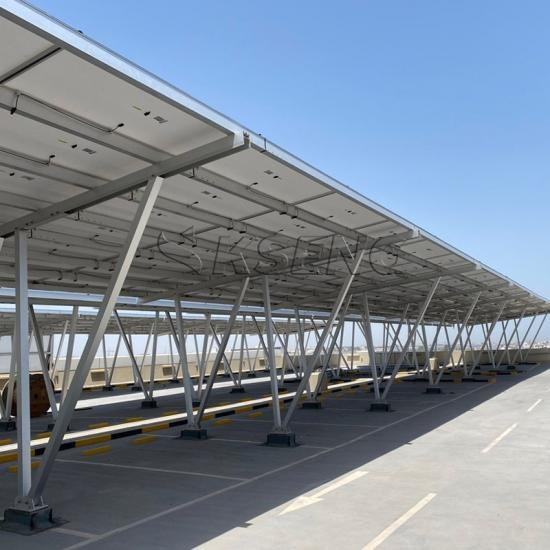
When selecting a carport solar panel mounting system, it must be able to safely withstand environmental loads while providing adequate clearance for the vehicle and charger. First, define the design loads according to local building codes. For example, US projects refer to ASCE 7 for wind and seismic load design; European projects refer to Eurocodes; and Indian projects refer to IS Codes. The mounting system’s cross-sectional area, component dimensions, and connections must be verified through structural analysis based on these site-specific loads.
Key structural considerations include panel orientation, effective tributary area per module, and tilt angle. In certain latitudes, a higher tilt can improve energy capture, but it increases wind lift and snow accumulation, increasing the required mounting stiffness and foundation size. For urban carports where clearance height is a concern, designers should achieve a minimum of 2.2–2.4 meters.
Furthermore, you must ensure that the mounting system maintains module clamping force and alignment under dynamic loads. Use lock washers or pre-torqued nuts where applicable, and design connectors to allow for simple on-site replacement without disturbing adjacent modules. For locations with significant temperature fluctuations, provide expansion joints or slots in the rails. For long spans, include mid-span supports or stronger profiles to prevent excessive deflection. If the carport utilizes a multi-bay modular array, consider modular column spacing that matches the bay dimensions to reduce material waste and simplify installation.
Foundation and Mounting Options
Choosing the appropriate solar panel mounting bracket for a carport electric vehicle charging station also depends on local soil conditions, budget, and installation speed. Power Dream’s solar carport mounting systems are designed for reinforced concrete pad foundations as well as driven or bored pile foundations.
Reinforced concrete provides stable support and is suitable for sites with good bearing capacity and surface preparation. To prevent corrosion, we hot-dip galvanize or use stainless steel for anchor bolts, and we protect the baseplate-concrete interface with a coating or sleeve to prevent water seepage. For pile foundations, we prefer screw piles, driven steel H-piles, or bored piles on sites with poor surface soil or limited excavation. Screw piles speed installation and reduce concrete usage. They can be load-tested on-site and provide immediate load-bearing capacity. For carport charging stations, we pre-assemble the main beams and tracks into manageable modules and then hoist them into place, rather than assembling numerous small components at height.
Determining PV Panel Layout and Orientation
The availability and usability of a charging carport depend not only on the solar panel mounting brackets but also on the PV panel layout and orientation. Power Dream’s flexible solar carport mounting systems allows panels to be installed vertically or horizontally, with tilts of 5° to 15° to the south or east. Leverage these degrees of freedom to optimize energy production and address site constraints.
For customers in the Northern Hemisphere, a south-facing array (or a north-facing array in the Southern Hemisphere) maximizes peak energy production. An east-facing array better suits morning charging patterns. For public or workplace charging with irregular arrival times, consider an east-west split array to balance power generation throughout the day. Both horizontal and vertical mounting options affect shading and panel spacing. Vertical layouts allow for closer integration with lampposts or signage, while horizontal layouts reduce wind and facilitate panel replacement. The electrical design should also consider string length, MPPT allocation, and distance from the EV charger and inverter. During the expected lowest temperature, you should keep the string voltage within the inverter input range to avoid overvoltage. Finally, the design should consider future expansion by reserving spare capacity in the column base and planning routing for additional cabling.
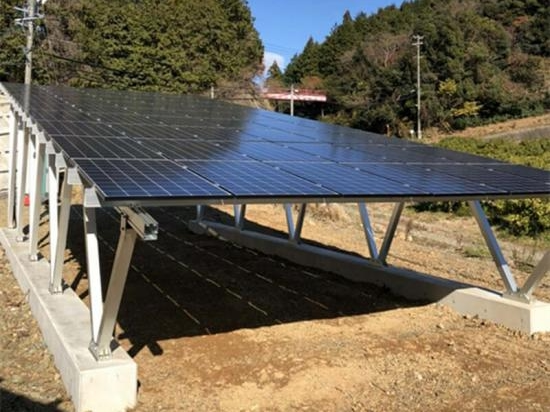
Suitable Mounting Brackets for Carport-Type Charging Stations
Selecting the appropriate solar panel mounting bracket for a carport-type EV charging station requires a balance between structural design, material science, electrical integration, and construction practicality. Power Dream provides solar panel mounting brackets certified to relevant standards. Under standard conditions, they utilize hot-dip galvanized, cold-rolled S235JR/S355JR steel compliant with ISO 1461:2009, as well as S350GD/Aluzinc/Magnelis steel for harsh environments, or anodized aluminum alloy. We also select the appropriate hardware based on site requirements, ensuring ISO-compliant A2-70 stainless steel or coated carbon steel. We also provide comprehensive certification, FAT/SAT testing, and a comprehensive warranty. Furthermore, engineers use energy modeling and shading analysis to confirm panel orientation and tilt, ensuring safe, long-term electric vehicle charging operations.