
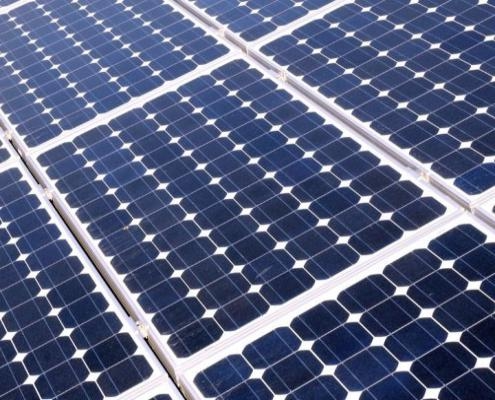
Why do monocrystalline PV modules have excellent low-light performance?
Monocrystalline PV modules often outperform other modules in low-light conditions, whether on an overcast morning or a cold winter day. Monocrystalline PV modules combine purer silicon, advanced cell structure, and optimized optical surfaces to convert a higher proportion of diffuse and low-irradiance light into useful electricity. First, the crystal quality and doping uniformity of monocrystalline silicon wafers reduce electrical losses and enable better carrier collection in low-light conditions. Second, cell and surface engineering enhance light absorption and maintain efficiency in low-angle and diffuse light. Third, module- and system-level designs preserve the advantages of cells, enabling installed solar panel systems to generate higher energy even under non-ideal conditions.
The advantages of crystal quality and semiconductor physics in monocrystalline PV modules
The core of excellent low-light performance lies in material quality. The core of monocrystalline PV modules is monocrystalline silicon ingots, whose wafers have extremely uniform atomic order and far fewer grain boundaries than multicrystalline silicon grains. These grain boundaries act as microscopic traps for photogenerated carriers, so fewer grain boundaries mean lower recombination losses in monocrystalline batteries. Under low irradiance conditions (where fewer carriers are generated), preserving each carrier becomes even more critical. Therefore, the advantages of monocrystalline silicon are more pronounced under cloudy skies or in early morning sunlight.
In addition, many monocrystalline PV module manufacturers use advanced processes to control doping concentration and lifetime, thereby increasing the diffusion length of minority carriers. When the diffusion length exceeds the cell thickness, carriers generated far from the pn junction can still reach the junction and generate current. Because the generated carrier density is lower at this point, better carrier collection results in a higher short-circuit current compared to competing batteries.
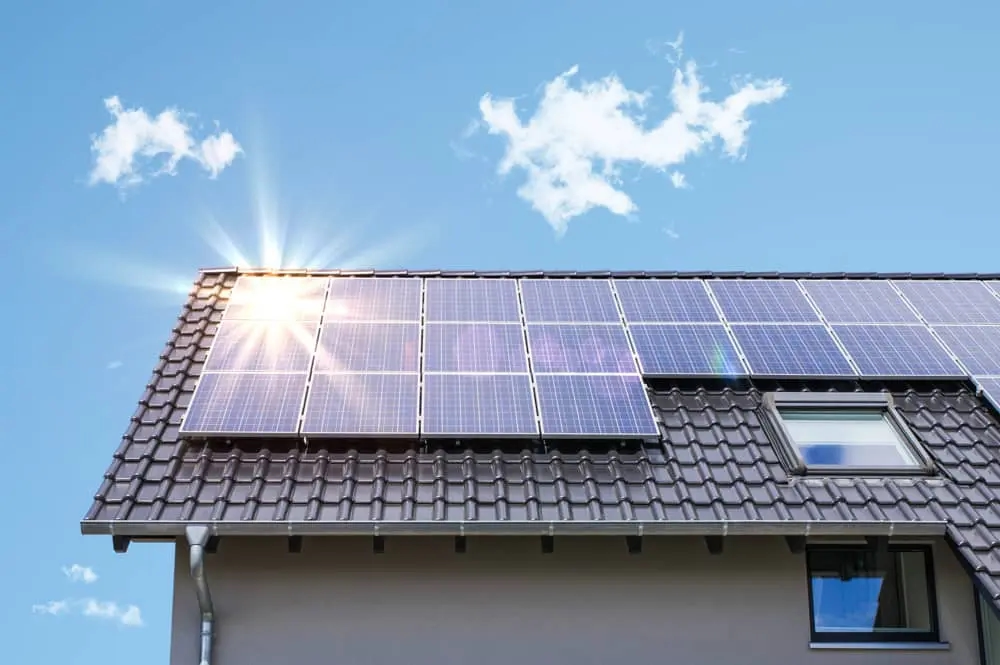
Battery Structure and Surface Engineering for Monocrystalline PV Modules
Materials are necessary but not sufficient. Battery structure and optical engineering are crucial for translating silicon’s advantages into practical output. Many monocrystalline PV modules utilize advanced cell structures such as PERC, heterojunction, TOPCon, or staggered back-contact designs. These structures reduce surface recombination, trap light internally, and allow for a longer optical path within the silicon wafer, thereby increasing the absorption of oblique and diffuse photons.
Surface treatment is also crucial. Anti-reflective coatings and textured surfaces can reduce reflection losses over a wide range of angles. At low solar angles or in diffuse lighting, modules that maintain low reflectivity will capture more photons. Furthermore, light-harvesting technologies such as rear reflectors, microtexturing, and specially designed rear passivation reflect weak rays into the silicon wafer, giving edge photons a second chance to generate charge carriers. Bifacial monocrystalline PV modules are particularly noteworthy. Because bifacial modules receive usable energy from both the front and back sides, their gain is higher under diffuse or ground-reflected light conditions.
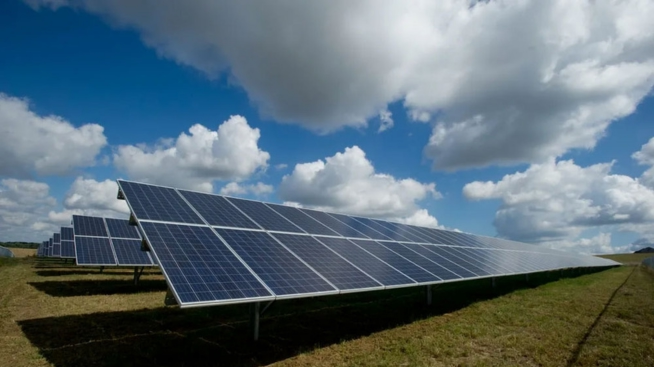
Electrical Properties and Current-Voltage Behavior Under Low Irradiance
Low-light performance is not only reflected in optical aspects, but also in electrical aspects. The electrical properties of monocrystalline PV modules under low irradiance conditions determine whether captured photons can be converted into usable power. Two of the most important parameters are the scaling of the short-circuit current (Isc) and the maintenance of the fill factor (FF).
Under ideal conditions, Isc has a roughly linear relationship with irradiance. However, actual modules can exhibit deviations due to shunting paths and recombination effects. High-quality monocrystalline batteries, due to their lower leakage current and longer carrier lifetime, are better able to maintain Isc in low-light conditions. Fill factor is also crucial; batteries with high internal series resistance or severe recombination effects will experience a reduction in fill factor in low-light conditions. However, monocrystalline batteries with low series resistance and good passivation processes can maintain fill factor, resulting in higher power output even with reduced Isc. Furthermore, open-circuit voltage (Voc) is less sensitive to irradiance but is affected by temperature. Voc is higher in low-light conditions and on cool mornings, helping maintain the module operating point and improving MPPT efficiency.
Preserving the Advantages of Low-Light Rooftops
Even the best monocrystalline PV module can underperform if poorly designed at the module and system levels. Good practices can preserve the advantages of the batteries and maximize the capture of low-light energy. First, keep the string voltage within the MPPT operating window and minimize mismatch losses. Mismatch becomes particularly critical in partial shading or when the modules are oriented differently. At the same time, designers should use string layout and module matching to ensure that the MPPT algorithm operates in the most efficient IV region under low irradiance. For systems affected by shading, microinverters or MLPE can maintain the single-module advantages of monocrystalline batteries by independently extracting maximum power from each module.
Secondly, well-placed bypass diodes can prevent localized hotspot losses under partial shading conditions. They can also prevent a sharp drop in power across the entire string when a partial area is shaded. Monocrystalline delivers its best performance when even illumination evenly lights the batteries. Finally, you must also use a charge controller or inverter with reliable low-irradiance MPPT performance. When combined with monocrystalline modules, which offer clearer IV characteristics in low-light conditions, this can result in higher daily energy yields.
Finally, the tilt, orientation, and height of the installation determine the amount of diffuse and reflected light reaching the modules. For example, in Thailand, a slight tilt can reduce midday overheating while capturing more diffuse light in the morning and evening. In southern Argentina, optimizing the tilt for the winter months can improve low-sun-angle performance. For solar panel systems, consult your monocrystalline PV module supplier for installation guidance to maintain the advantages of low-light conditions on site.
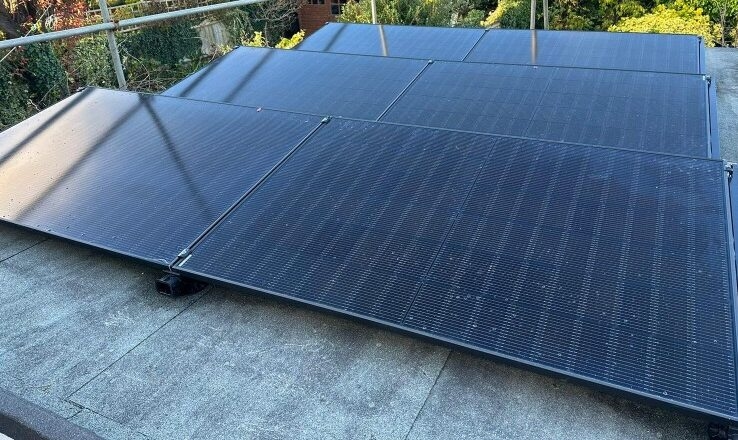
Site Examples and Recommendations for Thailand and Argentina
Both Thailand and Argentina have areas where diffuse light, seasonal variations, or high-latitude sun angles reduce peak irradiance. During the monsoon season in Bangkok and the cloudy winter weather in Santiago, installed systems benefit from modules that efficiently convert diffuse photons. Similarly, in Patagonia or southern Argentina, the shorter winter days and lower sun angles require modules that can extract more energy at low irradiance levels.
For users in Thailand, consider monocrystalline PV modules with robust anti-reflective coatings and excellent hotspot performance. However, be mindful of the temperature coefficient, as tropical regions often experience higher ambient temperatures. Modules with a better temperature coefficient can maintain low-light gain in hot, cloudy weather.
For users in Argentina, in temperate and high-latitude locations, optimize module tilt and orientation based on the winter sun angle, prioritizing modules with strong low-angle response. When selecting a solar panel package, consider seasonal energy yield models and examine the cell’s nominal operating temperature (NOCT) and low-irradiance IV curves to obtain realistic winter energy yield estimates.
Leveraging the advantages of monocrystalline for better real-world yields
Monocrystalline silicon PV modules excel in low-light environments thanks to their superior wafer quality, advanced cell architecture, and carefully engineered optical and electrical designs that maintain carrier collection and fill factor even in photon-scarce conditions. Furthermore, combined with thoughtful module-level engineering and system design, appropriate stringing, MPPT, and site-specific installation translate into more reliable energy collection in diverse climates.

