
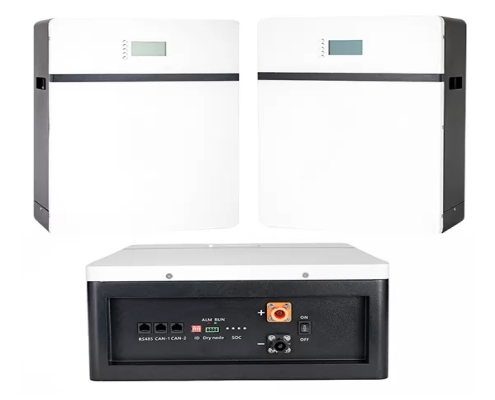
BMS Features to Look For When Buying a lithium ion solar battery
When purchasing a lithium ion solar battery, the battery management system (BMS) is the most significant factor influencing its safety, lifespan, performance, and cost. A high-performance BMS can transform a battery pack into a reliable energy asset; a weak or underspecified BMS can turn the same batteries into a liability. Therefore, buyers of lithium ion solar batteries should prioritize BMS features early in the purchasing process, rather than as an afterthought. Features to consider when purchasing a lithium-ion solar cell include: individual cell voltage and temperature monitoring; accurate state of charge and state of health estimation; active or passive battery balancing; and robust overvoltage, undervoltage, and overcurrent protection. We will explain in simple terms the importance of each feature for both residential and commercial lithium ion solar battery applications.
The Foundation for Long Life and Safe Operation of Lithium ion solar battery
Accurate individual battery monitoring and effective battery balancing are core BMS responsibilities for any lithium ion solar battery. Batteries age and drift: Initially, minor differences in capacity and internal resistance increase with cycling and calendar aging. If left uncontrolled, these differences can concentrate stress on weaker cells, accelerating performance degradation and creating safety risks. Therefore, a qualified BMS should continuously measure the voltage of individual cells and frequently sample temperatures at multiple locations within the battery stack.
Balancing maintains a uniform state of charge across all batteries. Currently, there are two prevalent balancing strategies: passive balancing, in which excess charge from high-voltage batteries is dissipated as heat; and active balancing, in which excess charge is removed from high-voltage cells. Active balancing redistributes charge from high-voltage cells to lower-voltage cells. Passive balancing is simpler and less expensive; active balancing is more complex and slightly more costly. It is suitable for large battery stacks and systems with significant imbalances, resulting in a longer battery life. Therefore, buyers of lithium ion solar batteries who desire frequent deep cycling or extended battery life may prefer BMS designs with active balancing.

Accurate Estimation of Voltage, Current, State of Charge (SOC), and State of Health (SOH)
State of Charge (SOC) and State of Health (SOH) estimation significantly impact nearly every aspect of lithium ion solar battery operation, from the system’s initial charge acceptance to the depth of discharge during backup events. A BMS that can report SOC to within a few percentage points and reliably track SOH enables strict depth-of-discharge strategies, maximizing available energy without risking premature capacity loss. BMSs typically combine multiple methods to calculate SOC, including coulomb counting (tracking charge inflow/outflow) and model-based corrections related to voltage and temperature.
The most accurate systems layer in model-based estimators, such as Kalman filters or adaptive algorithms, compensates for sensor drift and cell aging. Lithium ion solar battery suppliers are required to provide SOC accuracy specifications at typical operating temperatures (e.g., ±2-5% SOC at 25°C, ±5-10% SOC from -10°C to +50°C), detailed information on the estimator algorithm, and evidence of long-term calibration strategies. Finally, BMSs are required to support configurable depth of discharge settings and automatic derating as SOH decreases; these features ensure safety and extend service life.
Thermal Management and Safety Features of Lithium ion Solar Battery
For any lithium solar battery, thermal performance is a primary factor affecting its safety and service life. BMSs must quickly detect and manage temperature, a critical requirement for systems operating in hot climates, in enclosed cabinets, or near heat-generating inverters. Practical BMS thermal features include temperature sensors for each module, dynamic charge and discharge derating based on temperature, active thermal control outputs, and well-defined thresholds for emergency shutdown in the event of a runaway indicator.
A high-quality BMS design distributes multiple temperature sensors throughout the battery stack, enabling the system to respond to local hot spots, not just the average stack temperature. The BMS should implement a graded response: mild derating when temperatures rise, forced shutdown at a preset maximum, and emergency pre-charging or isolation measures when temperatures rise to levels that indicate thermal runaway. For high-risk applications, the BMS can incorporate thermal event mitigation measures such as forced ventilation, fire suppression interlocks, or commands to external HVAC systems.
Protection Mechanisms, Fault Handling, and Fail-Safe Logic
A robust lithium ion solar battery BMS can provide layered protection to handle both conventional and catastrophic faults. These protections include overvoltage and undervoltage protection at the cell and module levels; overcurrent and short-circuit protection; high and low temperature protection; isolation monitoring; and ground fault detection. Furthermore, the BMS must not only detect faults but also coordinate the isolation of cells, comprehensively report events, and enable controlled recovery when necessary.
The choice of fault handling design is also crucial. The BMS should use time-domain logic to distinguish transient faults from sustained faults. It should offer configurable trip thresholds and lockout strategies to accommodate the system integrator’s tolerance for automatic recovery versus manual inspection. Therefore, when purchasing, consider both protective hardware and intelligent software logic, and request fault injection test results from the supplier, along with examples of how the BMS responds to simulated worst-case scenarios.
Communication, Interoperability, and Smart Grid Capabilities
Modern lithium ion solar batteries must be fully compatible with the rest of the energy system, making the BMS’s communication capabilities a crucial purchasing parameter. Essential features include support for widely used protocols (CANbus, Modbus RTU/TCP, RS485, and the increasingly popular Ethernet/IP), secure remote telemetry, and a comprehensive integration API.
Beyond basic telemetry capabilities, BMS functionality for lithium ion solar batteries can enhance value by enabling time-of-use scheduling, programmable charge and discharge profiles, demand response integration, and virtual factory compatibility. Therefore, the BMS should accept external setpoints and must be able to enforce local safety limits independently of external commands. Good communication and intelligence capabilities can transform lithium-ion solar cells from static energy storage into flexible assets that participate in grid optimization and revenue generation strategies.
Choosing a BMS that protects value and enables integration
When purchasing lithium ion solar batteries, evaluate the BMS as a tool to protect your investment, enhance safety, and support integration with a broader energy strategy. Prioritize single-cell monitoring and active balancing to extend battery life; accurate SOC/SOH estimation to determine usable capacity; and robust thermal management and well-defined derating curves to ensure safety in real-world installations. Additionally, ensure the BMS supports the correct protocols, enables secure remote operation and firmware management, and provides lifecycle features that align with your procurement and operational maintenance (O&M) plans.

