
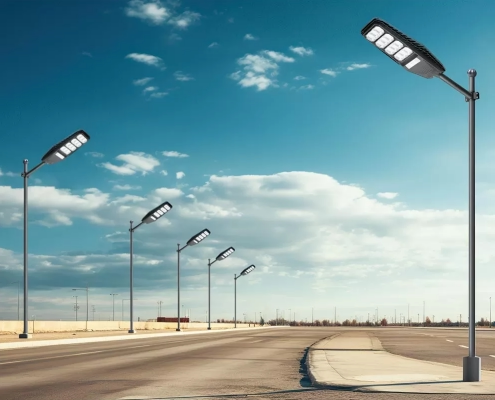
Commercial Solar Street Lights: A Better Choice for Commercial Solar Use
Commercial solar street lights are widely used in municipal, campus, retail, and industrial applications. When facility managers or developers purchase commercial solar street lights for use in commercial settings, they must simultaneously analyze multiple performance dimensions: reliable daily energy harvesting, predictable nighttime lumen output, durable hardware that can withstand harsh outdoor environments, and easy maintenance to minimize lifecycle costs. Commercial applications require continuous operation, not only under laboratory conditions but also in harsh environments that include years of weather, dust, and heavy use.
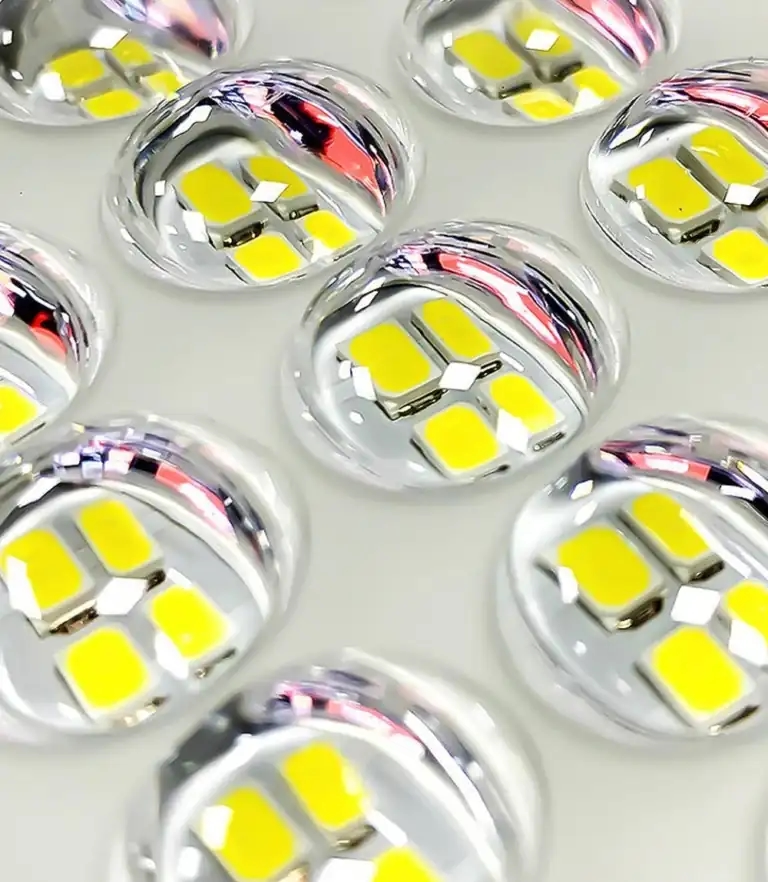
Commercial solar street light supplier PowerDream positions the MJ-LH model as a solar lighting solution for a wide range of commercial applications. The MJ-LH solar street light incorporates key design choices that commercial buyers value. Its LED array features evenly spaced bulbs and optical elements, and its mechanical and electrical designs are designed for outdoor toughness. Paired with high-quality polycrystalline silicon solar panels, it quickly harvests available sunlight and shortens the charging window—all crucial features for commercial applications.
Key Performance Characteristics of Commercial Solar Street lights in Commercial Deployments
For commercial projects, brightness alone is not enough. Efficient commercial solar street light require a combination of photometric performance, electrical performance, and intelligent energy management. First, consider photometric requirements. Commercial solar streetlights for parking lots, sidewalks, and roads typically target an average illuminance of 20-50 lux, with a uniformity ratio of 0.4-0.6 for pedestrian and parking applications. Arterial roads typically require higher-maintained illuminance and stricter uniformity. The MJ-LH solar street light’s uniformly distributed LED architecture and integrated optics help achieve these uniformity targets while reducing glare, making it easier to meet IESNA/IES RP-8 and other regional standards.
Second, consider lumen efficacy. System-level efficiencies for the commercial solar street light should exceed 120-160 lm/W. High efficiency reduces the LED power required to achieve the target lux level, thereby reducing battery capacity and PV array size. The MJ-LH’s low optical loss design embodies this principle: for the same luminous flux output, fewer wasted lumens means smaller balance-of-system components.
Durability, Protection Rating, and Environmental Adaptability of Commercial Solar Street Lights
Commercial installations subject luminaires to a variety of stresses: extreme weather, mechanical stress, electrical transients, and vandalism. Therefore, the mechanical and electrical durability of commercial solar street lights is a primary consideration when purchasing. Begin by clarifying the protection rating and mechanical shock standards. IP65 is the benchmark for water and dust resistance, indicating that solar street lights can withstand low-pressure water jets and provide reasonable protection against dust. Therefore, many commercial buyers prefer IP65 ratings for harsher environments. The MJ-LH’s IP65 rating provides robust protection against rain and splashes, while features like sealed cable glands and gaskets ensure the long-term integrity of the luminaire.
Lightning protection and surge suppression are crucial for commercial locations, particularly in areas where buildings, metal poles, and extensive wiring runs increase the risk of power surges. PowerDream’s MJ-LH includes lightning protection, reducing downtime and avoiding costly electronics replacement after storms.

Designing the Powertrain
The core of any solar street lighting system is the powertrain: solar panels, battery storage, and charging/motor control. For commercial solar street lights, careful and industrial-grade component selection is crucial to ensure predictable lifetime performance. As a professional commercial solar street light supplier, PowerDream specified high-quality polycrystalline silicon panels for the MJ-LH. Polycrystalline silicon panels offer reliable performance in a wide range of climates and generally provide stable thermal and mechanical properties for the luminaire’s mounting system. Furthermore, battery chemistry determines cycle life, safety, weight, and usable depth of discharge. Lithium iron phosphate batteries have become a mainstream choice for commercial solar street lights due to their long cycle life, wide operating temperature range, and safety. Older lead-acid and gel batteries are less popular in commercial applications due to their shorter lifespan and higher maintenance costs.
Installation, Siting, and Operational Optimization
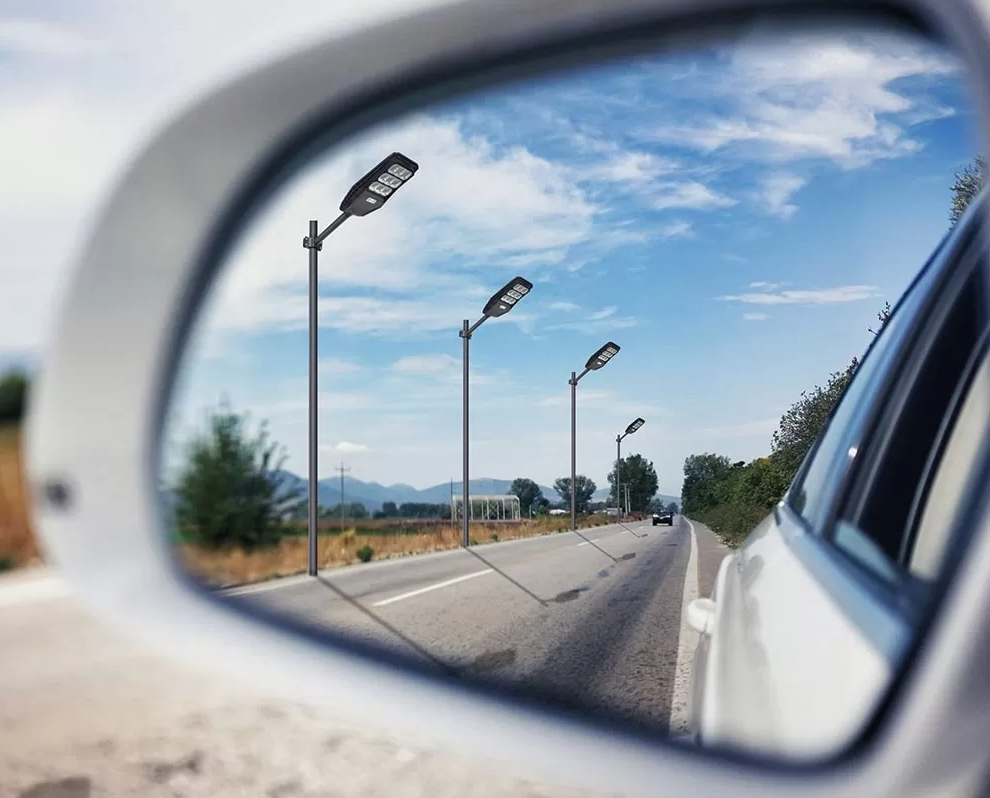
Proper site selection and installation are just as important as the hardware. Commercial solar street lights will perform poorly if they are installed at suboptimal tilt, shading, or at suboptimal pole height, regardless of their quality. First, a site survey is required to simulate isolation, shading dynamics, and microclimate. PowerDream utilizes GIS or simple sun path analysis tools to ensure that solar panels receive unobstructed sunlight during most peak hours, taking into account seasonal variations in sun angle and potential shading from future landscaping or development.
Regarding pole height and spacing, height affects illuminance and uniformity. For parking lots and commercial parks, 6-10 meter poles are standard; for main roads, taller poles (10-15 meters) may be required to achieve appropriate beam distribution. Commercial solar street light suppliers’ photometric profiles (IES or LDT) allow you to model spacing based on target lux values and uniformity. Generally speaking, you should orient solar panels due south or north whenever possible; you may find east-west arrays more beneficial for morning and evening use. For year-round optimization, you typically set the tilt angle near the latitude of the location.
Economics, Lifecycle Cost, and Return on Investment
Purchasing commercial solar street lights is not only an engineering decision, but also a financial one. The total cost of ownership (TCO) encompasses initial capital expenditures, installation, maintenance, energy savings, and disposal or recycling costs upon retirement. When these factors are quantified, commercial solar street lights generally offer a competitive return on investment (ROI) compared to grid-powered lighting, especially in situations where grid expansion or ongoing energy costs are high.
Due to the need for solar panels and batteries, commercial solar street light typically have higher upfront costs than traditional lamps with grid connection. However, cost savings can be achieved by avoiding trenching, reducing utility connection fees, and lowering electricity costs. Battery replacement, cleaning, and electronics repair are the primary operating cost items. However, choosing lithium-iron-phosphate batteries and industrialized modules can help reduce annual maintenance costs.
In terms of return on investment and levelized cost of electricity, commercial solar street lights typically have a lifespan of 10-15 years. You can model the energy and maintenance costs avoided over this period to calculate ROI. The levelized cost of electricity for solar street lights considers the system’s kilowatt-hour output and lifecycle costs. High-efficiency LEDs, efficient MPPTs, and longer battery life can reduce LCOE.
MJ-LH Solar Street Lights Are a Better Choice for Many Commercial Applications
Commercial solar street lights are now a proven option for a wide range of commercial locations, including distribution centers, campuses, municipal streets, and retail parking lots. When carefully designed and installed, they provide flexible lighting solutions, simplify installation, lower operating costs, and support sustainability goals. PowerDream’s MJ-LH solar street light perfectly embodies the features commercial buyers seek: uniformly distributed LED optics ensure uniform light distribution with low loss; IP65 weather and lightning protection ensures robustness for outdoor use; and high-quality polycrystalline silicon panels ensure efficient solar energy collection, making it an attractive and low-maintenance solution.

