
How to Compare Solar Panel Types When Buying an Off Grid Solar Kit?
When purchasing an off grid solar kit, it’s essential to compare different solar panel types based on the energy delivered per unit area, durability in your specific climate, actual lifespan, and system-level compatibility, rather than relying solely on a single specification. For homeowners building an eco-friendly homes off grid solar system, choosing the right solar panel directly impacts the annual kilowatt-hours of energy available and the total cost of ownership over decades. Therefore, it’s crucial to translate technical specifications (efficiency, temperature coefficient, degradation rate, warranty) into site-specific metrics, such as annual energy production per unit of available rooftop area, lifetime cost per kilowatt-hour, and maintenance expectations, to make your selection.
Different Solar Panel Types in Off Grid Solar Kit
When purchasing an off grid solar kit, it is essential to understand the available panel technologies. The main panel types include monocrystalline, multicrystalline, bifacial, and thin-film.
Monocrystalline panels are the mainstay of the residential solar system market. They offer the highest cell efficiency. Because monocrystalline panels deliver higher wattages per square foot, they typically provide the best energy production when rooftop or ground space is limited. Furthermore, monocrystalline silicon panels generally have lower degradation and come with a good warranty, making them more suitable for residential users who require long-term, stable power generation. Multicrystalline silicon panels are slightly less expensive, have lower efficiency (approximately 15-18%), and need a larger footprint for the same wattage. If you have ample mounting space and require a low initial investment, multicrystalline silicon panels are a viable option.
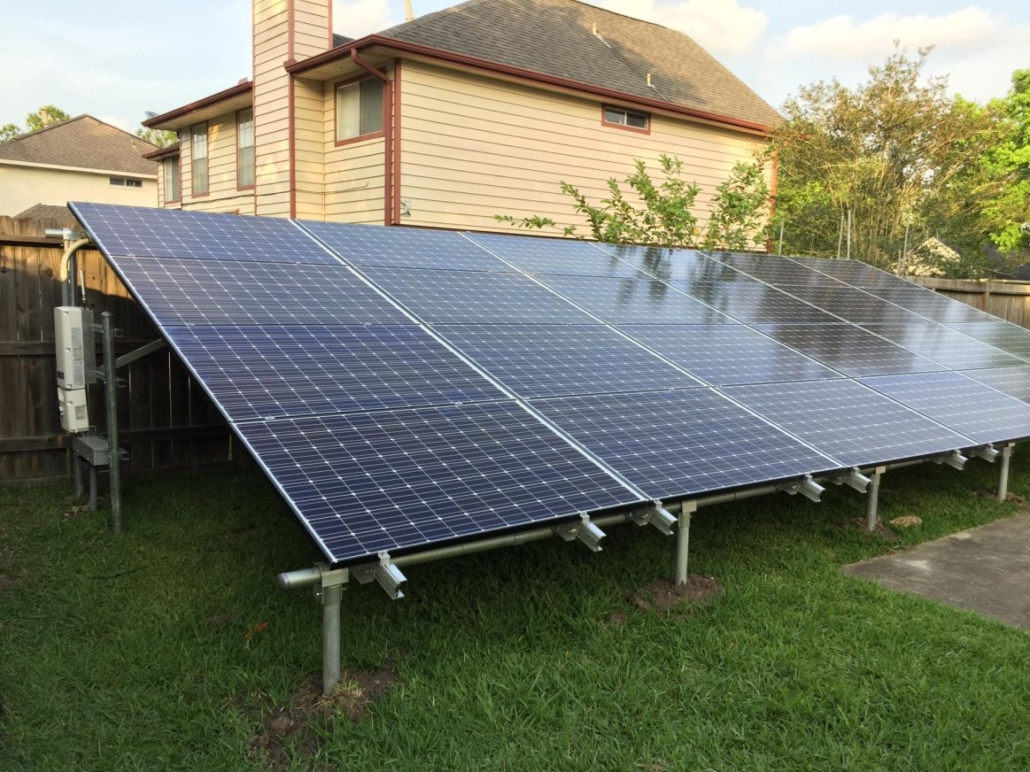
Bifacial modules capture light from both the front and back sides and can generate more energy if mounted above a reflective surface or with sufficient ground clearance. This bifaciality benefits ground-mount installations and some rooftop installations with reflective platforms. For off-grid solar panels, bifacial gain depends heavily on albedo and mounting geometry, requiring careful modeling. Thin-film technologies such as CIGS perform better in diffuse light and at high temperatures, and also have lower temperature coefficients. Their drawbacks include lower efficiency and a generally larger area, but the flexibility of thin-film technology enables customized installations or integration into building surfaces.
Choose based on efficiency, area, and expected annual output.
Efficiency directly determines how much electricity an off grid solar panel can collect from a given rooftop area. When rooftop area is limited, more efficient solar panels can provide greater capacity, resulting in more annual electricity production.
Convert efficiency to actual production by calculating watts per square meter and annual energy production. Calculate the power per square meter of solar panels by ≈ efficiency × 1000 watts/square meter (solar irradiance). For example:
1. 22% efficient panels ≈ , 220 watts/square meter.
2. 18% efficient panels ≈ , 180 watts/square meter.
Suppose your off grid solar system’s annual load demand is 4,000 kWh. In that case, the efficiency of your solar panels will determine whether you choose a single-array solution or require additional racks or more solar panels. Also, consider orientation losses and tilt. A south-facing solar array with the correct tilt can achieve higher annual energy production; an east-west facing solar array may have a flatter daily energy production curve but lower peak midday energy production.
Temperature Coefficient, Actual Performance, and Shading
Solar panel specifications are measured under standard test conditions, but actual performance is highly dependent on temperature and shading. When comparing panels for off grid solar modules, it’s essential to consider the temperature coefficient, particularly in hot climates and for eco-friendly residential off-grid solar systems. The temperature coefficient indicates the power loss of a panel when the cell temperature exceeds 25°C. Typical monocrystalline silicon panels may have a coefficient of around -0.30 to -0.35%/°C, while some thin-film and premium N-type panels may have coefficients closer to -0.20 to -0.25%/°C.
Shading performance and partial sunlight response are also important. Module designs using half-cut cells or multi-busbar layouts can reduce mismatch and losses caused by partial shading. In off-grid solar systems, where arrays may be shaded by trees or obstacles, modules that maintain optimal output under partial shading can reduce the need for additional modules and improve reliability. In installations with significant sunshades, you can also consider using a microinverter or DC optimizer for module-level MPPT.
Mechanical Durability, Certifications, and Environmental Resistance
In off grid solar kit installations, solar panels are exposed to wind, snow, salt spray, hail, and UV radiation. Therefore, when comparing off grid solar kit options, it’s essential to examine the mechanical and environmental specifications, as well as relevant certifications.
Standard key mechanical specifications include checking the frame and glass. Tempered low-iron glass and a sturdy anodized aluminum frame are both impact- and corrosion-resistant. Thicker glass and a reinforced frame can increase hail and snow load ratings. For areas with heavy winter snow, choose solar panels rated for a wind load of at least 2400 Pa and a snow load of at least 5400 Pa. Installations in coastal areas require modules that are PID-resistant and IEC salt spray-tested to avoid accelerated degradation near seawater.
Also, installing a waterproof (IP65/68) junction box and durable MC4 connectors can reduce points of failure. Finally, ensure certifications for IEC 61215 and IEC 61730, as well as ammonia resistance certifications such as UL 1703 or IEC 62716.
Ensure compatibility with off grid solar systems.
Choosing solar panels is only part of sizing an off-grid solar system. You must also ensure the system is compatible with the inverter, MPPT charge controller, battery chemistry, and mounting method. The electrical characteristics of the solar panels determine the string configuration, which must be kept within the operating range of the MPPT controller or inverter, especially on cold nights when the open-circuit voltage (Voc) rises.
For off grid solar systems, ensure that the off-grid charge controller and hybrid inverter have a maximum open-circuit voltage and input voltage range that matches the system’s requirements. If connecting high-voltage strings to an inverter/charger, ensure the equipment supports the string voltage; otherwise, use a lower voltage configuration or connect strings in parallel. It’s also essential to select a racking system that complies with local structural codes and optimizes the tilt based on seasonal energy conditions. If necessary, ensure the kit includes monitoring capabilities that report PV power generation, battery SoC, and inverter status.
Choosing the Right Panels for Your Off Grid Solar Kit
Comparing solar panel types for off grid solar kits requires translating the solar system supplier’s specifications into site-specific energy and lifespan metrics. First, quantify the available area and daily energy requirements. Then, prioritize panel performance, assess the mechanical durability of the panels for your local environment, and ensure electrical compatibility with the inverter/MPPT and battery system to create a safe, reliable, and environmentally friendly off-grid solar system for your home.

