
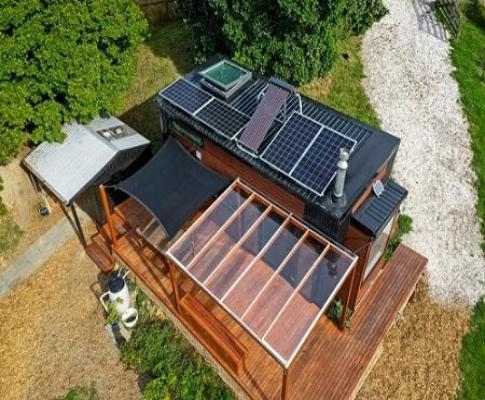
Off Grid Solar System Kit for Single-Story vs Multi-Story Homes: Panel Placement
One building is a single-story residence, and the other is a three-story building with balconies and dormer windows. Both houses require a reliable power supply during grid outages, but how sunlight hits the roof and the placement of the solar panels will determine whether the final system will meet your needs. For homeowners evaluating an off grid solar system kit, the placement of solar panels is more than just a rooftop task; it is one of the most critical design decisions affecting energy harvesting, battery capacity, cost, and long-term stability.
Assessing Roof Geometry and Solar Resources for Single-Story Residences
For single-story residences, the roof geometry is often the best choice for installing off grid solar system kit. Key advantages include a large roof area, predictable azimuth, and simple shading patterns. A site assessment of the system is essential, including roof orientation, slope, available area, and shading analysis for different seasons.
First, measure the available floor area and document any obstructions. Single-story residences often allow for larger, continuous arrays, simplifying series configurations and reducing system balancing costs. Second, assess the azimuth: in the Northern Hemisphere, south-facing or near-south-facing planes capture the most annual power generation. Third, determine the roof slope: a slope angle close to the local latitude generally achieves balanced power generation throughout the year; flatter roofs may require tilted supports to optimize energy capture.
Additionally, considering shading is crucial; even small trees or nearby buildings can cast long shadows in winter, disproportionately reducing power generation. A simple solar path application or a professional shading analysis can create a shading map and prioritize unshaded planes. For single-story homes with minimal shading, ground-mounted microinverters or optimisers are unnecessary; string inverters are typically the most cost-effective option. Finally, consider the ease of cleaning and maintenance of the panels. Lower roofs are easier to maintain and contribute to long-term energy output.
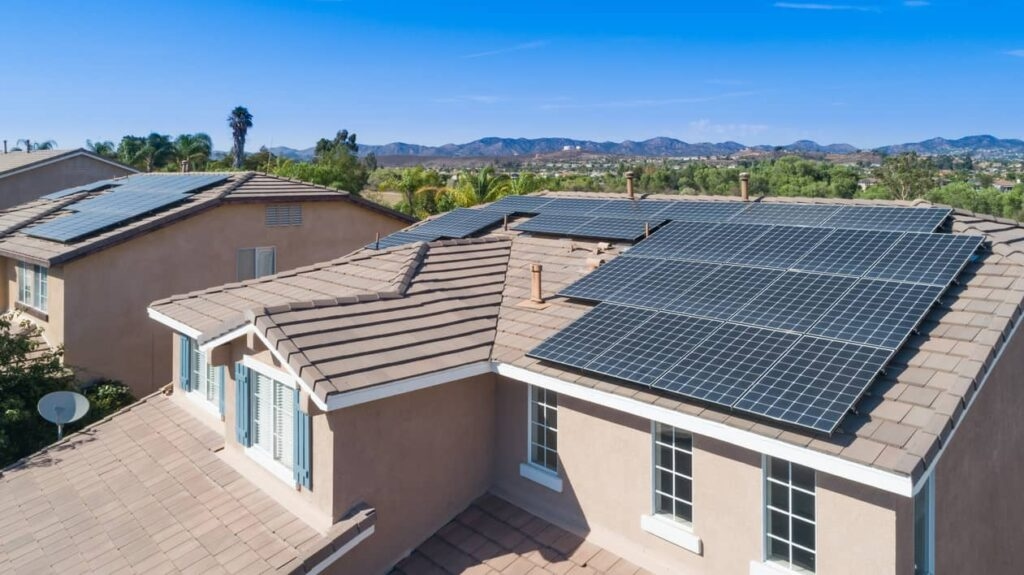
Complexity of Installing Off Grid Solar System Kit in Multi-Story Homes
The vertical structure of multi-story homes results in varying roof orientations, slope angles, and azimuths. Therefore, designing the installation locations of solar panels for multi-story homes requires a more meticulous and comprehensive approach.
First, plot the azimuth and slope angles for each roof plane. Multi-story building roofs typically include a south-facing gable, east-west dormer windows, and a north-facing shaded side. You can leverage this diversity to install more efficient solar panels on less-than-ideal surfaces and larger arrays in optimal locations. Next, assess shading from surrounding tall trees, neighboring buildings, and the building’s own eaves—multi-story buildings can experience self-shading over time.
Due to varying orientations and tilt angles, MPPT segmentation technology is necessary. This can be achieved through multiple MPPT inputs on a string inverter, a DC optimizer, or a microinverter, to avoid losses caused by string mismatch. For example, connect east-facing panels to one MPPT and west-facing panels to another. If panels are located on balconies or vertical facades, designers should treat them as auxiliary generators and account for their lower output in the off grid solar system design.
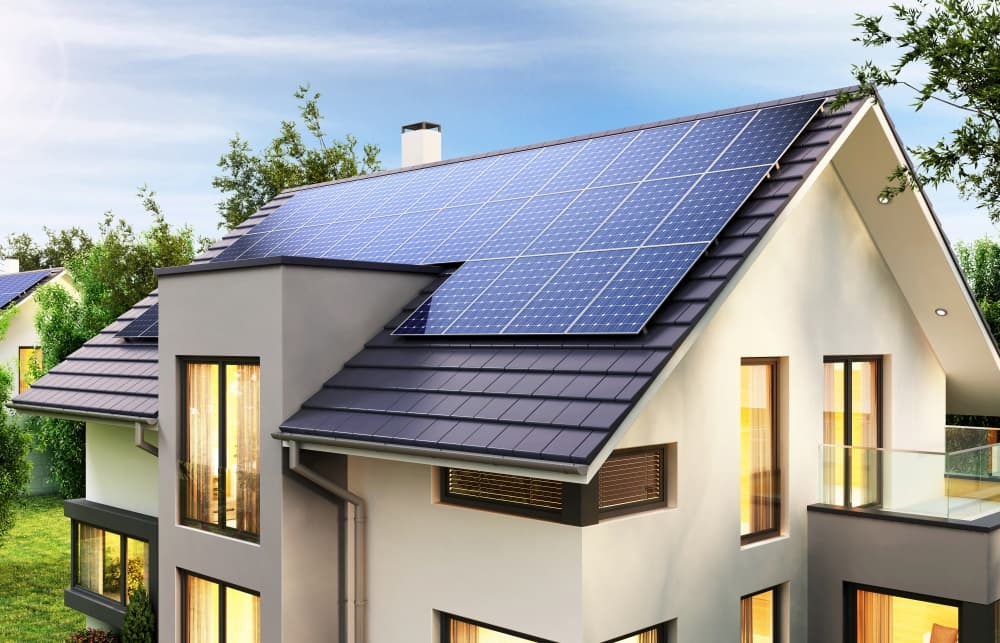
Balancing Orientation and Tilting Angle
Orientation (south/east/west) and tilt angle determine the energy output time and total power generation of an off grid solar system suite. For both single-story and multi-story residences, during installation, we prioritise factors such as daily peak power generation (south-facing), power generation during peak electricity demand periods (east- or west-facing), or a more balanced, flatter power generation curve.
South-facing arrays typically maximize annual power generation and simplify string design. If your load is evenly distributed and you prioritise maximum total power generation, a south-facing orientation is recommended, with the tilt angle set to the local latitude. East-facing arrays concentrate power generation in the morning; west-facing arrays concentrate it in the evening. For households with higher evening electricity consumption, a slightly west-facing orientation can improve self-consumption and reduce battery cycle counts or generator runtime. East-west-oriented split arrays are particularly useful when roof geometry limits the continuous south-facing area. They produce a flatter daily power generation curve, better matching the electricity demands of many residences. Additionally, for multi-story residences with multiple orientations, you should use dedicated MPPTs or module-level power electronics to maximize energy from different orientations without compromising the off grid solar system kit’s efficiency.
Shading Mitigation and Array Layout for Off Grid Solar System Kit
Shading causes energy loss. Whether it’s a single-story or multi-story building, we incorporate shading mitigation measures and rigorous power generation modeling into your off grid solar system kit or residential solar solution. First, we conduct 24/7, year-round shading simulations to quantify expected losses and determine the optimal solar panel installation locations.
Mitigation measures include:
Micro-inverters/DC optimizers: These component-level electronics allow each panel to operate independently at its maximum power point, significantly reducing shading losses common in multi-story roofs under mixed azimuth or partial shading conditions.
Multiple MPPTs: Different strings are used for each azimuth or tilt angle, assigned to separate MPPT channels on the inverter so that each group performs optimally.
Strategic panel placement: Avoid installing panels in locations that will be shaded at least part of the time in the morning/afternoon; choose unshaded flat surfaces and sunny, fan-shaped areas whenever possible. If shading is unavoidable, consider its impact—use shaded modules for lower-priority loads or as supplemental power. Panel Spacing and Row Layout: In installations with significant inclination, ensure rows do not overlap during winter; maintain adequate setback distances for maintenance access and to comply with fire safety regulations.
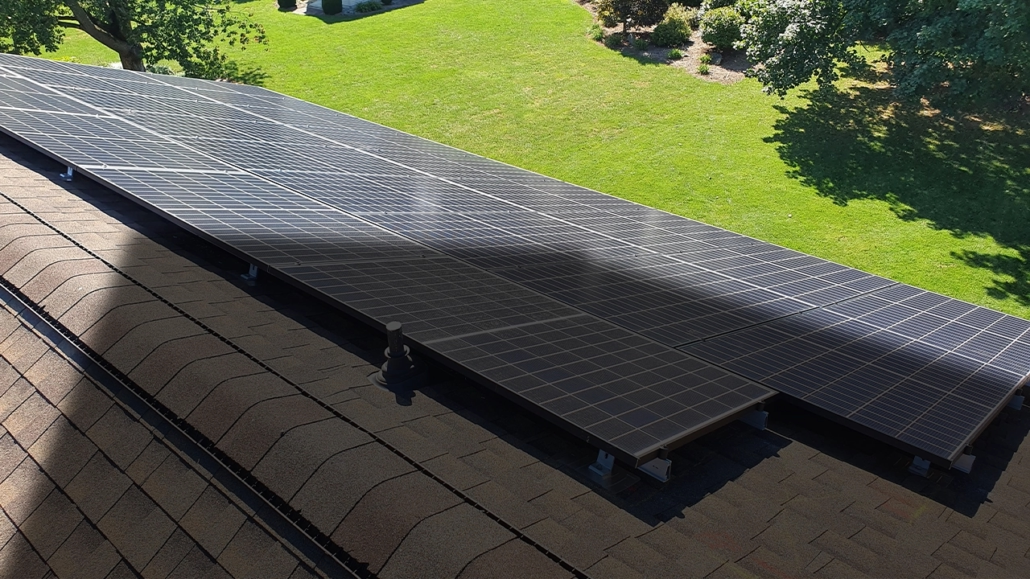
Performance Monitoring, Maintenance, and Size Selection Considerations
For off grid solar system kits, panel installation location determines system capacity, monitoring strategies, and maintenance plans. After installation, continuous monitoring and preventive maintenance ensure power generation and that the system meets household electricity demands.
Performance Monitoring: Install a monitoring platform to report power generation, battery SoC, and inverter status for each MPPT or each series connection. For mixed-orientation sites, real-time data from each MPPT helps quickly identify poorly performing roof surfaces or shading. Many off-grid inverters include cloud monitoring or maximum power point tracking diagnostics.
Maintenance: Single-story systems typically require seasonal inspection and cleaning every 6-12 months. Multi-story systems may require longer maintenance intervals due to complex access routes, but can benefit from remote monitoring alerts.
Key Considerations for Capacity Planning: The installation location of the panels will affect actual daily power generation, so engineers need to run model simulations based on expected orientation and shading conditions to determine battery backup and generator capacities. For example, if peak demand does not match power generation, an east-west-oriented split array may require a larger battery buffer capacity.
Finally, we consider lifecycle factors to estimate solar panel degradation, seasonal fluctuations in power generation, and future load growth. Therefore, when selecting the location for solar panel installation, we consider both current demand and reasonable growth expectations.
Adjusting Layout to Home Conditions for Resilient Off-Grid Living
The panel layout in an off grid solar system kit is a design consideration that brings together roof geometry, home needs, and system structure. For single-story homes, priority should be given to large, unobstructed south-facing planes, simple series designs, and ease of maintenance. For multi-story homes, segmented layouts, MPPT diversity, and carefully designed shading measures should be adopted to utilize complex roof areas while minimizing power generation losses fully. Throughout the process, we select appropriate inverters/chargers and battery capacities based on the actual power generation of the chosen layout, and plan the installation process, safety measures, and permit compliance as early as possible.


Leave a Reply
Want to join the discussion?Feel free to contribute!